Cyclone Country Steel: Why Kit Homes Built Tough Stand Up When It Counts
Listen, building a house anywhere in Australia has its challenges. But if you're eyeing off a block north of, say, Gladstone, or anywhere up that WA coast, you're not just building a house. You're building a fortress, because cyclones are a dead-set reality. And let me tell you, when the wind starts howling at 200 clicks an hour, you want more than a bit of timber holding your roof on. This is where a steel frame kit home, properly engineered and built, isn't just an option; it's practically a necessity.
We've been doing this for a long time, supplying steel frame kit homes across this big, brown land. And in those high-wind regions, the talk always comes back to steel. It's not just marketing hype either. There are very good, practical reasons why steel, especially high-tensile BlueScope TRUECORE steel, is the only material you should be considering when Mother Nature decides to throw everything she's got at your home.
Engineering for the Absolute Worst: Wind Loads and Beyond
When you're designing for a cyclone zone, it's not about making a house look pretty. It's about engineering. Every single connection, every bolt, every bracket has to be designed to resist immense forces. We're talking about uplift on the roof that wants to rip it clean off, and racking forces on the walls that try to push the whole thing sideways. The National Construction Code (NCC) and Australian Standards like AS/NZS 1170.2 (Wind actions) aren't just suggestions up here; they're the bible. And steel, with its predictable strength and stiffness, gives engineers something solid to work with.
Think about it. A properly designed steel frame system from a reputable kit home supplier will have specific details for bracing, tie-downs, and connections tailored for C2, C3, or even C4 wind classifications. This isn't just bolting a few bits together; it's an integrated system. The roof trusses are often fixed directly to the wall frames, which are then tied down to the slab or foundation with heavy-duty connections. You can't just 'wing it' here. The engineering drawings will show every detail, right down to the number and size of screws for each connection. And that's exactly what you need when a category 5 is bearing down on you.
The Strength Advantage: When Timber Just Doesn't Cut It
Look, timber is fine for a lot of places. But timber has its inconsistencies, doesn't it? Knots, grain run-out, natural defects – these all affect its strength. Steel, on the other hand, is manufactured to precise standards. You know what you're getting, every single time. It's got an incredibly high strength-to-weight ratio. This means you can get incredible structural integrity without overly bulky members.
When a cyclone hits, it's not just the sustained wind, it's the sudden gusts and pressure differentials that really do the damage. One side of the house might be getting sucked outwards, while the other side is being hammered inwards. A steel frame, because of its inherent strength and rigidity, can distribute these loads more effectively throughout the entire structure. It’s like a continuous web of strength, all tied together. We've seen homes after cyclones where timber frames have splintered and twisted. Steel frames, while they might get bent out of shape in the absolute worst-case scenario, rarely just 'give up' and collapse.
Lightweight Yet Rock Solid: Easier for Owner-Builders
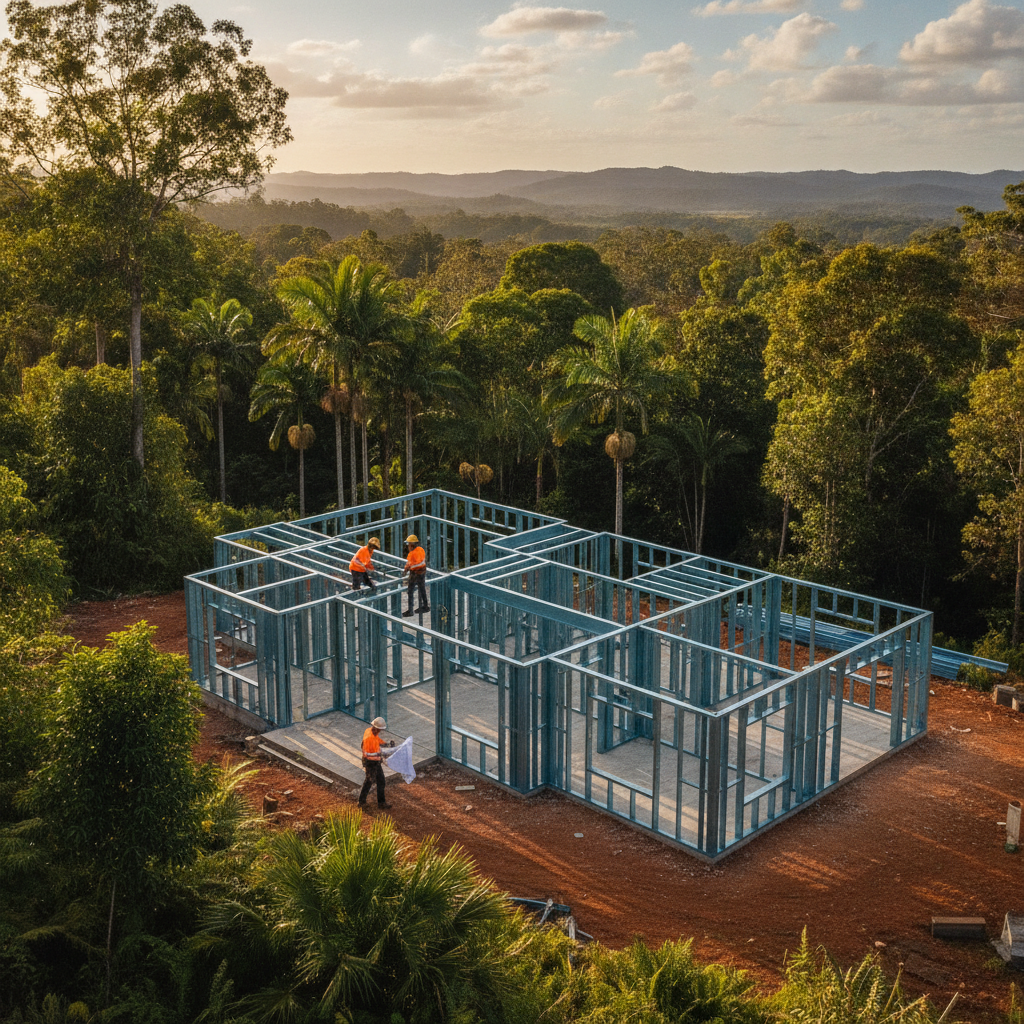
Now, as an owner-builder, you might be thinking, “Heavy steel? That’s going to be a nightmare to put up.” Not so. Modern light-gauge steel frames, like those made from TRUECORE steel, are actually quite light. The individual components are easy to handle for a couple of blokes, or even one if you've got a good plan. The framing is precision-manufactured, cut to exact lengths, and often pre-punched for services. This means less cutting on-site, less waste, and a much faster build time for the frame itself.
We've seen owner-builders in regional Queensland, with not a lot of building experience, get their steel frame up and locked down in a matter of days or a couple of weeks, depending on the size of the house. The accuracy of the frame means everything fits together square and true. That makes cladding, plasterboard, and fitting windows a heap easier down the track. In a cyclone zone, getting that frame up fast and secure means you're reducing your exposure to sudden changes in weather during the build process. Plus, the less time your frame is exposed, the better.
Beyond the Wind: Other Steel Benefits in Tropical Climates
It's not just cyclones that steel frames deal with better. Up north, you've got other issues to contend with, and steel helps with those too:
- Termites: This is a massive one. Termites are an absolute plague in many tropical and sub-tropical areas. They'll chew through timber framing faster than you can say 'pest control'. Steel? They can't eat it. Full stop. This is a huge peace of mind for homeowners, especially when your house is nestled amongst bushland.
- Rot and Mould: High humidity and moisture are a constant in the tropics. Timber can swell, warp, and eventually rot if it gets repeatedly wet and doesn't dry out properly. This creates perfect conditions for mould too. Steel doesn't rot, warp, or support mould growth. Your structural integrity remains sound, even in the dampest conditions.
- Fire Resistance: While a steel frame won't stop a raging bushfire on its own, it won't add fuel to the fire. In a high BAL (Bushfire Attack Level) area, steel frames can contribute positively to your overall fire-resistant design. They maintain their strength longer than timber under fire conditions, offering crucial time for occupants to escape.
- Consistency and Accuracy: Steel frames don't shrink, twist, or warp over time like timber can. This means your walls stay straight, your ceilings stay level, and you're less likely to get cracks in plasterboard down the line. In a region where temperature and humidity swings can be significant, this stability is a real bonus.
Practical Tips for Owner-Builders in Cyclone-Prone Areas
So, you're keen on a steel frame kit home in the tropics? Good choice. Here are a few things you absolutely need to nail:
1. Don't Skimp on the Engineering
Seriously, this is not the place to save a few bucks. Ensure your kit home supplier provides engineering that specifically addresses your site's wind classification. The drawings will show things like hold-down straps, specific bolt patterns, and bracing. Follow them to the letter. Any deviation could compromise the structural integrity. Your council's building certifier will be checking this very closely, and rightfully so.
2. Get Your Slab Right
The strength of your house starts with the foundation. In cyclone zones, the slab engineering often specifies deeper edge beams, more reinforcement, and robust hold-down points for the steel frame. Don't cut corners here. Get a reputable concreter who understands the local conditions and has experience with cyclone-rated slabs.
3. Follow Fastener Schedules Precisely
Every screw, every bolt, every rivet matters. Your kit instructions and engineering drawings will specify the type, size, and quantity of fasteners for every connection. Don't use a few less screws because you ran out or you think 'she'll be right.' She won't be 'right' when a cyclone hits. Use the correct product, every time.
4. Prioritise Weatherproofing
It's not just about stopping the wind from blowing the house down; it's about stopping the rain from blowing in. Ensure your windows and doors are rated for your wind zone. Pay meticulous attention to flashing details around penetrations, windows, and roof junctions. Use high-quality sealants. Water ingress during a cyclone can cause almost as much damage as the wind itself.
5. Secure Everything on Site
During construction, especially in those unpredictable build seasons, keep your site tidy and secure. Any loose materials - timber offcuts, tarps, tools - can become dangerous projectiles in even a strong gust of wind. Tie down anything that isn't bolted down, particularly if there's any forecast of heavy weather.
6. Understand Your Bushfire Attack Level (BAL)
While the focus is cyclones, many tropical areas also have high BAL ratings. Steel frames are a good start, but you'll also need to consider things like non-combustible cladding, ember screens on windows and doors, and careful landscaping around the home. Talk to your local council or a fire consultant early on.
The Final Word
Building in a cyclone zone is a serious undertaking. It demands respect for the forces of nature and a commitment to quality construction. A steel frame kit home, leveraging materials like TRUECORE steel, offers an incredible starting point. It's strong, precise, resistant to pests, and engineered for the extreme. For the owner-builder, it provides a manageable, robust structure that, when built correctly, gives you and your family the best possible chance of weathering the storm, literally. It's about building smart, building tough, and building to last. That's what a good steel kit home delivers, especially when the going gets rough up north.