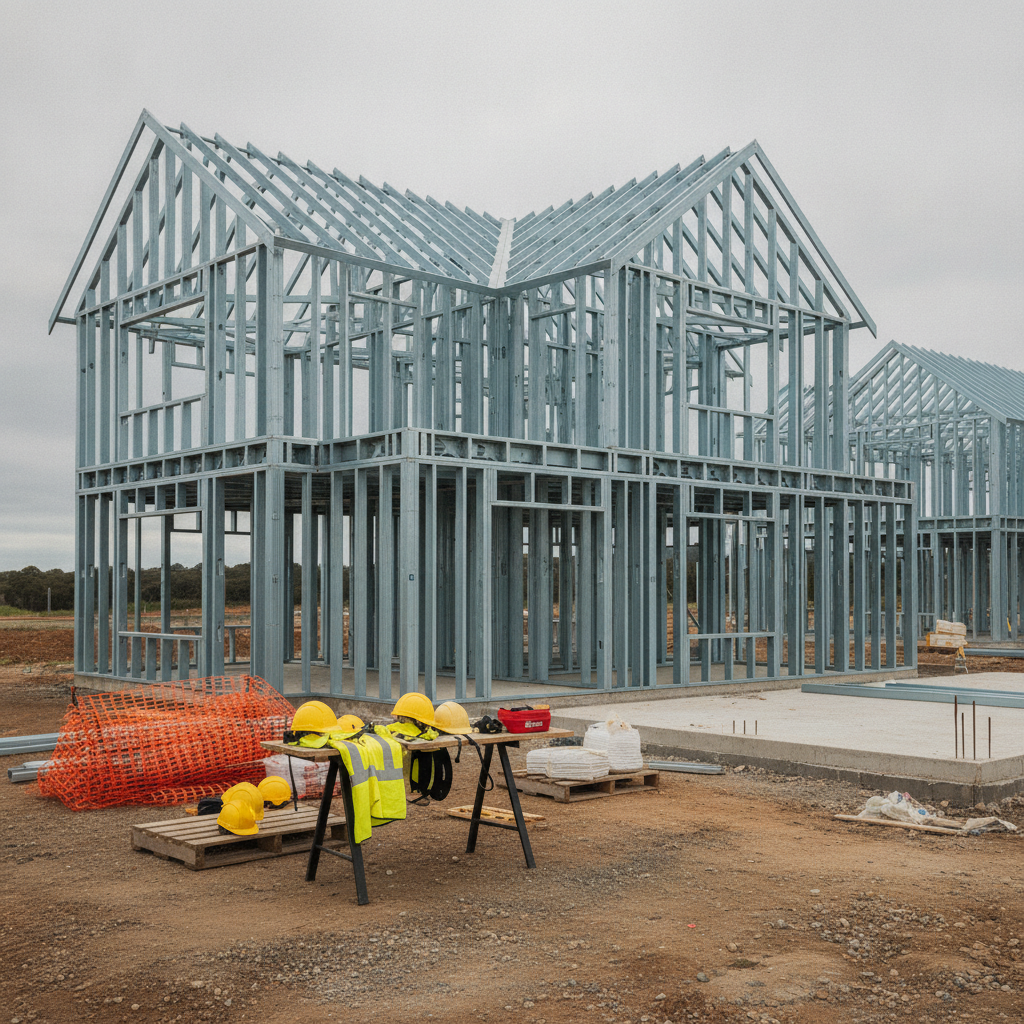
Mastering Safe Work Method Statements (SWMS) for Owner-Builders
Introduction
Embarking on an owner-builder journey, especially with a steel frame kit home, is a significant undertaking that offers immense personal satisfaction and potential cost savings. However, with the autonomy of being your own head contractor comes a paramount responsibility: ensuring the health and safety of everyone on your building site. This isn't merely a moral obligation; it's a legal one, enshrined in Australian Work Health and Safety (WHS) legislation. At the heart of meeting this obligation, particularly for high-risk construction work, lies the Safe Work Method Statement (SWMS).
This comprehensive guide is designed specifically for Australian owner-builders engaged in steel frame kit home construction. It will demystify the SWMS, explain its critical role, and provide actionable, step-by-step instructions for developing, implementing, and reviewing these essential safety documents. We'll delve into the legislative framework, highlight state-specific nuances, and offer practical tips tailored to the unique aspects of steel frame kit home construction, including working with products like TRUECORE® and BlueScope Steel. By the end of this guide, you will possess a robust understanding of SWMS, empowering you to manage risks effectively, protect all workers (including yourself and any volunteers), and build your dream home safely and compliantly.
This guide assumes an intermediate level of construction knowledge. While we will explain core concepts thoroughly, the focus is on practical application and compliance within the Australian WHS landscape. Your commitment to safety will not only safeguard lives but also ensure your project progresses smoothly, avoiding costly delays, legal ramifications, and tragic incidents.
Understanding the Basics
What is a Safe Work Method Statement (SWMS)?
A Safe Work Method Statement (SWMS), pronounced 'Swims', is a document that sets out the high-risk construction work activities to be carried out at a workplace, the hazards arising from these activities, and the measures to be put in place to control the risks. It specifies how the control measures are to be implemented and reviewed.
WHS Regulation 2017 (NSW) Part 6.3 - Clause 299(1): "A safe work method statement for high risk construction work must: ... (a) identify the work that is high risk construction work; and (b) specify the hazards relating to the high risk construction work; and (c) describe the measures to be implemented to control the risks; and (d) describe how the control measures are to be implemented, monitored and reviewed; and (e) be readily accessible to persons who are to carry out the high risk construction work or who are likely to be affected by the high risk construction work; and (f) be kept at the workplace where the high risk construction work is being carried out." Similar regulations exist across all Australian states and territories.
The SWMS is a critical planning tool, not a bureaucratic hurdle. It forces you, as the Person Conducting a Business or Undertaking (PCBU) – which, as an owner-builder, you are – to think systematically about potential dangers before work commences. It acts as a live document, guiding workers through safe procedures and serving as a record of your commitment to safety.
Who Needs a SWMS?
Any PCBU (an employer, a self-employed person, or in your case, the owner-builder managing construction) who carries out 'high-risk construction work' (HRCW) must prepare a SWMS, or ensure one has been prepared, before the work commences. This is not limited to paid workers; if you have friends, family, or volunteers assisting with HRCW, they must also be briefed on and understand the SWMS.
What Constitutes High-Risk Construction Work (HRCW)?
The WHS Regulations define specific types of construction work as 'high-risk'. For owner-builders of steel frame kit homes, several of these are highly relevant. Here's a non-exhaustive list, with particular emphasis on those often encountered during such projects:
- Work at height: Any work where there is a risk of a person falling more than 2 metres. This is almost certain during frame erection, roof installation, and cladding.
- AS/NZS 1891.4:2009: Industrial fall-arrest systems and devices - Selection, use and maintenance.
- AS/NZS 1657:2018: Fixed platforms, walkways, stairways and ladders - Design, construction and installation.
- Work involving the demolition of an element of a structure that is load bearing or otherwise critical to the integrity of the structure: While less common for new builds, modifications might arise.
- Work involving the structural alteration or repair of a structure that is load bearing or otherwise critical to the integrity of the structure: Again, potential for modifications or rectifications.
- Work involving a confined space: e.g., working in a trench or a tight crawl space under the house.
- Work involving a trench or shaft if the excavated depth is more than 1.5 metres.
- Work on or near energised electrical installations or services.
- Work on a telecommunication tower.
- Work involving asbestos or asbestos containing material.
- Work in an area that may have a contaminated atmosphere.
- Work in an area where there is a risk of engulfment.
- Work in an area where there is a risk of an uncontrolled collapse of a structure or an excavation.
- Work in, on or adjacent to a road, railway, shipping lane or other traffic corridor in use by traffic.
- Work in, on or adjacent to an operating plant.
- Work in an area that is or is likely to be inundated with water or other liquid.
- Work involving the use of explosives.
- Work involving tilt-up or precast concrete.
- Work carried out in an area where there is any movement of earth likely to cause collapse of a work area.
For a steel frame kit home, 'work at height' is the quintessential HRCW. Erecting steel frames, installing roof trusses, laying roofing iron, and even some wall cladding tasks will likely exceed the 2-metre threshold, making SWMS mandatory.
Australian Regulatory Framework
National Construction Code (NCC) and WHS Legislation
While the National Construction Code (NCC) primarily focuses on the technical performance requirements for buildings, ensuring their health, safety, amenity, accessibility, and sustainability, it works in conjunction with Work Health and Safety (WHS) legislation to create a holistic safety framework. The NCC specifies how a building must be constructed to be safe and fit for purpose, while WHS legislation dictates how work is carried out safely during construction.
NCC 2022, Volume Two, Part H1 - Structural Provisions: Sets requirements for structural design and construction to resist loads, ensuring the stability and integrity of the building. This indirectly impacts SWMS by defining the structural elements that must be safely erected.
Work Health and Safety Act 2011 (Cth) & WHS Regulations 2011 (Cth): These form the model WHS laws, adopted with minor variations by most Australian states and territories (with VIC and WA having their own equivalent legislation). These Acts and Regulations define the duties of various parties, including PCBUs (owner-builders), and mandate SWMS for HRCW.
Key duties for owner-builders (as PCBUs):
- Primary Duty of Care (WHS Act, Section 19): You must ensure, so far as is reasonably practicable, the health and safety of workers and other persons (e.g., visitors, neighbours) at your workplace.
- Consultation (WHS Act, Section 47): You must consult with workers and health and safety representatives when making decisions about WHS matters, including developing SWMS.
- Information, Training, Instruction, and Supervision (WHS Act, Section 19(3)(f)): You must provide workers with the necessary information, training, and supervision to perform their work safely.
State-Specific Variations and Regulatory Bodies
While the model WHS laws provide a consistent foundation, there are state-specific details and regulatory bodies that owner-builders must be aware of.
| State/Territory | Primary WHS Regulator | Key Legislation & SWMS Focus | Owner-Builder Specifics |
|---|---|---|---|
| New South Wales (NSW) | SafeWork NSW | Work Health and Safety Act 2011 (NSW), Work Health and Safety Regulation 2017 (NSW). SWMS for HRCW is mandatory, particularly for work at heights. | Owner-builders must complete an 'owner-builder permit' course which includes WHS components. SafeWork NSW provides extensive guidance and templates. |
| Queensland (QLD) | Workplace Health and Safety Queensland (WHSQ) | Work Health and Safety Act 2011 (QLD), Work Health and Safety Regulation 2011 (QLD). SWMS is required for HRCW. Specific codes of practice (e.g., working at heights) detail requirements. | WHSQ offers guides for small businesses and contractors, which apply to owner-builders as PCBUs. |
| Victoria (VIC) | WorkSafe Victoria | Occupational Health and Safety Act 2004 (VIC), Occupational Health and Safety Regulations 2017 (VIC). Requires 'Safe Work Method Statements' for 'prescribed high risk construction work'. | WorkSafe VIC has specific guidance for residential construction. Owner-builders must be familiar with their obligations as a 'main contractor'. |
| Western Australia (WA) | WorkSafe WA | Occupational Safety and Health Act 1984 (WA), Occupational Safety and Health Regulations 1996 (WA). Similar requirements for identifying and controlling hazards for HRCW. | WorkSafe WA provides specific publications for small business and owner-builders. |
| South Australia (SA) | SafeWork SA | Work Health and Safety Act 2012 (SA), Work Health and Safety Regulations 2012 (SA). SWMS for HRCW is mandatory and must be reviewed regularly. | SafeWork SA offers guidance documents and training resources relevant to owner-builders. |
| Tasmania (TAS) | WorkSafe Tasmania | Work Health and Safety Act 2012 (TAS), Work Health and Safety Regulations 2012 (TAS). Aligns with model WHS laws regarding SWMS for HRCW. | WorkSafe TAS has builder and DIY guides that cover safety requirements. |
| ACT/NT | WorkSafe ACT / NT WorkSafe | Adhere generally to the model WHS laws. | Similar requirements for owner-builders as other model WHS jurisdictions. |
Always check your specific state/territory WHS regulator's website for the most up-to-date legislation, codes of practice, and templates. These resources are invaluable and often provide free SWMS templates that can be adapted for your project.
Step-by-Step Process: Creating a SWMS for Your Kit Home
Developing a SWMS is a systematic process. It’s not about ticking boxes; it’s about genuinely identifying and mitigating risks. Here’s a detailed approach:
Step 1: Identify High-Risk Construction Work (HRCW) Activities
Review your kit home construction plan and identify all tasks that fall under the HRCW definition. For a steel frame kit home, critical HRCW will include:
- Site Preparation & Earthworks: Deep excavations (over 1.5m), working near utilities.
- Slab/Foundation Work: Working in trenches if over 1.5m.
- Steel Frame Erection: This is a major one. Lifting large steel components, working at heights (even before roofing), using mobile plant (e.g., telehandler, crane).
- Roof Installation: Working at heights for purlins, battens, sarking, roof sheeting (e.g., COLORBOND® steel for roofing).
- Wall Cladding Installation: Working at heights for external cladding.
- Installation of Upper Floor Systems: If your kit home is multi-storey – major height risk.
- Scaffolding Erection/Dismantling: If using hired scaffolding, ensures the scaffolders have their own SWMS, and you have one for interacting with it.
Practical Tip: Break down complex tasks. Instead of "Erect Frame," consider "Unloading Steel Components," "Assembling Wall Panels on Ground," "Lifting and Securing Wall Panels," "Installing Roof Trusses/Rafters." Each might have distinct hazards.
Step 2: For Each HRCW Activity, Identify Hazards
Once you’ve listed the HRCW, brainstorm all potential hazards associated with each specific task. Think broadly – what could go wrong?
Example: Steel Frame Erection (Lifting and Securing Wall Panels)
- Hazards:
- Falls from height: While lifting/securing panels, working on ladders, unstable surfaces.
- Being struck by falling objects: Dropped tools, steel components.
- Structural collapse: Unstable propping, premature removal of temporary bracing.
- Collision with plant/equipment: Telehandler/crane movement, reversing vehicles.
- Crush injuries: Trapped between steel components, plant.
- Cuts/lacerations: Sharp edges of steel, poor handling.
- Musculoskeletal injuries (MSIs): Manual handling of heavy or awkward steel sections.
- Contact with live electrical services: Plant striking overhead lines, hand tools on conduits.
- Weather conditions: High winds affecting lifting, wet surfaces causing slips.
- Inadequate supervision/communication.
Step 3: Assess the Risks
For each identified hazard, consider its likelihood (how likely is it to happen?) and consequence (how severe would the injury be?). This helps prioritise your control measures using a simple risk matrix (e.g., Low, Medium, High, Extreme).
Step 4: Determine Control Measures (Hierarchy of Controls)
This is the most crucial step. You must systematically select control measures following the 'Hierarchy of Controls'. This hierarchy ranks control measures from most effective to least effective.
- Elimination: Physically remove the hazard. (E.g., prefabricating wall frames on the ground to eliminate work at height for individual studs).
- Substitution: Replace the hazard with a safer alternative. (E.g., using lightweight TRUECORE® steel sections instead of heavier timber for manual handling).
- Engineering Controls: Isolate people from the hazard or reduce the risk by design. (E.g., installing temporary fall protection like scaffolding or edge protection, using mechanical lifting aids like cranes/telehandlers, safety netting, temporary bracing).
- Administrative Controls: Change the way people work. (E.g., developing safe work procedures, implementing a 'no-go' zone around lifting operations, providing specific training, a 'spotter' during plant operations, permit-to-work systems for hot work).
- Personal Protective Equipment (PPE): Protect workers with suitable equipment. (E.g., hard hats, safety glasses, high-visibility clothing, safety footwear, gloves, harnesses for fall arrest).
Critical Note: You must choose controls from the higher levels of the hierarchy where reasonably practicable. Relying solely on PPE is generally the least effective and should be a last resort or complement other controls.
AS/NZS ISO 31000:2018: Risk management - Guidelines. Provides a framework for managing risk that aligns with the hierarchy of controls.
Example Controls for Steel Frame Erection (Lifting and Securing Wall Panels):
- Elimination/Substitution:
- Pre-fabricate wall panels on the slab/ground where possible.
- Use lightweight TRUECORE® steel frame components where specified by design.
- Engineering Controls:
- Utilise a crane or telehandler with an experienced, licensed operator for lifting heavy wall panels and trusses.
- Install temporary edge protection or guardrails on elevated work platforms (EWPs) or erected floors.
- Ensure robust temporary bracing is designed and installed by a competent person.
- Provide stable, level lifting points on steel components for crane hooks.
- Administrative Controls:
- Develop and communicate a detailed lifting plan.
- Establish exclusion zones around lifting operations.
- Ensure all workers are inducted, trained, and understand their roles and the SWMS.
- Implement a 'buddy system' for working at heights.
- Toolbox talks prior to start of complex tasks.
- Weather monitoring (stop work in high winds/lightning).
- PPE:
- Hard hats, steel-capped boots, high-vis clothing, gloves, safety glasses.
- Fall arrest harness systems (with appropriate anchor points and rescue plan) where edge protection is not reasonably practicable.
Step 5: Describe Implementation, Monitoring, and Review
Your SWMS must clearly state how the control measures will be put into practice, who is responsible, how their effectiveness will be monitored, and when and how the SWMS will be reviewed.
- Implementation: Who will ensure the crane operator has a license? Who checks scaffold tags? Who conducts toolbox talks? How will HRCW be communicated to all involved?
- Monitoring: How will you ensure controls are effective? Regular site inspections, safety audits, observation of work practices.
- Review: When will the SWMS be reviewed? Often when: 1) the work changes, 2) a new hazard is identified, 3) an incident occurs, 4) new equipment is used, or 5) after a set period (e.g., yearly for ongoing projects).
Step 6: Consultation
Before finalising the SWMS, you must, as a PCBU, consult with all workers (including contractors, volunteers, and sub-contractors) who will be involved in the HRCW. They may have valuable insights into the task, hazards, and practical control measures that you might have overlooked. Their understanding ensures buy-in and compliance.
Step 7: Signature and Accessibility
Once finalised, all workers involved in the HRCW must sign the SWMS to acknowledge they have read, understood, and agree to comply with it. The SWMS must be readily accessible at the workplace (e.g., in a site office, on a clearly marked board) for the duration of the HRCW.
SWMS Template Structure Example (for a specific task)
| Item | Description | Hazards | Control Measures | Responsible Person(s) | Review Date |
|---|---|---|---|---|---|
| Project Details | |||||
| Project Name: | [Your Kit Home Address] | ||||
| Owner-Builder Name: | [Your Name] | ||||
| Date Prepared: | [Date] | ||||
| Activity: | Erection of Steel Wall Panels (2 Storey) | ||||
| 1.0 Planning & Preparation | Site Induction, Pre-starts, Tool Inspection | Inadequate communication, faulty equipment, untrained personnel. | All workers complete site specific induction. Daily pre-start meetings. All tools inspected before use. | Owner-Builder | Ongoing |
| 2.0 Unloading & Laydown | Crane/Telehandler operation, manual handling | Plant/pedestrian collision, crushing, MSIs, struck by objects. | Establish exclusion zone. Spotter with radio. Pre-slinging where safe. Mechanical lifting where possible. PPE: Gloves, boots, hard hat. | Owner-Builder, Crane Operator | When conditions change |
| 3.0 Assembling Panels (Ground Level) | Fixing steel components | Cuts, pinch points, eye injuries. | Ensure stable work surface. Use jigs. Correct PPE: Cut-resistant gloves, safety glasses. | All workers | If new tools are introduced |
| 4.0 Lifting Wall Panels | Crane/Telehandler operation, working at height (spotter) | Plant/pedestrian collision, structural collapse, falls from height (spotter), dropped load. | Engineering: Licensed crane/telehandler operator. Certified lifting points. Design-approved temporary bracing plan. Admin: Lifting plan briefing, clear signals, exclusion zones. PPE: Hard hats, high-vis. | Owner-Builder, Crane Operator, Spotter | After each lift |
| 5.0 Securing Wall Panels | Working at height (on temporary platforms/slab edge), temporary bracing | Falls from height, structural instability, struck by objects. | Engineering: Ensure stable work platform/EWP with edge protection. Install temporary bracing as per engineer's design immediately. Admin: Max 2 workers on unstable partially braced frame. PPE: Fall arrest harness (if no edge protection possible), general PPE. | Owner-Builder, Installers | Prior to each panel sec. |
| Emergency Procedures: | |||||
| First Aid | First Aid Kit available, designated First Aider identified. | ||||
| Fire | Fire extinguishers onsite, evacuation plan. | ||||
| Sign-off: | |||||
| I have read and understood this SWMS and agree to comply with its requirements. | |||||
| Name: | Signature: | Date: | |||
| (All persons involved in the HRCW to sign) |
Practical Considerations for Kit Homes
Steel Frame Specialisation (TRUECORE® and BlueScope Steel)
Steel frames, particularly those manufactured from TRUECORE® steel (a product of BlueScope Steel), offer distinct advantages but also present specific safety considerations that should be addressed in your SWMS.
- Lightweight Components: TRUECORE® steel frames are often lighter than their timber counterparts, making manual handling easier. However, this doesn't eliminate the risk of MSIs or the need for team lifts. Highlight the benefits but maintain best-practice manual handling techniques.
- Sharp Edges: Cut edges of steel can be extremely sharp. Your SWMS must emphasise the mandatory use of appropriate cut-resistant gloves (AS/NZS 2161.3:2020 Occupational protective gloves – Protection against mechanical risks) during handling, assembly, and installation.
- Conductivity: Steel is conductive. Working near live electrical services (overhead power lines, buried cables) is a significant hazard. Ensure 'look up and live, look down and live' principles are integrated into your SWMS, with clear instructions on contacting service providers for disconnections or safe work clearances.
- Thermal Conductivity: On hot days, steel can heat up significantly leading to burn risks. Include a control measure to wear long sleeves and specific gloves, and schedule hot work tasks for cooler parts of the day where practicable.
- Fastening Methods: Steel frames utilise specific fastening methods (e.g., self-drilling screws, bolts). Your SWMS should specify the correct tools and PPE (e.g., eye protection for drilling, hearing protection for impact drivers) and ensure workers are trained in their safe use.
- Temporary Bracing: While robust, steel frames require careful temporary bracing during erection according to engineering designs. Your SWMS must detail the installation and removal sequence of temporary bracing to prevent structural instability, especially during high winds.
Kit Home Specific Challenges
- Delivery & Storage: Large steel components will arrive on-site. The SWMS for unloading must consider safe exclusion zones, use of appropriate lifting equipment, and safe storage to prevent collapses or trip hazards.
- Assembly on Ground: Many steel kit homes allow for wall panel assembly on the slab or ground. This significantly reduces work at height during initial assembly but increases manual handling during lifting. Your SWMS needs to detail safe assembly practices and the lifting operation strategy.
- Sequential Construction: Kit home construction often follows a specific sequence. Any deviation that impacts structural integrity or safety must trigger a review of relevant SWMS.
- Reliance on Manufacturers' Instructions: SWMS should incorporate and reference manufacturers' safe installation instructions for specific components, particularly for BlueScope Steel roofing and cladding products. These instructions often contain vital safety information regarding handling, cutting, and fixing.
Cost and Timeline Expectations
Preparing SWMS is an investment in safety, not an additional cost per se. The real cost lies in not having one or having an inadequate one.
Financial Costs (Estimates in AUD):
- Owner-Builder Time: This is the primary cost. Expect to spend 2-5 hours per complex HRCW activity to draft a detailed SWMS. For a typical steel frame kit home, you might need 5-10 distinct SWMS for frame erection, roof installation, scaffolding, earthworks etc. This could easily total 20-50 hours for the entire project.
- Training and Consultation Fees: If you hire a WHS consultant to review your SWMS or conduct specific site inductions, expect to pay $100 - $250 per hour. This could be a wise investment for complex aspects.
- Templates/Software: While free templates are available from WHS regulators, some paid SWMS templates or software can cost $50 - $500 for a suite of pre-filled, customisable documents. These can save significant time if high quality.
- Indirect Costs of Non-Compliance: These are potentially devastating:
- Fines: WHS breaches can result in substantial fines, ranging from tens of thousands to hundreds of thousands of dollars for individuals and corporations.
- Legal Fees: Defending WHS charges can be extremely expensive.
- Work Stoppage Orders: Regulators can issue stop-work orders, causing project delays and increased costs.
- Increased Insurance Premiums: Following incidents, your insurance costs may rise.
- Reputational Damage: While less critical for an owner-builder, it can impact future building endeavours.
Timeline Expectations:
- Initial SWMS Preparation: Dedicate 1-2 weeks in your pre-construction phase to draft the initial set of SWMS for your major HRCW tasks. Do this before work commences.
- Consultation & Review: Factor in a few days for consultation with workers and any necessary revisions.
- Ongoing Review: SWMS should be reviewed regularly. A quick review (15-30 minutes) at the start of each new HRCW, or after any significant change or incident, should be part of your daily/weekly routine.
Realistic Approach: Don't try to create all SWMS at once. Prioritise the first high-risk tasks (e.g., site prep, slab, frame erection) and develop these thoroughly. Then, as the project progresses, develop SWMS for subsequent HRCW (e.g., roofing, external cladding) well in advance of the work commencing.
Common Mistakes to Avoid
- "Copy-Paste" or Generic SWMS: Using a generic template without customising it to your specific site, specific kit home design, and specific work methods is a common and dangerous mistake. Regulators can easily spot this. Your SWMS must reflect your project's reality, including the type of steel frame, site conditions, and specific tools/equipment.
- Lack of Consultation: Failing to involve workers in the SWMS development. This alienates them, reduces their understanding and buy-in, and means you miss valuable practical insights. Consultation is a legal requirement.
- SWMS Not Followed or Understood: Having a SWMS stored away in a folder that no one reads or understands. The SWMS must be communicated, understood, and actively implemented on site. Daily toolbox talks highlighting relevant sections are crucial.
- No Review/Update: Failing to review and update the SWMS when conditions change, new hazards emerge, or an incident occurs. A static SWMS quickly becomes irrelevant and ineffective.
- Focusing Only on PPE: Over-relying on Personal Protective Equipment (PPE) as the primary control measure. Remember the hierarchy of controls. While PPE is vital, it should supplement, not replace, higher-level controls like elimination or engineering solutions.
- Ignoring Volunteers/Unpaid Workers: Assuming WHS responsibilities don't apply to friends or family helping out. As a PCBU, your duty of care extends to anyone performing work on your site, paid or unpaid. They must be inducted and understand the SWMS for HRCW.
- Inadequate Emergency Procedures: Not detailing what to do in case of an incident or emergency (e.g., fall from height, electric shock). Your SWMS should include clear emergency contacts, first aid provisions, and rescue plans where appropriate (e.g., for fall arrest systems).
- Poor Record Keeping: Not keeping signed copies of SWMS, site inductions, and training records. These are critical evidence of your due diligence in the event of an incident or audit.
When to Seek Professional Help
While owner-builders are empowered to manage their projects, knowing when to tap into professional expertise is a hallmark of responsible construction management. For SWMS, engaging a professional can be invaluable:
- Complex HRCW: For tasks involving significant structural loads, complex lifting, deep excavations near utilities, or working near hazardous substances, a WHS consultant can help draft robust and compliant SWMS. Their expertise can ensure all risks are adequately addressed and controls are appropriate.
- Lack of Confidence/Time: If you feel overwhelmed by the WHS regulations or lack the time to dedicate to thorough SWMS development, a consultant can provide tailored templates or even write specific SWMS for you. This allows you to focus on other aspects of your build while ensuring safety compliance.
- Site-Specific Risk Assessments: For particularly challenging sites (e.g., steep slopes, restricted access, proximity to public areas), a professional WHS assessment can identify unique hazards that feed directly into your SWMS.
- Verification of Controls: An independent WHS consultant can review your proposed control measures to ensure they are 'reasonably practicable' and meet legislative requirements. They can also assist with site audits to verify ongoing compliance.
- Specialised Equipment Use: If you are using specialised equipment like cranes, large excavators, or erecting significant scaffolding, consult with the equipment supplier or a WHS expert to ensure your SWMS for these activities are comprehensive.
- Incident Investigation: In the unfortunate event of a serious incident, a WHS professional can assist with the investigation, ensuring compliance with reporting requirements and helping prevent recurrence.
Types of Professionals:
- WHS Consultant: A qualified safety professional. Look for those with construction-specific experience. Many offer consulting services for small businesses and owner-builders.
- Engineers (Structural/Civil): Crucial for temporary works design (e.g., bracing plans for large steel frames), complex excavation designs, or assessing structural modifications. Their designs will inform your SWMS.
- Licensed Scaffolders: For any scaffold erected beyond a basic 'low-risk' platform. They will have their own SWMS for erection/dismantling, but you need to integrate their activities into your overall site SWMS.
Approximate Costs (AUD): Hiring a WHS consultant for a few days to set up your SWMS framework could range from $1,500 - $5,000, depending on the complexity of your project and the consultant's experience. This is a small price to pay for genuine peace of mind and legal protection.
Checklists and Resources
Owner-Builder SWMS Development Checklist
- Understand Owner-Builder WHS Duties: Confirmed responsibilities as PCBU.
- Identify All HRCW Tasks: Reviewed construction plan for tasks that meet HRCW criteria.
- Gather Site-Specific Information: Site plan, soil reports, utility diagrams.
- Identify Hazards: Brainstormed all potential hazards for each HRCW task.
- Assess Risks: Evaluated likelihood and consequence of each hazard.
- Determine Control Measures (Hierarchy of Controls): Selected controls from Elimination down to PPE.
- Engineering Controls: Installed temporary edge protection, scaffolding, temporary bracing, certified lifting gear.
- Administrative Controls: Safe work procedures, exclusion zones, training plans.
- PPE: Ensured suitable PPE is available and used.
- Detail Implementation: Who (roles, responsibilities), What, When, Where, How controls will be put in place.
- Detail Monitoring: How effectiveness of controls will be checked regularly.
- Detail Review Process: Triggers for review (changes, incidents, timeframes).
- Draft Emergency Procedures: First aid, emergency contacts, rescue plan (if applicable).
- Consult with Workers: Shared draft SWMS; incorporated feedback.
- Finalise SWMS: Signed by all workers and owner-builder.
- Ensure Accessibility: SWMS readily available on site.
- Maintain Records: Keep all SWMS, induction records, review logs.
- Toolbox Talks: Conduct regular pre-task safety briefings related to the SWMS.
Essential Resources and References
- Your State/Territory WHS Regulator Website:
- SafeWork NSW: https://www.safework.nsw.gov.au/
- Workplace Health and Safety Queensland (WHSQ): https://www.worksafe.qld.gov.au/
- WorkSafe Victoria: https://www.worksafe.vic.gov.au/
- WorkSafe WA: https://www.commerce.wa.gov.au/worksafe/
- SafeWork SA: https://www.safework.sa.gov.au/
- WorkSafe Tasmania: https://worksafe.tas.gov.au/
- WorkSafe ACT: https://www.worksafe.act.gov.au/
- NT WorkSafe: https://worksafe.nt.gov.au/
- These sites offer free SWMS templates, codes of practice (e.g., Code of Practice for Managing the Risk of Falls at Workplaces), and guidance documents.
- Safe Work Australia: https://www.safeworkaustralia.gov.au/ - National body, provides model WHS laws, guidance material, and statistics.
- AS/NZS Standards: Access to these typically requires purchase, but many local libraries or industry associations may provide access.
- AS/NZS 4801:2001: Occupational health and safety management systems - Specification with guidance for use (though often superseded by ISO 45001, still referenced).
- AS/NZS 1891.4:2009: Industrial fall-arrest systems and devices - Selection, use and maintenance.
- AS/NZS 1657:2018: Fixed platforms, walkways, stairways and ladders - Design, construction and installation.
- AS 2550.1:2011: Cranes, hoists and winches – Safe use – General requirements. Relevant if using cranes.
- AS/NZS 2161.3:2020: Occupational protective gloves – Protection against mechanical risks.
- BlueScope Steel/TRUECORE® Technical Manuals: Always refer to the manufacturer's specific handling and installation guides for their steel products. These often contain critical safety information.
- Building Approvals (Local Council/Private Certifier): Your building approval process will likely include WHS requirements. Ensure your principal certifier is aware of your WHS plan.
Key Takeaways
As an owner-builder, your duty to ensure a safe construction site is absolute. The Safe Work Method Statement (SWMS) is not just a document; it's a fundamental risk management tool for high-risk construction work, safeguarding lives and ensuring compliance with Australian WHS laws. For your steel frame kit home, anticipate HRCW in frame erection, roofing, and any work at height exceeding 2 metres. Develop customised SWMS that are site-specific, involve your workers in the process, and actively implement and review them throughout your project. Leverage the hierarchy of controls, focusing on elimination and engineering solutions before relying on administrative controls and PPE. When in doubt, seek professional WHS advice – it's a wise investment in your project's success and, more importantly, the safety of everyone on your building site.
Investing time and effort upfront into robust SWMS will not only fulfil your legal obligations but also streamline your project, prevent costly incidents, and contribute to the safe and successful completion of your steel frame kit home. Your personal commitment to safety is the most powerful control measure you can implement. Build smart, build safe.
Topics
Share this guide