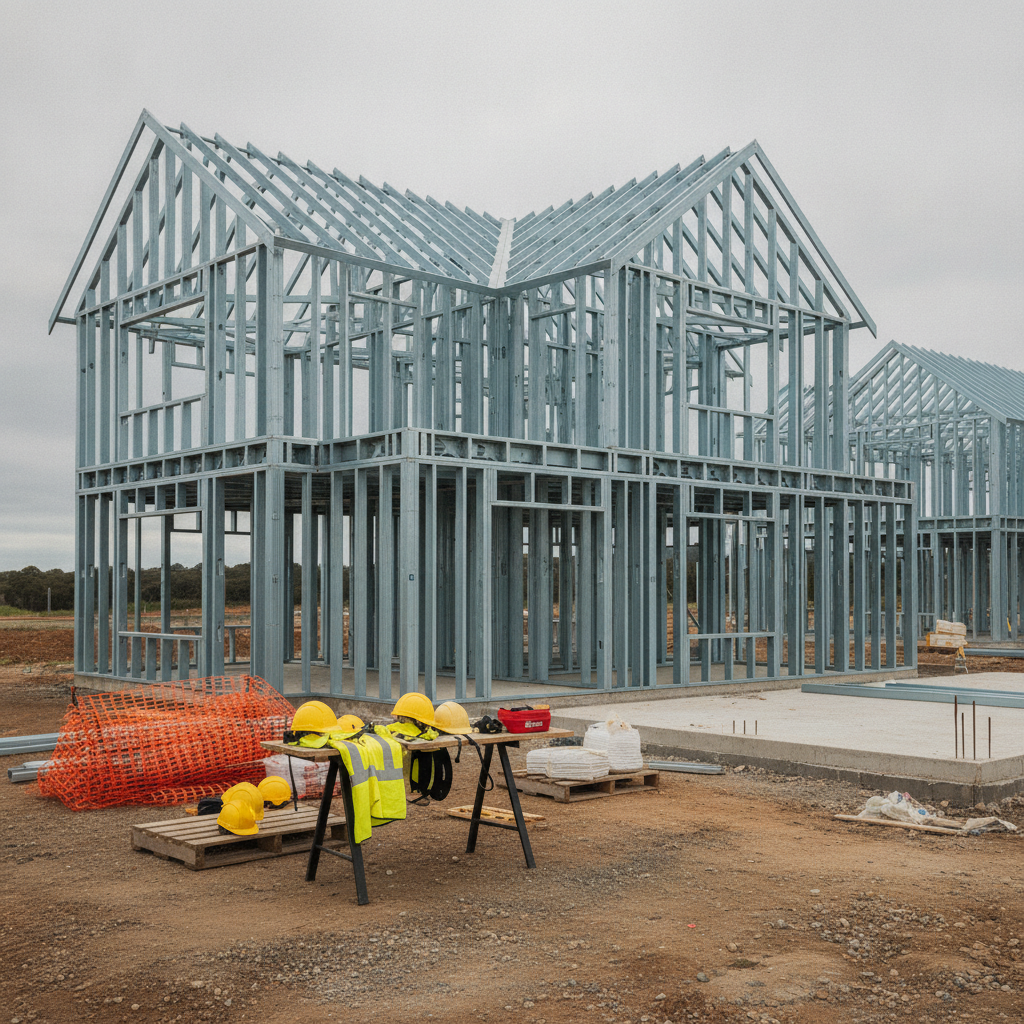
WHS Obligations for Australian Owner-Builders of Steel Frame Kit Homes: A Comprehensive Guide
Introduction
Embarking on an owner-builder journey in Australia, especially with a modern steel frame kit home, is an ambitious and incredibly rewarding endeavour. As an owner-builder, you're not just a future homeowner; you're also taking on the significant responsibilities typically handled by a professional builder. One of the most critical, yet often underestimated, aspects of this role is Work Health and Safety (WHS). For many, WHS might sound like bureaucratic jargon, but it's fundamentally about ensuring everyone on your construction site – including yourself, your family, volunteers, and hired tradespeople – goes home safely at the end of each day. This guide aims to demystify WHS for the Australian owner-builder, particularly those constructing steel frame kit homes, providing actionable, comprehensive advice.
Building a steel frame kit home offers numerous advantages, from the precision and speed of construction to the durability and sustainability of materials like TRUECORE® steel. However, these modern construction methods come with their own set of WHS considerations. Understanding and diligently applying WHS principles is not just a legal requirement; it's an ethical obligation and a smart way to protect your project, your finances, and, most importantly, the well-being of all involved. This guide will walk you through the "what," "why," and "how" of WHS in a clear, accessible manner, empowering you to manage your site safely and compliantly from slab to lock-up. We'll cover the core regulations, state-specific nuances, practical safety measures, and even cost and time implications, ensuring you're well-equipped for your significant undertaking.
Understanding the Basics
What is WHS?
Work Health and Safety (WHS) is a national framework of laws, regulations, and codes of practice designed to protect the health, safety, and welfare of people at work. This includes anyone performing work, whether paid or unpaid, on your construction site. As an owner-builder, your site is considered a 'workplace' under WHS legislation, placing significant legal responsibilities on you.
At the heart of Australian WHS legislation is the concept of a 'Person Conducting a Business or Undertaking' (PCBU). While you might not see yourself as a business, under WHS laws, an owner-builder engaging others (even volunteers) to assist with construction is generally considered a PCBU. This is a crucial distinction, as it means you have a primary duty of care to ensure, so far as is reasonably practicable, the health and safety of workers and other persons at your workplace. 'Reasonably practicable' means doing what a reasonable person would do in your situation, taking into account the likelihood of a hazard or risk occurring, the degree of harm that might result, what is known about ways of eliminating or minimising the risk, and the availability and suitability of those ways, balanced against the cost.
Key terms you'll encounter and need to understand:
- Hazard: Something that has the potential to cause harm (e.g., scaffolding, power tools, unstable ground, working at heights).
- Risk: The likelihood that a hazard will cause harm, and the severity of that harm (e.g., a fall from scaffolding, electric shock from a power tool, being struck by a falling object).
- Control Measure: Actions taken to eliminate or minimise risks (e.g., using safety harnesses, securing tools, setting up exclusion zones).
- Risk Assessment: A systematic process of identifying hazards, assessing the risks associated with those hazards, and determining appropriate control measures.
- Safe Work Method Statement (SWMS): A document that details how high-risk construction work will be carried out safely. It must identify the work, the hazards, the risks, and the control measures to be implemented. More on this later.
- PCBU (Person Conducting a Business or Undertaking): As an owner-builder, you are likely classified as a PCBU, incurring primary duties of care under WHS law.
- Competent Person: Someone who has acquired through training, qualification, experience, or a combination of these, the knowledge and skill to carry out a task safely.
For owner-builders constructing steel frame kit homes, understanding these terms is the first step toward effective WHS management. The nature of steel framing, while efficient, involves specific hazards such as working with heavy components, cutting and grinding steel, and potential for sharp edges. Your WHS plan must specifically address these.
Australian Regulatory Framework
Australia's WHS laws are largely harmonised across most states and territories, primarily based on the model WHS Act, Regulations, and Codes of Practice. However, it is critical to understand that specific state or territory adaptations and regulatory bodies apply.
National Construction Code (NCC) and WHS:
While the NCC (Volume Two for housing) primarily deals with structural integrity, fire safety, health, and amenity for the finished building, its requirements indirectly impact WHS. For instance, NCC 2022 Performance Requirement H1P1 related to structural stability means components must be installed correctly, which relies on safe work practices. Similarly, requirements for ventilation and natural light under H4P5 and H4P6 indirectly promote a healthier worksite environment during construction. The NCC defines standards for safe access and egress (F5D2, F5D5 in NCC 2022 V2), which, while applicable to the final building, influence the need for safe ladders and scaffolding during construction.
Australian Standards (AS/NZS) and WHS:
Numerous AS/NZS standards are directly or indirectly relevant to WHS on a construction site. Some key ones include:
- AS/NZS 4801:2001 – Occupational health and safety management systems (though superseded by ISO 45001, still referenced).
- AS/NZS 1576 series – Scaffolding.
- AS/NZS 1891 series – Industrial fall-arrest systems and devices.
- AS/NZS 3012:2019 – Electrical installations – Construction and demolition sites (CRITICAL for site power).
- AS/NZS 1337.1:2009 – Personal eye protection.
- AS/NZS 2210 series – Occupational protective footwear.
- AS/NZS 1716:2012 – Respiratory protective devices.
- AS/NZS 1715:2009 – Selection, use and maintenance of respiratory protective devices.
- AS 2550 series – Cranes, hoists and winches – Safe use.
State-Specific Regulatory Bodies and Variations
While the general principles are similar, each state/territory has its own WHS regulator and specific requirements, especially regarding owner-builder permits and WHS management plans.
- New South Wales (NSW): SafeWork NSW. Owner-builders must complete a WHS induction course (the 'White Card') and are subject to the Work Health and Safety Act 2011 (NSW) and Work Health and Safety Regulation 2017 (NSW). SafeWork NSW provides extensive guidance material. For residential construction, the
Code of Practice for construction workis highly relevant. - Queensland (QLD): Workplace Health and Safety Queensland (WHSQ). Owner-builders fall under the Work Health and Safety Act 2011 (QLD) and Work Health and Safety Regulation 2011 (QLD). Similar to NSW, a White Card is mandatory. WHSQ actively audits residential sites.
- Victoria (VIC): WorkSafe Victoria. The Occupational Health and Safety Act 2004 (VIC) and Occupational Health and Safety Regulations 2017 (VIC) apply. Victoria's owner-builder permit process is managed by the Victorian Building Authority (VBA). While the White Card is nationally recognised, specific OH&S induction requirements may apply, and WorkSafe VIC has specific guidance for domestic construction.
- Western Australia (WA): WorkSafe WA (part of the Department of Mines, Industry Regulation and Safety). The Occupational Safety and Health Act 1984 (WA) and Occupational Safety and Health Regulations 1996 (WA) apply. A White Card is required. WA owner-builders should consult WorkSafe WA's publications tailored for residential construction.
- South Australia (SA): SafeWork SA. The Work Health and Safety Act 2012 (SA) and Work Health and Safety Regulations 2012 (SA) are the governing legislation. A White Card is mandatory. SafeWork SA offers resources specifically for small businesses and domestic construction.
- Tasmania (TAS): WorkSafe Tasmania. The Work Health and Safety Act 2012 (TAS) and Work Health and Safety Regulations 2022 (TAS) are the key documents. White Card is required. WorkSafe Tasmania provides guidance on managing WHS for construction projects.
Mandatory 'White Card':
All persons who carry out construction work in Australia must undergo general construction induction training and be issued with a White Card (or its equivalent). This means YOU, as the owner-builder, and anyone you engage for construction work, must have a valid White Card. This is a crucial foundational requirement.
Step-by-Step Process for WHS Management
Managing WHS on your owner-builder site can be broken down into a structured, proactive process. This isn't about filling out forms for the sake of it; it's about systematic risk reduction.
Obtain Your White Card (and ensure everyone else has one):
- Action: Complete a 'General Construction Induction Training' course through a Registered Training Organisation (RTO). These are often available online or in-person. The cost is typically AUD $50-150.
- Why: It provides fundamental knowledge of WHS laws, common construction hazards, and basic risk control measures. It's a legal requirement before you set foot on a construction site for work.
Develop a Site-Specific WHS Management Plan (WHSMP):
- Action: This is your overarching safety bible for the project. While not legally required for all owner-builders in all states for domestic work, it is highly recommended as best practice, especially when engaging various trades. It demonstrates diligence.
- What it includes:
- Site Rules: General safety rules for everyone on site (e.g., no alcohol/drugs, wear PPE, report hazards).
- Emergency Procedures: How to respond to incidents – first aid, fire, evacuations. Include emergency contact numbers, location of first-aid kit, and assembly points.
- Hazard Identification & Risk Assessment (HIRA): A register of all identified hazards, assessed risks, and proposed control measures.
- SWMS Register: A schedule of high-risk construction activities and associated Safe Work Method Statements (see step 3).
- Induction Process: How you will brief new workers/visitors to the site.
- Consultation Arrangements: How you will consult with workers about WHS matters.
- Roles & Responsibilities: Clearly define who is responsible for what WHS task.
- Site Layout Plan: Mark out first aid, fire extinguishers, emergency exits, site office, toilets, and exclusion zones.
Identify High-Risk Construction Work (HRCW) and Implement SWMS:
Action: For any HRCW, you must prepare a SWMS before work commences. This is a legal requirement under WHS Regulations.
What is HRCW? Examples highly relevant to steel frame kit homes:
- Work at heights (e.g., installing roof sheeting, working on scaffolding for upper storey frames).
- Work involving structural alterations or demolition that could affect the structural integrity of a building.
- Work involving the use of powered mobile plant (e.g., cranes for lifting steel beams, excavators).
- Work carried out near energised electrical installations (e.g., overhead power lines).
- Work in an area where there is any actual or potential for a person to fall more than 2 metres.
- Work carried out in or near a shaft or trench more than 1.5 metres deep.
- Work involving hazardous chemicals (e.g., sealants, paints, solvents).
SWMS Structure:
- List the specific HRCW activity (e.g., 'Erecting steel wall frames for Level 2').
- Identify the tasks involved in that activity.
- Identify the hazards associated with each task.
- Assess the risks associated with those hazards.
- Detail the control measures to eliminate or minimise each risk.
- Describe the person responsible, and how the control measures will be implemented.
Example SWMS control measure for working at heights (installing roof purlins):
- Hazard: Fall from height (over 2m) during purlin installation.
- Risk: Serious injury or fatality.
- Control Measure: Use of compliant scaffolding (AS/NZS 1576) with guardrailing, or fall arrest system (AS/NZS 1891 series) with correctly anchored lifelines and full body harnesses, with workers trained in their use. Exclusion zone below work area.
Conduct Site Inductions:
- Action: Before anyone (worker, volunteer, visitor) starts work or accesses hazardous areas, they must receive a site-specific induction from you.
- What to cover: Site rules, emergency procedures, location of first aid, known hazards, site-specific control measures, and any relevant SWMS. Document who attended and when.
Provide and Ensure Use of Personal Protective Equipment (PPE):
- Action: You are responsible for providing appropriate PPE to workers where a risk cannot be eliminated or adequately minimised by other means. Ensure it's maintained and used correctly.
- Common PPE for steel frame construction:
- Hard Hat (AS/NZS 1801): Essential for head protection against falling objects or striking head on structures.
- Safety Glasses/Goggles (AS/NZS 1337.1): Crucial for eye protection, especially when cutting, grinding, or drilling steel.
- High-Visibility Clothing (AS/NZS 4602.1): Ensures workers are seen, particularly around mobile plant or on busy sites.
- Steel-Capped Boots (AS/NZS 2210 series): Protects feet from falling objects and punctures.
- Gloves (AS/NZS 2161 series): Essential for handling steel frames to prevent cuts, splinters, and chemical burns.
- Hearing Protection (AS/NZS 1270): When using noisy power tools like saws, grinders, or compressors.
- Sun Protection: SPF 30+ sunscreen, long sleeves, wide-brimmed hat.
Maintain a Safe Site:
- Action: Regularly inspect your site for new hazards, ensure control measures are effective, and maintain good housekeeping.
- Key aspects: Keep walkways clear, manage waste, secure tools and materials, ensure electrical leads are tagged and in good condition (AS/NZS 3012). Remember that BlueScope Steel and TRUECORE® steel products, while durable, should be stored on skids, kept dry, and stacked safely to prevent collapse.
Respond to Incidents:
- Action: Have a clear plan for responding to accidents, near misses, or dangerous incidents. Provide immediate first aid. Report serious incidents to your state WHS regulator immediately.
- Why: Learning from incidents is key to continuous improvement in safety.
Practical Considerations for Kit Homes
Steel frame kit homes, often featuring TRUECORE® steel, bring specific WHS advantages and considerations.
Advantages of Steel Frames for WHS:
- Precision and Consistency: Prefabricated steel frames arrive on site ready for assembly, reducing on-site cutting, measuring, and fabrication, which in turn reduces associated tool hazards and repetitive strain injuries.
- Lightweight Components (relative to timber): Many light gauge steel frame components, especially purlins and studs, can be handled by one or two people, reducing manual handling risks compared to heavy timber beams. However, larger structural steel members may still require mechanical lifting.
- Strength-to-Weight Ratio: The inherent strength of steel means less material for the same structural integrity, potentially simplifying some lifting tasks.
- Non-Combustible (NCC Vol 2, Part C2D14): Steel frames are non-combustible, reducing fire risk during construction compared to timber frames, especially during welding or grinding activities (though sparks can still ignite other materials).
- Pest Resistant: No need for chemical pest treatments post-framing, avoiding associated chemical exposure risks.
Specific WHS Considerations for Steel Frames:
Manual Handling of Steel Components:
- While individual TRUECORE® studs can be lighter than timber, bundles of frames or larger beams are heavy. Plan lifting, consider mechanical aids (e.g., HIAB crane on truck, telehandler, genie lift), and ensure correct lifting techniques for manual handling (bend knees, keep back straight, lift with legs).
- Risk: Sprains, strains, crushing injuries.
- Control: Team lifts, mechanical aids, training in safe manual handling.
Sharp Edges and Burrs:
- Cut ends of steel components can be very sharp. Fabricated sections might have burrs.
- Risk: Lacerations, cuts.
- Control: Always wear appropriate cut-resistant gloves (AS/NZS 2161), inspect components, deburr where necessary.
Working at Heights during Frame Erection and Sheeting:
- Erecting walls, especially for two-storey homes, and installing roof trusses/purlins/sheeting are high-risk activities.
- Risk: Falls from height.
- Control: Use compliant scaffolding (AS/NZS 1576 series), elevated work platforms (EWPs), fall restraint, or fall arrest systems (AS/NZS 1891 series). Ensure scaffolding is erected by a competent person (licensed scaffolder for more complex structures). Edge protection (guardrails) is essential during roof sheeting.
Cutting and Grinding Steel:
- Angle grinders and abrasive saws generate sparks, heat, noise, and dust.
- Risk: Eye injuries, burns, fire, hearing loss, respiratory issues.
- Control: Safety glasses (AS/NZS 1337.1) or face shield, hearing protection (AS/NZS 1270), fire extinguisher nearby, protect surrounding combustible materials, wear long sleeves and trousers, respiratory protection (e.g., P2 mask for dust from galvanised steel). Ensure proper ventilation.
Electrical Safety (AS/NZS 3012:2019):
- Power tools, temporary site power (switchboards, leads).
- Risk: Electrocution, electric shock.
- Control: All electrical equipment on site must be tested and tagged (usually quarterly), use RCDs (Residual Current Devices) on all circuits, ensure leads are not damaged or run through water. Temporary switchboards to meet AS/NZS 3012. Never use domestic extension leads in a construction environment.
Weather Conditions:
- Steel frames can be slippery when wet. High winds can make handling large components dangerous.
- Risk: Falls, loss of control of materials.
- Control: Cease work at height in high winds, ensure good drainage, apply anti-slip measures if necessary, cover work areas during rain.
Cost and Timeline Expectations
Implementing good WHS practices isn't just about compliance; it's also about efficiency and cost savings in the long run. An accident can derail your timeline and blow out your budget significantly.
Typical WHS Costs for an Owner-Builder (AUD):
| Item | Estimated Cost (AUD) | Notes |
|---|---|---|
| White Card (per person) | $50 - $150 | Online or in-person course. |
| First Aid Kit (basic) | $50 - $200 | Essential. Larger kits for bigger sites. |
| Fire Extinguisher (2.5kg ABE) | $30 - $70 | At least one, check type suitability. |
| PPE (initial set per person) | $200 - $500 | Hard hat, safety glasses, gloves, boots, hi-vis vest, ear plugs/muffs, sun protection. Replacements needed. |
| Temporary Site Power (setup) | $500 - $2,000+ | Hiring/buying temporary portable switchboard, RCDs, tested/tagged leads. Can be a rental item. |
| Scaffolding (rental) | $100 - $300 per week | For a typical two-storey home, you might need it for 6-12 weeks. Total: $600 - $3,600. Professional erection adds significantly. |
| Fall Arrest System (hire/buy) | $50 - $200 per week (hire) / $500+ (buy) | Harnesses, lanyards, anchor points. Often included by roofing contractors. |
| Rubbish Skips (waste management) | $300 - $800 each | Essential for site cleanliness and hazard reduction. You'll need several throughout the build. |
| Safety Signage | $50 - $150 | 'Danger: Construction Site', PPE required, etc. |
| Professional WHS Advice | $150 - $300 per hour | If hiring a WHS consultant for plan review or specific advice. |
| Total Estimated WHS Budget | $2,000 - $10,000+ | This is an active budget, not a one-off cost. Contingency important. |
This doesn't include potential costs for compliance breaches (fines are substantial, in the tens or hundreds of thousands for serious breaches) or damages from accidents. Investing in WHS is damage prevention.
Timeline Implications:
- Pre-Construction (1-2 weeks): Developing WHSMP, obtaining White Cards, ordering PPE, setting up site safety (fencing, temporary power).
- Ongoing (daily/weekly): Daily toolbox talks, weekly site inspections, maintenance of PPE, reviewing SWMS, managing waste. This takes continuous effort.
- Delay due to Incident: An accident can halt work for days or weeks (regulatory investigation, recovery time), severely impacting your build schedule. Ignoring WHS often leads to slower progress in the long run.
Common Mistakes to Avoid
- Underestimating Your PCBU Obligations: Many owner-builders assume WHS laws don't fully apply to them because it's their own home. This is a dangerous misconception. As soon as you engage anyone else, paid or unpaid, your PCBU duties kick in. SafeWork NSW, for example, is very clear on owner-builder responsibilities.
- Lack of Site-Specific Induction: Relying solely on the White Card isn't enough. Every person on site needs to be inducted into YOUR rules, YOUR hazards, and YOUR emergency procedures. Failure to do so is a common breach.
- Inadequate Fall Protection: Falls from height are a leading cause of fatalities and serious injuries in construction. Not using proper scaffolding, edge protection, or fall arrest systems for tasks like roofing or upper-storey framing (common with kit homes) is a critical error.
- Poor Electrical Safety: Using damaged leads, un-tagged equipment, or non-RCD protected power is incredibly risky. AS/NZS 3012:2019 is very strict on construction site electrical safety.
- Failure to Plan for High-Risk Work (No SWMS): Thinking you can just 'wing it' for activities like crane lifts, working in trenches, or at heights. This is a non-negotiable legal requirement. If an incident involving HRCW occurs without a SWMS, you're in serious legal trouble.
- Neglecting Housekeeping: A messy site (debris, tools left lying around, materials incorrectly stacked) is a hazardous site. Tripping hazards, material collapse, and difficulty of access breed accidents. Good housekeeping is fundamental safety.
- Ignoring Material Specifics: Steel frame components, even products like TRUECORE® steel, have specific handling and storage requirements to prevent corrosion, warping, or injury from sharp edges. Not educating yourself on these specifics can lead to damage or injury.
- Lack of Consultation: Not engaging with your workers (even sub-contractors) about WHS issues is a missed opportunity for risk identification and a breach of WHS laws that require consultation on health and safety matters.
When to Seek Professional Help
As an owner-builder, you're wearing many hats, but you don't have to be an expert in everything. Knowing when to call in a professional is a sign of good management.
- Structural Engineering Advice: Critical for steel frame setup, especially if modifying the kit design or if your site has unusual conditions. Your kit home supplier will provide engineering for the standard kit, but any variations need qualified input. (NCC Vol 2, Performance Requirement P2.1.1 on structural stability).
- Licensed Scaffolder: For complex or high scaffolding, or for structures exceeding certain heights (often 4m or more), a licensed scaffolder is required to erect, alter, and dismantle. This ensures compliance with AS/NZS 1576 and state regulations.
- Licensed Electrician: All electrical work, including temporary site power connections and permanent wiring, must be done by a licensed electrician (AS/NZS 3000, AS/NZS 3012 for construction sites).
- WHS Consultant: If you find the WHS regulations overwhelming, or if you have complex high-risk activities, a WHS consultant can help develop your WHSMP, SWMS, and provide site-specific advice. This is an investment in peace of mind and compliance.
- Crane Operators / Riggers: For lifting heavy steel beams or trusses, engaging certified crane operators and riggers is essential. They are competent professionals who understand safe lifting plans, rigging, and exclusion zones. (AS 2550 series).
- Experienced Builder/Mentor: Engaging a builder to act as a mentor or advisor, even on a casual basis, can provide invaluable practical WHS insights for an owner-builder.
Remember, your insurance might also require certain parts of the build to be completed by licensed professionals. Always check your owner-builder insurance policy thoroughly.
Checklists and Resources
Here are some actionable checklists to get you started and keep you on track.
Pre-Construction WHS Checklist:
- Obtain owner-builder permit (state-specific).
- Complete White Card training (yourself and all workers/volunteers).
- Develop Site-Specific WHS Management Plan.
- Conduct site hazard identification and risk assessment.
- Identify all High-Risk Construction Work activities.
- Prepare SWMS for all identified HRCW.
- Source and equip your basic first aid kit (e.g., compliant with Safe Work Australia's 'First Aid in the Workplace' Code of Practice).
- Purchase/rent fire extinguishers (appropriate type for your site, e.g., ABE dry chemical).
- Arrange for temporary site power installation (by licensed electrician, compliant with AS/NZS 3012).
- Install site security fencing and signage (e.g., 'DANGER: CONSTRUCTION SITE – AUTHORISED ENTRY ONLY').
- Acquire basic PPE for yourself and ensure availability for others (hard hats, safety glasses, gloves, boots, hi-vis).
Ongoing Site Safety Checklist (Weekly Review):
- Are all workers/volunteers inducted and recorded?
- Is relevant PPE being worn and is it in good condition?
- Are access and egress points clear and safe?
- Is housekeeping maintained (no excessive rubbish, materials stacked safely)?
- Are control measures from SWMS being followed?
- Are scaffolds/ladders safe, stable, and correctly used?
- Are electrical tools and leads tested and tagged, RCDs working?
- Is there an updated SWMS for any new HRCW?
- Is the first aid kit stocked and accessible?
- Have any new hazards emerged, and been controlled?
- Have all incidents/near misses been reported and investigated?
- Is consultation occurring with workers on WHS matters?
Resources:
- Safe Work Australia: The national body providing model WHS laws, codes of practice, and guidance material. (www.safeworkaustralia.gov.au)
- Your State/Territory WHS Regulator: (e.g., SafeWork NSW, WorkSafe Victoria) – These are your primary resources for state-specific legal requirements, forms, and guidance. (Google "[Your State] WHS Regulator")
- Building Regulators: (e.g., NSW Fair Trading, VBA) – For owner-builder permits and general building regulations.
- Standards Australia: Purchase or access AS/NZS standards relevant to your build. (www.standards.org.au)
- BlueScope Steel / TRUECORE®: For specific handling and safety information related to their steel products. (www.bluescopesteel.com.au, www.truecore.com.au)
- Registered Training Organisations (RTOs): For White Card and other WHS training.
Key Takeaways
As an Australian owner-builder constructing a steel frame kit home, you are legally obligated to provide and maintain a safe workplace. This isn't an optional extra; it's a fundamental part of your role. Embrace your responsibilities as a PCBU, develop a comprehensive WHS Management Plan, ensure all high-risk construction work is supported by a Safe Work Method Statement, and rigorously enforce PPE use. Proactive WHS management protects lives, saves money, avoids project delays, and provides immense peace of mind. Leverage the precise nature of modern steel frames, like those made from TRUECORE® steel, to your advantage in planning safety, but meticulously manage specific steel-related hazards like sharp edges and working at height. By being diligent, informed, and proactive, you can successfully build your dream home while ensuring everyone involved remains safe and healthy throughout the process.
Topics
Share this guide