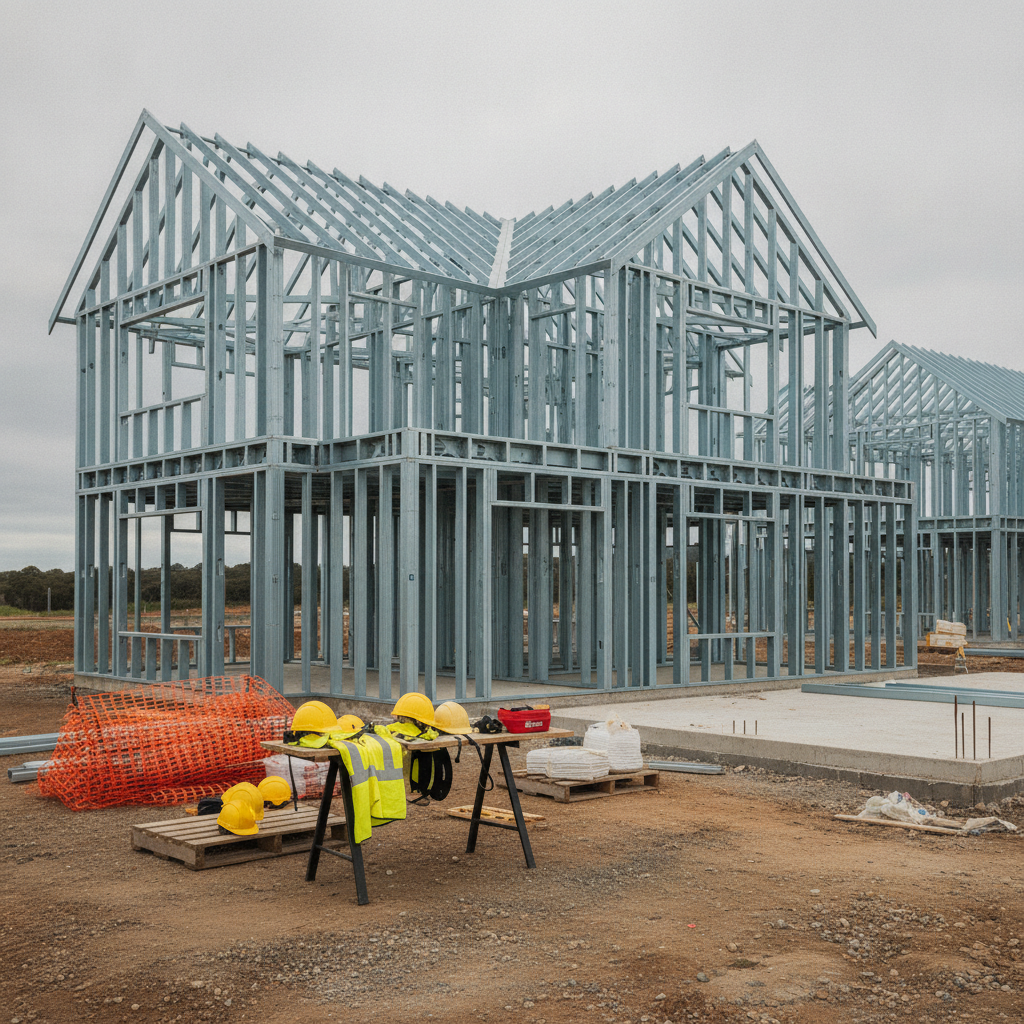
Working at Heights: Safety & Compliance for Steel Frame Kit Homes (Intermediate Guide)
Introduction
Building your own steel frame kit home in Australia is an incredibly rewarding endeavour, offering significant cost savings and the satisfaction of creating your dream dwelling with your own hands. However, it also comes with immense responsibility, particularly concerning safety. Among the most critical safety aspects for any construction project, and especially for a two-storey or even a single-storey home with a steep roof pitch, is working at heights. Falls from height are a leading cause of serious injury and fatalities in the construction industry, consistently topping the list of workplace incidents. As an owner-builder, you are legally obligated to provide a safe working environment, not just for yourself but for any family, friends, or contractors assisting you on site. Ignorance of the law is not an excuse, and the penalties for non-compliance, both financial and personal, can be severe.
This comprehensive guide is specifically tailored for intermediate owner-builders undertaking steel frame kit home construction in Australia. We will delve deep into the intricacies of working at heights, covering everything from the fundamental regulatory frameworks like the National Construction Code (NCC) and Work Health and Safety (WHS) legislation to practical, actionable strategies for risk assessment, control, and equipment selection. We'll explore the unique considerations presented by steel frame construction, including the use of products like TRUECORE® steel for framing, and how these impact your working at heights strategy. Our aim is to equip you with the knowledge and confidence to safely and compliantly manage all tasks involving elevated work, ensuring your project progresses without incident and to the highest safety standards. This isn't just about avoiding penalties; it's about safeguarding lives.
Understanding the Basics
Before we dive into regulations and equipment, it's crucial to establish a foundational understanding of what 'working at heights' truly means in an Australian construction context and the fundamental principles governing its safe execution.
What Constitutes 'Working at Heights'?
In Australia, any work performed where there is a risk of a fall of two metres or more is generally considered 'working at heights'. However, it's vital to understand that many states and territories (e.g., NSW, QLD, VIC) define 'working at heights' as any height where a person could fall and injure themselves, regardless of the distance. This encompasses situations like working on a ladder, a scaffold, an elevated work platform, on a roof, near an edge, or on formwork. The key is the potential for injury from a fall, not an arbitrary height threshold. For owner-builders, even tasks like installing sarking, roofing sheets, or fascia on a single-storey dwelling will invariably involve working at heights.
The Hierarchy of Control: Your Guiding Principle
Central to all WHS legislation concerning working at heights is the Hierarchy of Controls, a systematic approach to managing risks. As an owner-builder, you must apply this hierarchy stringently:
- Elimination: Can the work at height be avoided altogether? For example, assembling roof trusses on the ground before lifting them into place (though often not feasible for steel frames where individual components are erected). Pre-fabricating wall panels or roof sections on the ground is a prime example of elimination.
- Substitution: Can the hazardous work method be replaced with a less hazardous one? E.g., using a cherry picker instead of scaffolding for certain tasks if the ground conditions permit.
- Engineering Controls: These are physical controls designed to minimise the risk. This is the preferred method for working at heights where elimination or substitution aren't possible. Examples include passive fall prevention devices like scaffolding, temporary work platforms, guardrailing, or safety nets. For a steel frame kit home, robust perimeter scaffolding or a well-designed safety mesh system across roof purlins are critical engineering controls.
- Administrative Controls: These are safe work procedures, training, and supervision. Examples include safety signs, exclusion zones, specific work instructions, and permits to work. While important, they rely on human behaviour and are therefore less reliable than engineering controls.
- Personal Protective Equipment (PPE): This is the last line of defence. Examples include safety harnesses, lanyards, and fall arrest devices. PPE protects the individual if a fall occurs but prevents neither the fall nor the hazard itself. PPE should never be the primary fall prevention method if higher-level controls are practicable.
NCC 2022 Volume One, Part B2 - Structural Performance: While not directly prescribing fall prevention, the NCC mandates that structures must withstand loads, including those from construction activities. This indirectly supports the use of robust and certified temporary structures (like scaffolding) for safe access and egress during the build. Furthermore, NCC encourages design for safety, which includes considering safe access for construction and maintenance.
Steel Frame Kit Home Specifics
Steel frame construction, particularly with lightweight framed systems like those using TRUECORE® or other galvanised steel sections, introduces certain considerations for working at heights:
- Lightweight Nature: While strong, the lighter sections can sometimes flex more under temporary loads than traditional timber, necessitating careful planning for temporary work platforms or access points that attach to the frame.
- Slippery Surfaces: Untreated galvanised steel can be slippery when wet, requiring extra caution and anti-slip measures on access ways.
- Open Web Trusses: Many steel roof trusses feature open web designs, presenting significant fall-through risks during roof installation. Safety mesh or temporary infill platforms become non-negotiable.
- Sharp Edges: Cut steel edges can be sharp, posing a laceration risk, especially when working in confined spaces or reaching across members. Gloves are essential.
- Thermal Conductivity: Steel can get very hot in direct sun, making surfaces uncomfortable or even unsafe to touch without appropriate gloves.
Understanding these fundamental principles and the specific characteristics of your steel frame kit home will lay a strong foundation for managing working at heights risks.
Australian Regulatory Framework
Navigating the regulatory landscape for working at heights as an owner-builder in Australia requires diligent attention to both national and state-specific legislation. Australia operates under a cooperative model where national WHS laws are implemented primarily through state and territory legislation, adapting them to local contexts.
National Construction Code (NCC) Requirements
While the NCC primarily focuses on the performance requirements of finished buildings, certain aspects indirectly influence working at heights, particularly regarding access and structural integrity during construction.
- NCC 2022 Volume Two, Part 3.9.1.2 - Protection from Falls: This section, while primarily aimed at protecting occupants post-construction (e.g., balustrades), establishes the principle that adequate fall protection is required where a person could fall more than 1m from a floor or trafficable surface. This principle resonates with construction safety.
- NCC 2022 Volume Two, Clause P2.1.1 - Structural Stability: The NCC mandates that a building must be structurally sound and capable of withstanding all loads, including those imposed during construction. This requirement necessitates that any temporary works, such as scaffolding or propping, must be structurally adequate and professionally designed or certified where necessary to support anticipated loads (workers, materials, equipment).
- NCC 2022 Volume One, Part B2 - Structural Performance: For commercial, industrial, and multi-unit residential buildings (sometimes relevant for larger or complex owner-builder projects), Part B2.1 mandates structural stability and resistance to various actions, including construction loads. This reinforces the need for sound engineering of temporary structures.
Note on NCC and Owner-Builders: While direct mandates on construction safety fall under WHS bodies, local councils and building certifiers will often look for evidence of safe work practices, especially regarding temporary structures that could impact the final building's integrity or public safety. Incorrectly erected scaffolding or a poorly secured roof system could lead to structural issues flagged during mandatory inspections.
Work Health and Safety (WHS) Legislation
The cornerstone of WHS in Australia is the Work Health and Safety Act 2011 (Cth), which has been adopted by most states and territories (with VIC and WA having their own equivalent Acts). This Act is supplemented by the Work Health and Safety Regulations and various Codes of Practice. For working at heights, the most critical documents are:
- Model Code of Practice: Managing the Risk of Falls at Workplaces: This national code provides detailed practical guidance on how to manage the risks of falls, outlining the hierarchy of controls, specific fall prevention devices, and safe work methods. It's an indispensable resource.
- AS/NZS 1891 (Industrial Fall-Arrest Systems and Devices Series): This series of Australian/New Zealand Standards sets out requirements for industrial fall-arrest systems, including safety harnesses, lanyards, karabiners, and anchorages. Any fall arrest equipment you use must comply with these standards.
- AS/NZS 1576 (Scaffolding Series): This series details requirements for the design, construction, and safe use of scaffolding.
- AS/NZS 4576 (Guidelines for Scaffolding): Provides practical guidance on scaffolding.
- AS/NZS 1657 (Fixed Platforms, Walkways, Stairways and Ladders): Covers permanent access systems, but its principles apply to temporary access.
WHS Act 2011, Section 19 – Primary Duty of Care: As an 'owner-builder', you are considered a 'person conducting a business or undertaking' (PCBU) on your site. This means you have a primary duty to ensure, so far as is reasonably practicable, the health and safety of yourself and any other persons (including volunteers) working on your site. This duty is non-transferable and paramount.
State-Specific Variations and Regulatory Bodies
While the national framework provides consistency, specific regulations, compliance requirements, fees, and enforcement bodies vary slightly across states and territories. It is imperative that you consult the relevant WHS regulator in your state.
| State/Territory | Regulatory Body | Key Legislation/Guidance (Specifics) |
|---|---|---|
| NSW | SafeWork NSW | Work Health and Safety Act 2011 (NSW), Work Health and Safety Regulation 2017 (NSW). NSW has specific requirements for high-risk work licenses (e.g., for operating boom-type EWPs over 11m, scaffolding over 4m). Code of Practice: Managing the Risk of Falls at Workplaces (NSW). NSW defines 'working at heights' as any height where a person could fall and injure themselves. |
| QLD | Workplace Health and Safety Queensland (WHSQ) | Work Health and Safety Act 2011 (QLD), Work Health and Safety Regulation 2011 (QLD). QLD's Working at Heights Code of Practice 2021 (adapted from the national model) stresses the hierarchy of controls. Requirements for fall prevention on residential construction often include specific guidance on roof work and edge protection. |
| VIC | WorkSafe Victoria | Occupational Health and Safety Act 2004 (VIC), Occupational Health and Safety Regulations 2017 (VIC). VIC has a strong focus on prevention. Compliance Code: Preventing Falls in Housing Construction, specifically targets residential building sites. It outlines practical solutions for common tasks like roof work, using safety nets, edge protection, and scaffold. Victoria considers any height from which a fall could cause injury to be 'work at height'. |
| WA | WorkSafe WA | Occupational Safety and Health Act 1984 (WA), Occupational Safety and Health Regulations 1996 (WA). WA's Code of Practice: Prevention of Falls in Workplaces provides guidance. Recent legislative reforms are aligning WA more closely with the national model WHS laws, but specific transitional guidance should be checked. |
| SA | SafeWork SA | Work Health and Safety Act 2012 (SA), Work Health and Safety Regulations 2012 (SA). SA closely follows the national model. The Code of Practice: Managing the Risk of Falls at Workplaces applies. SA has clear guidance on fall prevention in residential construction, emphasizing safe entry/exit and working platforms. |
| TAS | WorkSafe Tasmania | Work Health and Safety Act 2012 (TAS), Work Health and Safety Regulations 2012 (TAS). Tasmania adopts the national model and the Code of Practice: Managing the Risk of Falls at Workplaces. Specific guidance exists for construction site safety, including working at heights. |
Key Action for Owner-Builders: Before commencing any work involving heights, visit your state's WHS regulator website. Download and thoroughly read their Code of Practice for Managing the Risk of Falls and any specific guidance for residential construction. This is your primary legal reference for compliance.
Step-by-Step Process: Managing Falls from Height
As an owner-builder, your approach to working at heights must be systematic, proactive, and documented. This step-by-step process aligns with WHS requirements.
Step 1: Planning and Risk Assessment (Before Work Even Starts)
This is the most critical phase. Do not rush it.
- Identify Tasks Involving Heights: Review your kit home plans. Which tasks require working at heights? (e.g., erecting wall frames, installing roof trusses/purlins, sarking, roofing, fascia, gutters, window installation on upper floors, external cladding at height).
- Conduct a Site-Specific Risk Assessment:
- Hazards: What are the potential fall hazards? (e.g., unprotected edges, fragile surfaces like skylights, fall-through risks in open roof structures, unstable ground for equipment, overhead power lines, slippery surfaces, weather conditions).
- Persons at Risk: Who could be harmed? (e.g., yourself, family, friends, contractors, visitors).
- Existing Controls: What measures are already in place or could be?
- Likelihood and Consequence: How likely is a fall, and how severe would the injury be?
- Consult with Experts (If Needed): For complex roof designs or difficult sites, consult with a WHS professional or a scaffold engineer. Their fees are minimal compared to the cost of an accident.
- Develop a Safe Work Method Statement (SWMS) or Safe Operating Procedure (SOP): Especially if using contractors or having multiple people on site, a written SWMS is essential. Even for yourself, documenting the steps for each high-risk task forces you to think through the process safely. It should detail:
- The task to be performed.
- Potential hazards.
- Control measures (applying the hierarchy of controls).
- Equipment to be used.
- Roles and responsibilities.
- Emergency procedures.
Step 2: Implement Control Measures (Applying the Hierarchy)
Based on your risk assessment, implement the most effective control measures.
- Prioritise Elimination/Substitution:
- Assemble as much of the steel wall and roof frame as possible on the ground before craning into position. This is a significant advantage of steel frame kit homes. Ensure safe lifting procedures.
- Prefabricate eaves linings or gutter sections on the ground.
- Engineering Controls (Primary Focus for Heights):
- Scaffolding (AS/NZS 1576, AS/NZS 4576): This is often the safest and most effective solution for multi-level work or extensive roof work. Renting a scaffold system is usually the most practical option for owner-builders. Ensure it's erected by a licensed scaffolder for structures above certain heights (e.g., 4m in NSW) or is a modular system erected strictly according to manufacturer instructions. Ensure it has guardrailing, toe boards, and safe access points (ladders).
- Edge Protection/Guardrailing (AS/NZS 4991): Where scaffolding isn't practicable for short-term tasks or specific roof sections, install temporary edge protection. This could be proprietary systems or site-built guardrails if engineered correctly, extending around roof perimeters, voids, and open edges. Steel frame building can integrate proprietary edge protection systems that fix directly to purlins or fascia.
- Safety Nets (AS/NZS 4389): For trussed roof structures or internal voids, safety nets are excellent collective fall arrest systems. They catch a person if they fall, preventing impact with the ground. Nets must be correctly installed, regularly inspected, and certified.
- Temporary Work Platforms: For individual tasks (e.g., installing a specific steel beam), consider proprietary work platforms or step platforms designed for roof work.
- Elevated Work Platforms (EWPs) (AS 1418.10): Scissor lifts or boom lifts can provide stable work platforms. Ensure the operator is trained and licensed (Yellow Card for under 11m boom lifts; High-Risk Work License for over 11m). Crucial for steel frame erection where heavy sections need to be manoeuvred into place. Ground conditions must be stable.
- Administrative Controls:
- Exclusion Zones: Barricade areas directly below where work at height is occurring to prevent falling objects injuring those below.
- Site Induction: Ensure everyone on site understands the risks and control measures.
- Weather Monitoring: Do not work at height in high winds, heavy rain, or extreme heat. Wet TRUECORE® steel can be very slippery.
- Personal Protective Equipment (PPE) (AS/NZS 1891): Only used where higher controls aren't practicable for certain segments of work, or as a backup to other controls (e.g., fall arrest for roof sheeting in addition to safety mesh).
- Full Body Harness: Must be correctly fitted and inspected before each use.
- Lanyards: Energy-absorbing lanyards are essential to reduce impact forces during a fall.
- Anchor Points: Must be certified, securely fixed to a structure capable of withstanding the impact load (e.g., a minimum of 15kN for a single person). For steel frames, consult an engineer regarding suitable anchorage points on purlins or beams.
- Fall Arrest System: A combination of anchor, harness, and lanyard designed to arrest a fall. Requires training and rescue plan.
- Gloves: Essential for handling steel, protecting against cuts and heat.
- Hard Hat: Always on site.
- Safety Footwear: Non-slip, steel-capped boots.
Step 3: Training and Supervision
- Competency: Ensure anyone working at height, including yourself, is competent. This means having the necessary skills, knowledge, and experience. For high-risk tasks, formal training (e.g., 'Working at Heights' course) is highly recommended and often legally required for high-risk work involving fall arrest systems.
- High-Risk Work (HRW) Licences: For operating certain EWPs, or erecting complex scaffolding, an HRW Licence is required. Do not attempt this work without one or ensure a licensed professional is doing it.
- Supervision: If others are assisting, ensure they are adequately supervised, especially if they are less experienced. The supervisor must be present and capable of intervening.
Step 4: Maintenance and Review
- Equipment Inspection: Regularly inspect all fall prevention/arrest equipment (scaffolding, harnesses, nets, ladders) before each use. Remove any damaged or faulty equipment immediately.
- Site Changes: Re-assess risks and control measures whenever there are significant changes to the work environment or the task itself.
- Emergency Plan: Have a clear plan for what to do in case of a fall, including first aid and rescue procedures. Does someone know how to lower someone suspended in a harness? This is critical and often overlooked.
Practical Considerations for Steel Frame Kit Homes
Building with steel frames, especially systems like those using TRUECORE® steel for roof trusses and wall frames, presents unique opportunities and challenges for working at heights.
Erection of Wall Frames
- Ground Assembly: A significant advantage of steel frames is the ability to assemble large wall sections on the ground using self-drilling screws. This eliminates much of the early height work. Once assembled, these frames are typically craned into position.
- Crane Safety: If using a crane, ensure the crane operator is licensed, the crane is certified, and a clear lift plan is in place. Establish exclusion zones around the lifting area. Always use safe lifting techniques, avoiding standing under suspended loads.
- Temporary Bracing: As wall frames are erected, they must be adequately braced (temporary cross bracing or permanent structural members) to prevent collapse, especially in windy conditions, until the roof and cladding provide full stability.
- Access for Top Plate Connection: Even for a single storey, connecting top plates and securing trusses will involve working approximately 2.4-2.7m off the ground. Portable work platforms (AS/NZS 1892.5) or mobile scaffold towers are safer than ladders for extended work. Full perimeter scaffolding is ideal for multi-storey frames.
Roof Structure Installation (Purlins, Trusses, C-sections)
This is where fall risks are highest.
- Open Web Trusses: Steel trusses often have open web designs, presenting significant fall-through risks before purlins or roof sheeting are installed. Safety mesh (AS/NZS 4389) is non-negotiable for large areas. This mesh is installed over the top of the trusses and below the purlins, providing a collective fall arrest system. Ensure it's correctly tensioned and secured.
- Purlin Erection: When installing steel purlins (e.g., C-sections or Z-sections) directly onto trusses, a crawling board or temporary work platform fixed to the trusses can provide a stable working surface. Ensure these are robust and securely fixed.
- Roof Sheeting (BlueScope Steel Products): When laying roof sheets (e.g., COLORBOND® steel or ZINCALUME® steel from BlueScope Steel), extreme care is needed. The sheets can be very slippery, especially with dew or light rain.
- Work from Below: Where possible, push sheets up from below the ridge, walking backwards on previously laid sheets.
- Roof Access Platforms: Proprietary roof working platforms or crawling ladders provide a safe foothold and distribute weight. Ensure they are secured.
- Fall Prevention: Ensure continuous edge protection or safety netting is in place. If using a harness system, ensure there are adequate, certified anchor points (at least 15kN) on the steel frame that are accessible at all times without having to disconnect.
- Skylights and Other Fragile Roof Surfaces: Mark and protect any areas that are not capable of supporting a person's weight (e.g., skylights, fibreglass roofing panels) with guardrails or infill panels.
Guttering and Fascia Installation
- Scaffolding: Perimeter scaffolding around the entire house provides the safest access for installing fascia, eaves linings, and gutters. This allows tools and materials to be easily managed.
- Boom Lifts: For areas inaccessible by scaffold or for quick checks, a small boom lift can be efficient, provided ground conditions are suitable.
Working with TRUECORE® Steel
TRUECORE® steel, known for its consistency, straightness, and light weight, offers benefits but also requires careful handling at heights:
- Lightweight Sections: While easier to lift, they may be prone to flex before being fully braced and clad. Avoid placing excessive, concentrated loads on incomplete sections of framing.
- Galvanised Finish: The metallic coating can be slick. Always wear appropriate non-slip gloves and footwear. Avoid working with wet TRUECORE® surfaces.
- Pre-Punched Service Holes: These can reduce the need for cutting and drilling at height, minimising manual handling risks.
Safety Tip: When working on a roof, always lay down your tools and materials in a way that prevents them from rolling or sliding off. Falling tools are a significant hazard for people below and can damage your new home or other property.
Cost and Timeline Expectations
Safety, especially working at heights, is an investment, not an expense. Budgeting for appropriate equipment and services is non-negotiable.
Cost Estimates (AUD, indicative only)
| Item/Service | Estimated Cost Range (AUD) | Notes |
|---|---|---|
| Scaffolding Hire (Perimeter) | $100 - $300 per lineal metre (LM) per month | Varies significantly by height, complexity, and duration. For a 200m² single-storey house (approx 60 LM perimeter), expect $6,000 - $18,000 for 3 months hire including erection/dismantle. For a two-storey, double this. Longer rental periods often include discounts. Critical expense. |
| Mobile Scaffold Tower Hire (Weekly) | $150 - $450 per week | For smaller, specific tasks. Cheaper to hire than fixed scaffold but less versatile. Ensure it's fit for purpose and has guardrails. |
| Elevated Work Platform (EWP) Hire | $300 - $800 per day (Scissor Lift) | $400 - $1200 per day (Boom Lift) |
| Safety Net Hire & Installation | $15 - $30 per m² per month | For roof fall-through protection. Includes certification and installation. Essential for open-web truss roofs. For a 150m² roof, estimate $3000 - $6000 for a month. |
| Temporary Edge Protection System Hire | $20 - $40 per LM per month | Alternative to full scaffolding for roof edges if suitable. |
| Safety Harness & Lanyard Set | $250 - $800 per set | Purchase. Basic entry-level to professional fall-arrest systems. Ensure it meets AS/NZS 1891. |
| Trained Anchor Point Installation | $50 - $150 per point + certification | If permanent roof anchor points are installed for construction (can also be used for future maintenance). Must be certified to AS/NZS 1891.4. |
| 'Working at Heights' Training (per person) | $200 - $400 per course | Highly recommended for owner-builders and any regular helpers for tasks involving fall-arrest systems. |
| PPE (Hard Hat, Gloves, Safety Boots) | $100 - $300 | Essential safety gear, ongoing expense for replacements. |
Realistic Timeframes
Integrating proper safety measures adds time to your project, but it's time well spent. Skimping on safety leads to delays, rework, regulatory fines, and potentially catastrophic injuries.
- Scaffolding Erection: Allow 1-3 days for professional scaffold erection for a typical house, depending on size and complexity. Dismantling takes similar time.
- Safety Net Installation: Allow half to a full day for professional safety net installation on a typical roof.
- Risk Assessment & SWMS Development: Allocate several intensive hours or even a few days before work commences on heights. This isn't just paperwork; it's critical planning.
- Training: A 'Working at Heights' course is usually a full-day commitment.
- Daily Set-up/Pack-down: Each day, allow 15-30 minutes for pre-start equipment checks, briefing, and establishing exclusion zones. This is non-negotiable.
Owner-Builder Reality: Many owner-builders underestimate the time and cost associated with compliant working at heights. Budget generously for safety equipment and services. A small delay or increased cost upfront pales in comparison to the consequences of a preventable fall.
Common Mistakes to Avoid
As an experienced owner-builder consultant, I've witnessed many common pitfalls. Avoiding these will significantly improve your safety record and project efficiency:
- Underestimating the Risk of a 'Small' Fall: "It's only three metres, I'll be fine." This attitude is deadly. Falls from as little as 1.5m can cause permanent disability or death. Every fall from height, regardless of distance, must be taken seriously.
- Relying Solely on Ladders for Extended Work: Ladders are for access, not for working platforms. Using a ladder for prolonged periods, carrying heavy items, or working with both hands leaves you unstable and vulnerable to falls or postural injuries. Invest in scaffold or an EWP.
- Using Uncertified or Damaged Equipment: Borrowing old harnesses, using fraying ropes, or erecting damaged scaffold components is a recipe for disaster. All equipment must be certified, in good condition, and inspected before each use. Check tags, dates, and look for wear and tear.
- Inadequate Edge Protection: Assuming a roof's slope is 'gentle enough' or that you'll 'just be careful near the edge' is dangerous. Continuous, compliant edge protection (guardrailing, scaffold) is required wherever there's a fall risk.
- Lack of a Rescue Plan: If someone falls while wearing a harness and is suspended, they can develop 'suspension trauma' (orthostatic intolerance) which can be fatal within minutes. You must have a rapid and effective rescue plan in place. This often requires another person trained in rescue techniques.
- Neglecting Fall-Through Protection: Open roof trusses or large floor voids before flooring is laid are extreme fall hazards. Not installing safety mesh or properly boarding over voids is a critical mistake.
- Working Alone at Heights: It's always safer to work with at least one other competent person when undertaking high-risk tasks. This ensures immediate assistance in an emergency and provides an extra set of eyes for safety checks.
- Ignoring Weather Conditions: Working on wet, icy, or wind-swept surfaces is exponentially more dangerous. Steel frames become extremely slippery when wet. High winds can turn sheet materials into sails and destabilise equipment.
- Not Budgeting for Safety: Treating safety equipment and services as an 'extra cost' to be cut. This short-sighted view leads to higher risks and ultimately, higher costs (fines, medical bills, project delays).
- Lack of Proper Training/Competency: Believing you instinctively know how to work safely at heights. Formal training equips you with modern safety techniques, legal obligations, and best practices. It's not optional for high-risk work.
When to Seek Professional Help
Even as an owner-builder, knowing your limitations and when to defer to licensed professionals is a sign of smart project management and an absolute requirement for safety and compliance.
- Scaffolding Erection (over 4m): In many states (e.g., NSW), erecting, altering, or dismantling scaffolding with a fall risk of more than 4m requires a High-Risk Work Licence (Scaffolding). Above 4m, always use a licensed scaffolder.
- Complex Roof Structures or Unusual Sites: If your steel frame kit home has a particularly complex roof design, a very steep pitch, or your site has challenging terrain (e.g., significant slope, uneven ground), consult with a Scaffold Design Engineer or a WHS Consultant specializing in Falls Prevention. They can design a custom access solution and provide certified SWMS.
- Operating Large Elevated Work Platforms (Boom Lifts > 11m): Operating boom lifts with a platform height of 11 metres or more requires a High-Risk Work Licence ('Boom-type EWP'). Below 11m, a Yellow Card EWP training is usually sufficient, but check your state's specific requirements.
- Installing Certified Anchor Points: If you intend to install permanent or temporary fall arrest anchor points onto your steel frame (e.g., for roofers), these must be designed and certified by a competent person (Engineer) to meet AS/NZS 1891.4 requirements. The installation itself should generally be done by a licensed contractor familiar with fall arrest systems.
- Safety Net Installation: While possible to do DIY, professional installation ensures correct tensioning, adequate overlap, and certification to AS/NZS 4389. Given the critical role of nets, professional installation is strongly recommended.
- Emergency Rescue Plans: If using fall arrest systems, consult with a WHS professional to develop a comprehensive rescue plan. Practising this plan is crucial.
- WHS Audits/Advice: If you are unsure about meeting your WHS obligations, especially with multiple people assisting, engage a WHS consultant to perform a site audit and provide advice on your safety management system. The cost of a consultant is negligible compared to the cost of an accident or fine.
Checklists and Resources
Use these checklists to ensure you cover all bases for working at heights on your steel frame kit home.
Pre-Work Preparation Checklist
- Read relevant state WHS 'Code of Practice: Managing the Risk of Falls at Workplaces'.
- Conducted a site-specific risk assessment for all tasks involving heights.
- Developed a Safe Work Method Statement (SWMS) for high-risk tasks.
- Established the hierarchy of controls for each height task, prioritising elimination/engineering.
- Budgeted for all required safety equipment and professional services (scaffolding, EWP, nets).
- Confirmed all personnel requiring it have appropriate WHS training (e.g., White Card, Working at Heights ticket, EWP Yellow Card/HRW Licence).
- Reviewed the kit home plans for specific steel frame elements that impact height safety (e.g., open web trusses).
- Confirmed ground conditions are suitable for scaffolding, EWPs, or crane operation.
- Checked overhead power lines and other hazards.
- Developed an emergency response and rescue plan for falls.
Daily Pre-Start Checklist (Working at Heights)
- Checked weather conditions (wind, rain, extreme heat).
- Ensured exclusion zones are in place and clear of personnel.
- Inspected all fall prevention equipment (scaffold, edge protection, nets) for damage or instability.
- Inspected all fall arrest equipment (harness, lanyard, anchorages) for damage, correct attachment, and certification dates.
- Confirmed all tools and materials are secured against falling.
- Verified clear and safe access/egress routes to work areas.
- Confirmed communication methods are working (if working with others).
- Briefed all personnel on the day's tasks, hazards, and control measures.
- Located first aid kit and emergency contact information.
Useful Resources
- Safe Work Australia: www.safeworkaustralia.gov.au/doc/model-code-practice-managing-risk-falls-workplaces (Provides the Model Code of Practice)
- Your State WHS Regulator:
- Standards Australia (for purchasing AS/NZS documents): www.standards.org.au
- BlueScope Steel - TRUECORE®: www.truecore.com.au (Information on steel framing products)
Key Takeaways
Working at heights is inherent in building a steel frame kit home, but with diligent planning and strict adherence to safety protocols, it can be managed safely. As an owner-builder, your legal and moral duty of care is paramount. Always prioritise the hierarchy of controls, focusing on elimination and engineering controls (like scaffolding and safety nets) over administrative controls and PPE. Understand that steel frames, including BlueScope Steel's TRUECORE® products, have unique characteristics that influence fall prevention strategies, such as the need for fall-through protection in open-web trusses and caution on slippery surfaces.
Never compromise on safety to save time or money. The financial, emotional, and legal consequences of a serious fall are devastating and far outweigh any perceived savings. Educate yourself, invest in certified equipment and professional services where necessary, and commit to continuous risk assessment. Your commitment to safety ensures not only regulatory compliance but, most importantly, the well-being of everyone on your site and the successful, incident-free completion of your dream home.
Topics
Share this guide