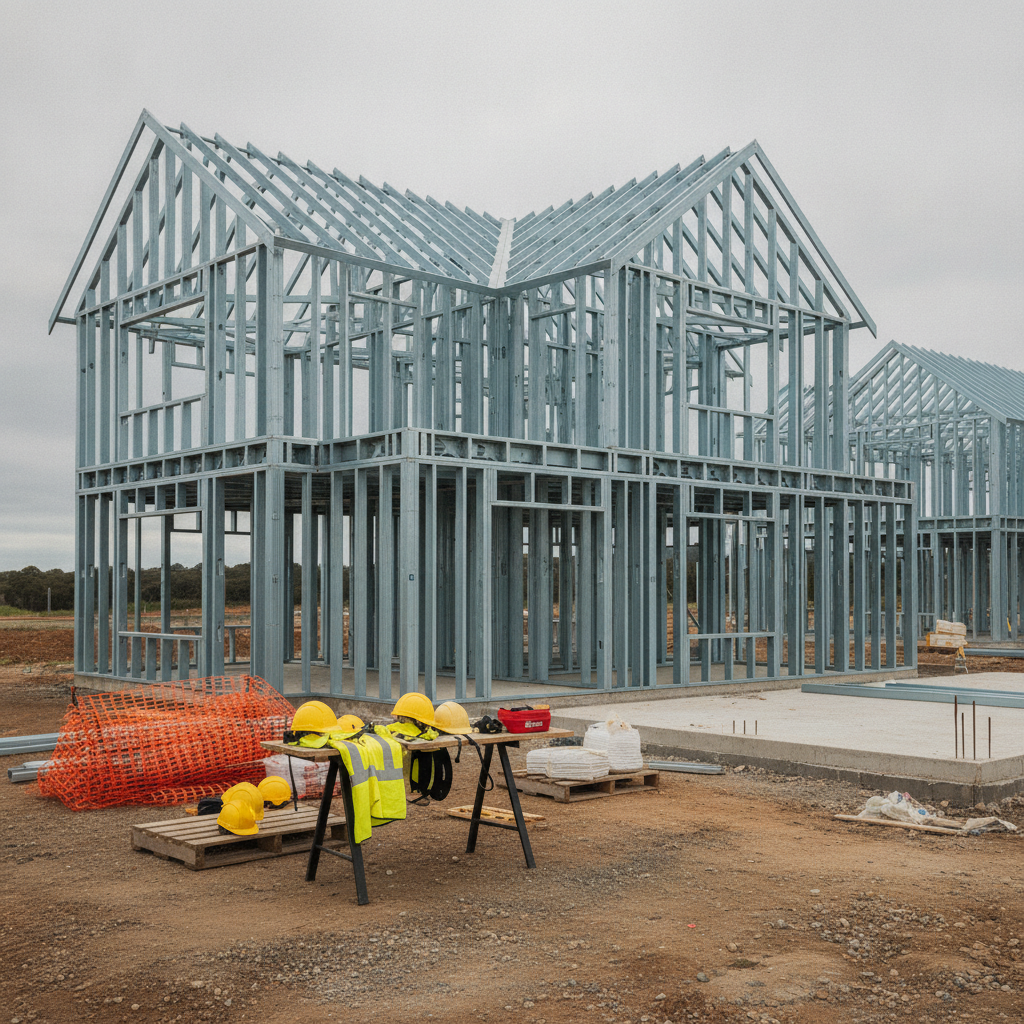
Safely Managing Subcontractors: An Owner-Builder's Guide for Steel Kit Homes
Introduction
Embarking on an owner-builder journey, particularly with a steel frame kit home, is a significant undertaking that offers immense satisfaction and potential cost savings. However, it also brings substantial responsibilities, chief among them being workplace health and safety (WHS). While you might be directly involved in some aspects of the construction, it's inevitable that you'll need to engage various subcontractors for specialised tasks – from pouring the slab to electrical wiring, plumbing, roofing, and painting. As the owner-builder, you assume the primary duty of care for ensuring a safe work environment for everyone on your construction site. This isn't just a moral obligation; it's a legal one with serious repercussions for non-compliance.
This comprehensive guide is meticulously crafted for the Australian owner-builder constructing a steel frame kit home. It aims to demystify the complexities of WHS regulations, providing practical, actionable advice on how to effectively manage subcontractors safely. We'll delve into your specific legal duties under Australian WHS laws, explore the intricacies of state-specific regulations, and offer strategies tailored to the unique characteristics of steel frame construction using products like TRUECORE® steel from BlueScope Steel. Our goal is to equip you with the knowledge and tools necessary to create a safe, compliant, and efficient building site, protecting your workers, your project, and yourself. By understanding and implementing the principles outlined here, you can confidently navigate the challenges of subcontractor management, ensuring your dream home is built not only to specification but also to the highest safety standards.
Understanding the Basics
The Owner-Builder's WHS Responsibilities
As an owner-builder in Australia, the moment you commence construction work, you become a 'Person Conducting a Business or Undertaking' (PCBU) under WHS legislation. While your undertaking might not be commercial in the traditional sense, the law treats you as such for the purpose of workplace safety. This means you have a primary duty of care to ensure, so far as is reasonably practicable, the health and safety of:
- Workers engaged or caused to be engaged by you (your subcontractors).
- Workers whose activities are influenced or directed by you.
- Other persons at the workplace (e.g., visitors, neighbours).
This duty is non-transferable, even if you engage a principal contractor (which is less common for owner-builders but can happen for specific stages). You cannot simply contract out of your WHS obligations. You must actively identify hazards, assess risks, and implement control measures. This includes providing and maintaining a safe work environment, safe systems of work, and appropriate information, instruction, training, and supervision.
WHS Reference: The primary duty of care is outlined in Section 19 of the 'Work Health and Safety Act 2011' (or equivalent state/territory legislation). It states, "A PCBU must ensure, so far as is reasonably practicable, the health and safety of workers, and other persons, so far as relevant, arising from the conduct of the business or undertaking."
What is a Subcontractor in this Context?
A subcontractor is an individual or business that you engage to perform specific work on your project. They are not your employees, but they are 'workers' under WHS law. This distinction is crucial because while they are responsible for their own safe work practices, you, as the PCBU, have an overarching duty to ensure their work environment is safe and that their activities don't pose risks to others. Examples include:
- Earthmovers: Site cut, slab preparation.
- Concreters: Pouring the slab, footings.
- Steel Erectors: Assembling the steel frame (if not done by you).
- Roofers: Installing roofing materials (COLORBOND® steel, insulation).
- Plumbers: Rough-in, fit-off, drainage.
- Electricians: Temporary power, rough-in, fit-off.
- Carpenters: Fixing out, internal framing.
- Wall/Ceiling Liners: Plasterboard installation.
- Painters, Tilers, Cabinet Makers, Landscapers, etc.
Key WHS Terminology
- PCBU (Person Conducting a Business or Undertaking): This is you, the owner-builder.
- Worker: Anyone who carries out work for a PCBU, including employees, contractors, subcontractors, labour hire workers, and even volunteers.
- Hazard: A situation or thing that has the potential to harm a person (e.g., fall from height, live electrical cable, moving machinery, asbestos).
- Risk: The possibility that harm (death, injury or illness) might occur when exposed to a hazard. It considers the likelihood and severity of harm.
- SWMS (Safe Work Method Statement): A document that sets out the high-risk construction work activities to be carried out, the hazards arising from these activities, and the measures to be put in place to control the risks. It must be prepared before high-risk construction work starts.
- SOP (Standard Operating Procedure): Detailed written instructions on how to perform a routine activity safely.
- PPE (Personal Protective Equipment): Equipment worn by workers to minimise exposure to hazards (e.g., hard hats, safety glasses, high-vis vests, steel-capped boots).
- WHS Management Plan: A document outlining how WHS risks will be managed on a construction project. Required for projects costing over $250,000 (or state equivalent).
Australian Regulatory Framework
The National Construction Code (NCC) and WHS
While the primary WHS legislation is state-based, the National Construction Code (NCC) Volume Two (Building Code of Australia - BCA Class 1 and 10 Buildings) contains requirements relating to health and amenity that indirectly influence site safety. For example, specific requirements for structural soundness (NCC 2022 Volume One, H1P1 Structural Reliability; Volume Two, H2P1 Structural Reliability) necessitate safe construction practices. Requirements for safe access (NCC 2022 Volume Two, H4D1 Safe movement) directly impact how you manage access for subcontractors. Furthermore, many Australian Standards referenced in the NCC (e.g., for roofing, scaffolding) also have WHS implications.
NCC Reference: For example, NCC 2022 Volume One, H1P1 refers to the structural reliability of a building, requiring it to withstand actions without loss of serviceability or failure. This implies safe procedures during construction to ensure the final product meets these criteria. Similarly, NCC 2022 Volume Two, H2P1 Structural Reliability for Class 1 and 10 buildings carries similar expectations.
WHS Legislation – State and Territory Specifics
Australia operates under a harmonised WHS framework, meaning all states and territories (except Victoria, which has its own OHS Act) have adopted similar Work Health and Safety Acts and Regulations. However, specific nuances, codes of practice, and enforcement approaches vary. It is absolutely critical to be familiar with the WHS body and legislation in your specific state.
| State/Territory | Regulatory Body | Primary Legislation | Relevant Codes/Guidance (as example) |
|---|---|---|---|
| NSW | SafeWork NSW | Work Health and Safety Act 2011 (NSW) | Code of Practice: Construction Work, Code of Practice: Work Health and Safety Consultation, Co-operation and Co-ordination |
| QLD | Workplace Health and Safety Queensland (WHSQ) | Work Health and Safety Act 2011 (QLD) | Code of Practice: Construction Work, How to Manage Work Health and Safety Risks Code of Practice |
| VIC | WorkSafe Victoria | Occupational Health and Safety Act 2004 (VIC) | Compliance Code: Construction, Compliance Code: Managing the risk of falls at workplaces |
| WA | WorkSafe Western Australia | Work Health and Safety Act 2020 (WA) | Code of Practice: Construction Industry, Code of Practice: Managing falls in the workplace |
| SA | SafeWork SA | Work Health and Safety Act 2012 (SA) | Code of Practice: Construction Work, Work Health and Safety Regulations 2012 |
| TAS | WorkSafe Tasmania | Work Health and Safety Act 2012 (TAS) | Code of Practice: Construction Work, Managing the Risk of Falls at Workplaces |
| ACT | WorkSafe ACT | Work Health and Safety Act 2011 (ACT) | Construction Work Code of Practice, How to Manage Work Health and Safety Risks |
| NT | NT WorkSafe | Work Health and Safety (National Uniform Legislation) Act 2011 (NT) | Construction Work Code of Practice, Falls in the Workplace Code of Practice |
Important Note: You must consult your state's specific WHS Regulations, not just the Act. For example, the
Work Health and Safety Regulation 2017 (NSW)specifies requirements for high-risk construction work, SWMS, and construction induction training (White Cards).
Australian Standards with WHS Implications
Numerous Australian Standards are critical for ensuring safe construction and often have WHS implications, either directly or indirectly by ensuring structural integrity and proper installation, reducing future risks.
- AS/NZS 1170 series: Structural design actions (e.g., wind loads, snow loads) – critical for a structurally sound building, preventing collapse during construction.
- AS 1657: Fixed platforms, walkways, stairways and ladders – design, construction and installation. Guiding safe access.
- AS/NZS 1891 series: Industrial fall-arrest systems and devices (e.g., harnesses, lanyards) – crucial for work at heights.
- AS/NZS 4576: Guidelines for scaffolding – safe erection and dismantling.
- AS/NZS 3000: Electrical installations (known as the 'Wiring Rules') – prevention of electrical hazards.
- AS/NZS 3500: Plumbing and drainage – safe installation to prevent disease, scalding, etc.
- AS/NZS 4024 series: Safety of machinery.
- AS/NZS 4687: Temporary fencing and hoardings.
- AS/NZS 4211: Temporary work platforms.
- AS 2550 series: Cranes, hoists and winches – Safe use.
Professional Tip: Always reference the latest version of these standards. Your builder's insurance will likely require compliance with relevant AS/NZS standards.
High-Risk Construction Work (HRCW)
Certain activities are legally defined as 'High-Risk Construction Work' and require a Safe Work Method Statement (SWMS) before they commence. As the PCBU, you must ensure these SWMS are prepared, understood, and implemented. Examples of HRCW include:
- Work involving a risk of a person falling more than 2 metres (or 3 metres in WA).
- Work on or near energised electrical installations or services.
- Work in a confined space.
- Work on or near a road, railway or shipping lane.
- Work in an area where there is any movement of powered mobile plant.
- Demolition work.
- Work on, in or near asbestos.
- Work that involves structural alteration or repair that requires temporary support/alteration to a structure.
For steel frame kit homes, HRCW is highly likely to include:
- Frame erection: Working at height for top plates, trusses.
- Roofing: Installing purlins, battens, and sheeting (especially COLORBOND® steel for its size).
- Scaffolding erection/dismantling.
- Plumbing/Electrical rough-in: If involving significant work in ceilings/sub-floors at height or with live services.
Step-by-Step Process for Managing Subcontractors Safely
Step 1: Pre-qualification and Selection
This is your first and most crucial line of defence against WHS incidents. Do not engage any subcontractor without thoroughly vetting their safety credentials.
1.1 Obtain Proof of Licencing and Qualifications
- Trade Licences: Confirm they hold current licences for their specific trade (e.g., electrical contractor, plumbing licence). Check with your state's licensing body (e.g., NSW Fair Trading, QBCC in QLD, VBA in VIC).
- WHS Licences/Certifications: For high-risk work (e.g., scaffolding, dogging, rigging, elevated work platforms), ensure individuals hold relevant High-Risk Work Licences.
- Construction Induction Training (White Card): Every person working on a construction site must hold a valid White Card. Request proof for all workers they intend to bring to your site.
1.2 Insurance Verification
- Public Liability Insurance: Essential to cover damage to third-party property or injury to third parties. Minimum coverage typically $10 million or $20 million. Request a Certificate of Currency.
- Workers' Compensation Insurance: If they employ staff, they must have this. If they are a sole trader with no employees, they may not, but should have personal income protection and relevant professional indemnity, especially for design-related work.
1.3 Safety Management System Check (for larger subcontractors)
- Ask for their WHS Policy and any relevant safety procedures. You might not get a full 'system' from a sole trader, but they should at least verbalise their safety approach.
- Discuss their approach to hazard identification and risk control.
1.4 References and Reputation
- Speak to previous clients. Ask about their safety record, communication, and professionalism.
Step 2: Contractual Agreements and WHS Provisions
Your contract is more than just about cost and scope; it's a critical WHS tool.
2.1 Explicit WHS Clauses
- Ensure the contract clearly states that the subcontractor must comply with all relevant WHS legislation, regulations, codes of practice, and Australian Standards.
- Specify that they must provide compliant SWMS for all high-risk work, and that work cannot commence until you've reviewed and accepted them.
- Stipulate their obligation to report all incidents, near misses, and hazards to you immediately.
- Include a clause on providing all necessary PPE for their workers.
- Outline consequences for non-compliance (e.g., suspension of work, contractual penalties).
2.2 WHS Management Plan (for projects over $250,000)
- If your project's total cost exceeds $250,000 (check your state's specific threshold, as it can vary, e.g., $250,000 is common but some states may specify others), you, as the PCBU, must prepare a written WHS Management Plan. This plan must be available to all workers, including subcontractors. It outlines:
- Names of relevant persons (owner-builder, site supervisor if any).
- How work health and safety will be managed (consultation procedures, incident management, site rules).
- Specific arrangements for managing falls, plant, hazardous chemicals, etc.
NCC Reference: While not directly WHS, compliance with relevant structural standards (e.g., AS/NZS 4600 Cold-formed steel structures, AS 4100 Steel structures) is paramount for the integrity of your steel frame kit home. Your structural engineer will ensure the design meets these, but the subcontractor erecting the frame must follow specified methods to maintain this integrity, which is a WHS consideration.
Step 3: Site Induction and Communication
Before anyone starts, they need to know the rules of your site.
3.1 Site-Specific Induction
Conduct a brief but thorough site induction for every new subcontractor and their workers. Cover:
- Site Layout: Entry/exit points, amenities, emergency assembly points.
- Emergency Procedures: Fire extinguishers, first aid kit location, emergency contacts, evacuation plan.
- Known Hazards: Identify any unique hazards specific to your site (e.g., uneven ground, power lines, overhead services, underground services). Show them the location of underground services if you have a dial before you dig report.
- Site-Specific Rules: e.g., no smoking, parking restrictions, specific PPE requirements, designated waste areas.
- Reporting Procedures: How to report hazards, incidents, or near misses.
- Coordination: Explain how different trades will interact and the schedule.
3.2 Consultation and Communication
- Regular Toolboxes/Meetings: Hold brief weekly or fortnightly safety discussions, especially if multiple trades are on site. Discuss upcoming tasks, potential clashes, and any new hazards.
- Open Door Policy: Encourage subcontractors to raise WHS concerns without fear of reprisal.
- Sign-in/Sign-out Register: Maintain a register to know who is on site at all times for emergency purposes.
Step 4: Work Commencement and Monitoring
This is where you actively oversee compliance.
4.1 Reviewing and Approving SWMS
- Before any HRCW begins, review the subcontractor's SWMS. Ensure it lists all relevant hazards, specifies adequate control measures, and is easy to understand. Do not allow work to proceed without a signed, compliant SWMS.
- Keep a copy of all SWMS on site, readily accessible.
4.2 Site Walks and Inspections
- Regularly walk around your site, observing work practices. Look for:
- Workers using correct PPE.
- Scaffolding correctly erected and tagged.
- Tools and equipment in good repair.
- Work areas clean and tidy, free of trip hazards.
- Compliance with SWMS for HRCW.
- Safe distances from power lines (e.g., up to 6.4m from 132kV lines).
- Address any non-compliance immediately. Document issues and actions taken.
4.3 Plant and Equipment Safety
- Ensure any plant or equipment brought to site (e.g., excavators, cranes for lifting TRUECORE® steel frames, elevated work platforms) is inspected, maintained, and operated by licensed, competent persons. Request evidence of plant maintenance logs and operator licences.
- Specifically for steel frame erection: When lifting large steel components, ensure appropriate lifting gear, correctly rated slings, and exclusion zones are in place. Cranes or telehandlers must be operated by licenced personnel.
4.4 Managing Simultaneous Operations (SIMOPS)
When multiple trades are on site, the risk dramatically increases. You must actively coordinate their activities to prevent clashes, for example:
- Plumbers roughing in below scaffolders working above.
- Electricians running cables while roofers are sheeting.
- Painters spray painting near hot work.
- Heavy machinery operating near pedestrians.
Establish clear exclusion zones, staggered work times, or physical barriers.
Step 5: Incident and Emergency Management
Despite best efforts, incidents can occur. Your preparedness is key.
5.1 Incident Reporting and Investigation
- Establish a clear procedure for reporting all incidents, injuries, illnesses, and dangerous occurrences (near miss incidents). This should be part of the site induction.
- Investigate all incidents thoroughly to identify root causes and implement corrective actions to prevent recurrence.
- Notify your state WHS regulator for serious incidents (e.g., fatality, serious injury requiring hospitalisation, or dangerous incident). The timeframes for notification are very strict (usually immediate).
5.2 First Aid
- Ensure a clearly identifiable and stocked first aid kit is available on site, and that at least one person present has current first aid qualifications if possible.
5.3 Emergency Evacuation Plan
- Develop and communicate an emergency evacuation plan for fire, natural disaster, or other emergencies. Designate an assembly point.
Practical Considerations for Kit Homes
Steel Frame Erection (TRUECORE® Steel & BlueScope Specifics)
Kit homes, particularly those with steel frames, come with specific WHS considerations:
- Weight and Size of Components: While lighter than timber frames, steel components can still be long and awkward. Use appropriate lifting techniques and mechanical aids. For larger sections, a crane or telehandler may be required, necessitating a specific lift plan and adherence to AS 2550 series.
- Sharp Edges: Steel framing members, especially at cut points, can have sharp edges. Emphasise the need for cut-resistant gloves.
- Thermal Expansion: While a design consideration, understanding how steel reacts to temperature changes can inform handling and installation schedules, particularly in extreme weather.
- Electrical Conductivity: Steel is highly conductive. Extreme care is required when working near live electrical services. This is especially critical during the installation of roof sheeting (e.g., COLORBOND® steel sheets) near overhead power lines, where the large conductive sheets pose a significant electrocution risk if they contact lines. Always maintain regulated exclusion zones or arrange for power isolation.
- Specific Assembly Instructions: Your kit home supplier (e.g., shed/kit home company using TRUECORE® steel for their frames) will provide detailed assembly instructions. These often include specific sequences and bracing requirements that must be followed for structural integrity, which is a direct WHS consideration. Deviating from these can lead to instability and collapse.
- Temporary Bracing: During the erection of a steel frame, temporary bracing is crucial to maintain stability until all permanent fixings and structural members are in place. Subcontractors must understand and implement these temporary bracing requirements as per the engineering drawings.
Product Reference: TRUECORE® steel frames are engineered for strength and durability. While this contributes to a safe final product, proper handling and installation by skilled trades are essential during construction to realise these benefits safely.
Roofing with COLORBOND® Steel
- Falls from Height: Roofing is inherently high-risk. Ensure roofers have fall protection systems in place (e.g., safety mesh, edge protection, harnesses and anchor points certified to AS/NZS 1891, safety nets).
- Heat: COLORBOND® steel can become extremely hot in direct sunlight. Plan work for cooler parts of the day or ensure adequate hydration and sun protection for workers.
- Slippery Surfaces: Dew or light rain can make COLORBOND® steel roofing incredibly slippery. Work should be ceased in such conditions.
- Cutting and SWMS: Cutting COLORBOND® steel often involves grinders or nibblers, producing hot metal shavings. Ensure appropriate PPE (eye protection, gloves) and fire prevention measures are in place. A SWMS is mandatory for this HRCW.
Managing Site-Specific Risks
- Entry/Exit: Ensure clear, safe paths for vehicles and pedestrians. Separate these where possible.
- Storage: Keep materials neatly stored to prevent trip hazards. Secure materials like steel framing components against wind overtopping or collapse.
- Waste Management: Regular removal of waste is crucial. Designate specific bins for different waste types to maintain a tidy and safe site.
- Weather: Plan for extreme weather, high winds, heavy rain, or extreme heat. Secure unsecured items and cease work if conditions are unsafe.
Cost and Timeline Expectations
Financial Investment in Safety
While seen as an 'extra cost', investing in safety is much cheaper than dealing with an incident. Budget for:
- Site Setup Costs: Temporary fencing (approx. $500 - $2,000 for a standard residential block), clear signage, basic first-aid supplies ($100 - $300).
- WHS Management Plan Development: If you need external help for this, budget $500 - $1,500.
- Safety Equipment Rental/Purchase:
- Scaffolding: $100 - $300 per week per bay (rental, often for multiple bays, can run into thousands for a full house wrap).
- Edge protection: $500 - $2,000 for a typical roof installation.
- Safety netting: $500 - $1,500 depending on size.
- Spotters for heavy machinery/cranes: $50-$80/hour.
- Subcontractor Rates: Generally, reputable, safety-conscious subcontractors might have slightly higher rates as they factor in their own WHS compliance costs (e.g., insurance, training, modern equipment).
- Insurance: Owner-builder construction insurance (including public liability, construction risks, and possibly workers' compensation for employed individuals if applicable) is a non-negotiable cost, typically 0.5% - 2% of total project value, e.g., $2,000 - $8,000 for a $400,000 build.
Warning: Never choose a subcontractor solely on price. Quality and safety record are paramount. An uninsured, non-compliant subcontractor is a ticking financial and legal time bomb.
Time Investment in Safety Management
This is often underestimated by owner-builders.
- Pre-qualification: 2-5 hours per subcontractor (research, calls, document review).
- Contract Drafting: 2-4 hours per contract iteration if customising or getting legal review.
- WHS Plan: 5-15 hours to develop and communicate (for projects over $250k).
- Site Inductions: 30 minutes - 1 hour per subcontractor group.
- SWMS Review: 15-30 minutes per SWMS presented.
- Daily Site Walks/Monitoring: 30 minutes - 1 hour per day when work is active.
- Meetings/Communication: 1-2 hours per week.
- Incident Management: Unpredictable, but can be days of effort.
Totaling these, expect to dedicate a significant portion of your owner-builder management time (10-20% of your total project management time) explicitly to WHS. This is not 'wasted time'; it's core to your role and ensures a smooth, incident-free build.
Common Mistakes to Avoid
1. Assuming Subcontractors 'Know Best'
While trades have expertise, you, as the PCBU, have the overarching responsibility for the site. Don't assume they'll automatically integrate with your site rules or coordinate with other trades. You must actively manage. Your site, your rules.
2. Failing to Verify Licences and Insurance
One of the most frequent and costly mistakes. Unlicensed work can invalidate insurance and lead to fines. Uninsured subcontractors expose you to massive financial risk if an incident occurs.
3. Not Getting a Site-Specific SWMS for High-Risk Work
Generic, templated SWMS delivered without site-specific details are inadequate. Insist on a SWMS that clearly addresses the hazards on your site for the specific task being undertaken. Without a compliant SWMS, you can be fined and held liable if an incident occurs during HRCW.
4. Poor Site Communication and Coordination
Lack of clear communication between trades leads to clashes, near-misses, and rework. Implement a system for daily/weekly briefings, notice boards, and clear task allocations to minimise these risks, especially with the sequential nature of steel frame assembly.
5. Neglecting Housekeeping and Site Tidy-up
A messy site is an unsafe site. Piles of offcuts (steel or timber), tools left lying around, and uneven ground are all trip hazards. Ensure clear pathways and regular waste removal. This is often where owner-builders, juggling many tasks, let standards slip.
6. Ignoring Near Misses
Treat near misses as warnings. They highlight system failures or unsafe practices that could have resulted in injury. Investigate them to prevent actual incidents.
7. Not Enforcing Safety Rules Consistently
Allowing one subcontractor to bypass a safety rule (e.g., not wearing PPE, working outside safety zones) undermines all your safety efforts. Be firm and consistent with all contractors. If rules are breached, issue a warning, and if repeat offences occur, consider removing them from site, as per your contract.
When to Seek Professional Help
Even as an owner-builder, knowing your limits and when to call in experts is a sign of good management. Do not hesitate to seek professional advice in these scenarios:
- WHS Management Plan Development: If your project exceeds your state's threshold for a WHS Management Plan (e.g., $250,000) and you are unsure how to create a compliant one, engage a WHS consultant. Costs might range from $500 to $1,500 depending on complexity.
- Complex High-Risk Work: For highly specialised or complex high-risk activities (e.g., major crane lifts for large, fabricated steel roof trusses, significant excavation in unstable ground), consider engaging a WHS professional to review the SWMS or even oversee the critical phase.
- Legal Advice: If you are unsure about your legal WHS duties, contractual obligations, or need to address a serious incident, consult a lawyer specialising in WHS law. Legal fees can range from $300-$600 per hour.
- Environmental Concerns: If your site has unusual environmental hazards (e.g., contaminated soil, protected flora/fauna requiring specific methodology), environmental consultants can provide guidance.
- Structural Advice Beyond Standard Kit: If you decide to modify your steel frame kit home design in any way – even seemingly minor changes – consult your structural engineer or the kit home supplier's engineer. Any alteration without professional sign-off could compromise structural integrity and vastly increase WHS risks during or after construction. The structural engineering for your TRUECORE® steel frame is designed precisely for your kit, and changes invalidate that design.
- Disputes with Subcontractors over Safety: If a subcontractor persistently refuses to comply with safety requirements, seek legal or WHS consultant advice on how to proceed, including termination procedures if necessary.
Checklists and Resources
Owner-Builder Subcontractor Safety Checklist
Before Engagement:
- Verify current trade licences (state regulator).
- Verify current White Cards for all workers.
- Obtain Certificate of Currency for Public Liability Insurance (min. $10-20M).
- Obtain Certificate of Currency for Workers' Compensation (if they employ staff).
- Request and review WHS Policy/procedures (if applicable).
- Check references for safety record.
- Include specific WHS clauses in the contract.
Site Setup (Initial Phase):
- Have a WHS Management Plan (if project cost > $X, check your state).
- Display clear WHS signage (e.g., 'Warning: Construction Site', PPE required).
- Secure site with appropriate temporary fencing (AS/NZS 4687).
- Establish emergency contacts and procedures.
- Set up a visible, stocked first aid kit.
- Designate emergency assembly point and communicate it.
- Ensure temporary power is safe and compliant (AS/NZS 3000).
During Works:
- Conduct site-specific induction for all new workers.
- Maintain a sign-in/sign-out register.
- Review and approve SWMS for all high-risk construction work (e.g., steel frame erection, roofing).
- Ensure SWMS are on-site and accessible to workers.
- Regularly inspect work areas for hazards and compliance.
- Ensure appropriate PPE is being worn by all workers.
- Ensure plant and equipment are safe, maintained, and operated by licensed personnel.
- Monitor for safe working distances from power lines during frame erection and roofing.
- Coordinate trades to prevent simultaneous operations (SIMOPS) risks.
- Maintain site cleanliness and minimise trip/fall hazards.
- Conduct regular safety discussions/toolbox talks.
- Implement system for incident/hazard reporting.
- Address non-compliance immediately and document actions.
Useful Resources
- State WHS Regulators:
- SafeWork NSW:
www.safework.nsw.gov.au - Workplace Health and Safety Queensland:
www.worksafe.qld.gov.au - WorkSafe Victoria:
www.worksafe.vic.gov.au - WorkSafe Western Australia:
www.commerce.wa.gov.au/worksafe - SafeWork SA:
www.safework.sa.gov.au - WorkSafe Tasmania:
www.worksafe.tas.gov.au - WorkSafe ACT:
www.worksafe.act.gov.au - NT WorkSafe:
www.worksafe.nt.gov.au
- SafeWork NSW:
- Standards Australia:
www.standards.org.au(for purchasing Australian Standards) - Your Kit Home Supplier: They often provide specific handling and installation guides for their steel frames (e.g., TRUECORE® steel products), including safety instructions.
- BlueScope Steel: Provides technical information and safety data sheets for their products like TRUECORE® and COLORBOND® steel:
www.bluescopesteel.com.au - Dial Before You Dig:
www.1100.com.au(Essential for locating underground services before excavation).
Key Takeaways
The role of an owner-builder extends far beyond budgeting and scheduling; it encompasses the critical responsibility of maintaining a safe construction site. For those building steel frame kit homes, this means understanding your PCBU obligations under Australian WHS laws, knowing your state's specific regulations, and rigorously applying safety management principles to every subcontractor you engage. Pre-qualify thoroughly, build WHS into your contracts, conduct robust site inductions, and actively monitor work on site. Be particularly mindful of high-risk tasks common in steel frame and roofing, such as working at heights, managing heavy lifts, and ensuring electrical safety. Your proactive commitment to safety not only protects your workers and prevents costly delays but also safeguards your personal liability. Embrace your responsibilities, seek professional help when needed, and use the resources provided to build your dream home safely and compliantly.
Topics
Share this guide