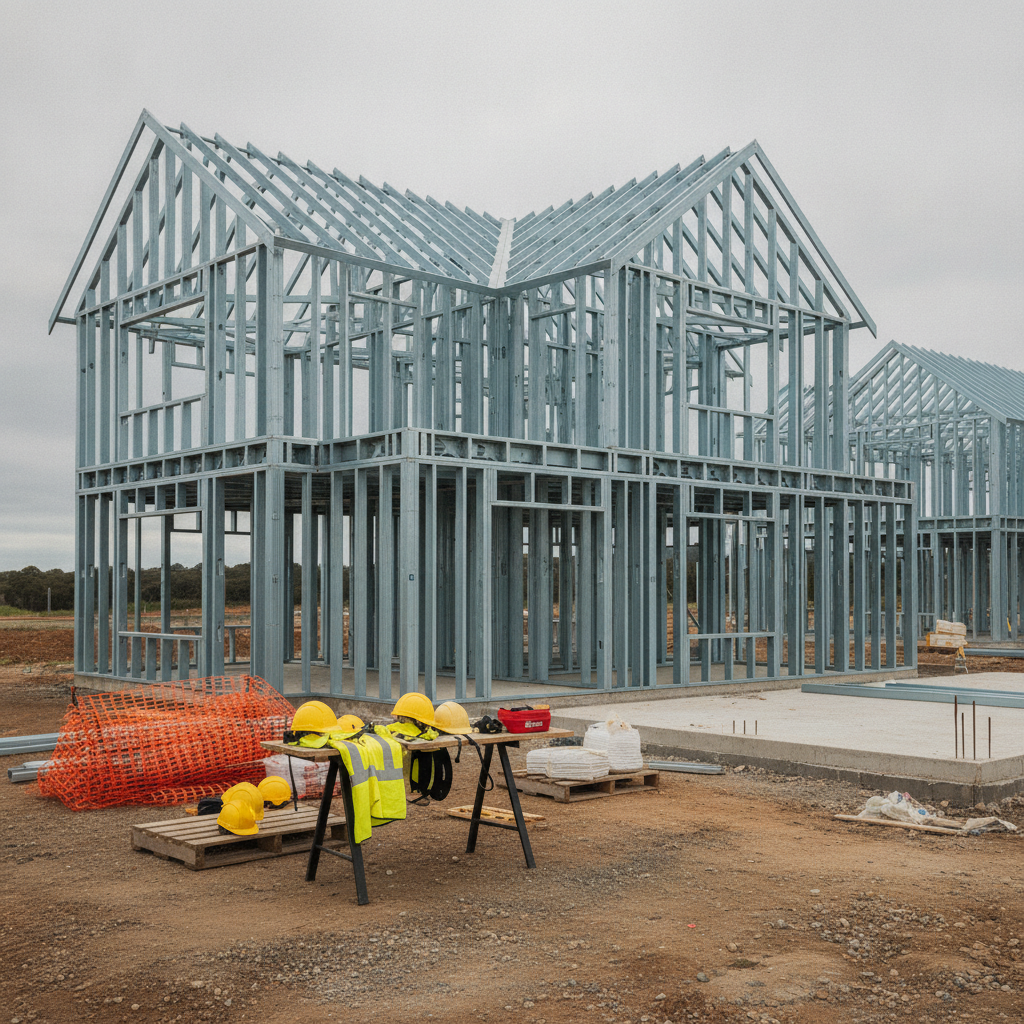
Navigating WHS Obligations for Australian Owner-Builders: A Comprehensive Guide to Building Your Steel Frame Kit Home Safely
1. Introduction
Embarking on the journey of building your own home as an owner-builder in Australia is an incredibly rewarding experience. The dream of a custom-built home, tailored to your family's needs and aspirations, is within reach. For many, a steel frame kit home represents an excellent choice, offering durability, cost-effectiveness, and speed of construction. However, with the excitement of building comes significant responsibility, particularly concerning Work Health and Safety (WHS).
As an owner-builder, you step into the role of the 'Person Conducting a Business or Undertaking' (PCBU) for your construction site. This means you carry the primary duty of care to ensure the health and safety of everyone involved in the build – yourself, your family, friends assisting you, and any tradespeople or contractors you engage. This isn't just a legal formality; it's a moral imperative. A safe site prevents injuries, saves lives, avoids costly delays, and protects your financial investment. Ignoring WHS can lead to severe penalties, devastating accidents, and the complete derailment of your building project.
This comprehensive guide is specifically designed for Australian owner-builders constructing steel frame kit homes. It will demystify your WHS obligations, providing practical, actionable advice that you can implement on your site. We'll break down the legal framework, explain common hazards inherent in steel frame construction, and offer step-by-step guidance to ensure your project is not only successful but, most importantly, safe. Whether you're a first-time builder or have some experience, this guide aims to equip you with the knowledge and confidence to manage WHS effectively, allowing you to focus on bringing your dream home to life safely.
2. Understanding the Basics of Work Health and Safety (WHS)
Before diving into the specifics, it’s crucial to understand the fundamental concepts of WHS in Australia. These principles form the bedrock of your responsibilities as an owner-builder.
What is WHS?
WHS stands for Work Health and Safety. It encompasses the laws, regulations, standards, and practices aimed at protecting the health, safety, and welfare of people at work or affected by work activities. Its primary goal is to prevent harm – injuries, illnesses, and fatalities – in the workplace.
Who is a PCBU? Your Role as an Owner-Builder
In the context of Australian WHS law, a Person Conducting a Business or Undertaking (PCBU) is an individual or organisation that carries out work. As an owner-builder, you are considered a PCBU for your construction site. This means you have the primary duty of care to ensure the health and safety of:
- Yourself
- Your workers (this includes any paid employees)
- Contractors you engage (e.g., plumbers, electricians, concreters)
- Volunteers helping on site (e.g., friends or family)
- Visitors to the site (e.g., inspectors, delivery drivers)
- Anyone else whose health and safety might be affected by the work carried out (e.g., neighbours, passers-by).
This duty is non-transferable. While you can delegate tasks, you cannot delegate your overall responsibility for WHS on your site.
NCC Reference: National Construction Code (NCC) Volume Two, Part 3.0.2 (Performance Requirements for Structure and Construction), mandates that structures must be constructed in a way that safeguards the health and safety of people during construction. While not explicitly a WHS regulation, it underpins the need for safe construction practices.
The Importance of Risk Management
Risk management is a systematic process of identifying, assessing, and controlling risks to health and safety. It's not about eliminating all risks (which is often impossible) but about reducing them to the lowest reasonably practicable level.
The Risk Management Process:
- Identify Hazards: What has the potential to cause harm? (e.g., working at heights, electrical cables, heavy lifting, sharp steel components, operating machinery).
- Assess Risks: How likely is harm to occur, and how severe could it be? (e.g., a fall from 3 metres is high severity, but the likelihood depends on controls).
- Control Risks: What can you do to eliminate or minimise the risks? (This is where the 'Hierarchy of Controls' comes in).
- Review Controls: Are the controls effective? Are new hazards emerging? (WHS is an ongoing process).
Hierarchy of Controls: Your Guiding Principle
When controlling risks, always follow the Hierarchy of Controls, which prioritises control measures from most effective to least effective:
- Elimination: Physically remove the hazard (e.g., don't work at heights if possible, though rarely possible in construction).
- Substitution: Replace the hazard with a safer alternative (e.g., use pre-fabricated components instead of on-site assembly).
- Engineering Controls: Isolate people from the hazard or redesign the work environment (e.g., guard rails, safety nets, scaffolding, mechanical lifting aids).
- Administrative Controls: Implement safe work procedures, training, and signage (e.g., Safe Work Method Statements (SWMS), site inductions, exclusion zones).
- Personal Protective Equipment (PPE): Provide and ensure correct use of safety gear (e.g., hard hats, safety glasses, gloves, steel-capped boots, high-visibility clothing). This is the least effective control and should always be used in conjunction with higher-level controls, not as a standalone solution.
3. Australian Regulatory Framework for WHS
Australia operates under a harmonised WHS legislative framework, though each state and territory maintains its own WHS Act and Regulations. As an owner-builder, understanding this framework is critical.
The Model WHS Laws
The Work Health and Safety Act (the 'model WHS Act') and the Work Health and Safety Regulations (the 'model WHS Regulations') form the basis of WHS laws across most of Australia. These are adopted in varying forms by NSW, QLD, SA, TAS, NT, and the Commonwealth. Victoria and Western Australia have their own distinct (though similar in principle) WHS legislation. The core principle remains consistent: all PCBUs have a duty to ensure health and safety so far as is reasonably practicable.
WHS Act Reference: The primary duty of care is outlined in Section 19 of the model WHS Act for PCBUs. This states, 'A PCBU must ensure, so far as is reasonably practicable, the health and safety of workers and other persons.'
Relevant Australian Standards (AS/NZS)
While not directly legally binding unless referenced in legislation or contracts, Australian Standards provide practical guidance and benchmarks for achieving compliance with WHS laws. Key standards relevant to owner-builders, especially with steel frame kit homes, include:
- AS/NZS 1891 series: Industrial fall-arrest systems and devices – Crucial for working at heights, including harnesses, lanyards, and anchor points.
- AS/NZS 1576 series: Scaffolding – Details requirements for safe design, erection, and use of scaffolding.
- AS/NZS 3012: Electrical installations – Construction and demolition sites – Specifies safety requirements for electrical installations, RCDs, and leads on site.
- AS 2550 series: Cranes, hoists and winches – Safe use – If you use lifting equipment to erect steel frames.
- AS/NZS 45001:2018 Occupational health and safety management systems – Provides a framework for managing WHS, useful for structuring your site safety.
- AS/NZS 1337 series: Personal eye-protection – For safety glasses/goggles.
- AS/NZS 2161 series: Occupational protective gloves – For hand protection, particularly when handling sharp steel.
- AS/NZS 2210 series: Occupational protective footwear – For steel-capped boots.
State-Specific Variations and Regulatory Bodies
It's crucial to understand that while the model WHS laws are harmonised, each state and territory has its own regulatory body responsible for enforcement, and minor legislative differences exist. Always consult your state's specific WHS regulator for the most up-to-date and localised information.
| State/Territory | Regulatory Body | Key Specifics for Owner-Builders |
|---|---|---|
| NSW | SafeWork NSW | Owner-builders require an 'owner-builder permit' for works over $10,000. Comprehensive WHS guidance available. |
| QLD | WorkSafe Queensland | Owner-builders need a permit for work over $11,000. Focus on falls, electrical safety, asbestos. |
| VIC | WorkSafe Victoria | Has its own OHS Act and Regulations. Owner-builders require a Certificate of Consent for works over $16,000. Emphasises 'due diligence'. |
| WA | WorkSafe WA | Has its own WHS Act and Regulations (recently adopted parts of model law). Owner-builder kits and guides available. Permit for works over $20,000. |
| SA | SafeWork SA | Follows model WHS laws. Owner-builder exemption for residential work. Focus on general construction hazards. |
| TAS | WorkSafe Tasmania | Follows model WHS laws. Owner-builder permit required for work over $20,000. Specific advice on managing contractors. |
| ACT | WorkSafe ACT | Follows model WHS laws. Owner-builder licence required for works over $20,000. |
| NT | NT WorkSafe | Follows model WHS laws. Owner-builder permit for works over $12,000. |
Action Point: Regardless of your state, your first step should be to visit your state's WHS regulator website. They provide specific owner-builder guides, checklists, and forms that are essential for compliance.
4. Step-by-Step Process for WHS Compliance on Your Site
Managing WHS on your steel frame kit home build can be broken down into manageable steps, from initial planning to project completion.
Step 1: Planning and Preparation (Before Breaking Ground)
This is the most critical phase for WHS. Good planning prevents most accidents.
1.1 Obtain Necessary Permits and Understand Responsibilities
- Secure your owner-builder permit/licence from your state regulator. Understand the specific WHS duties outlined for owner-builders in your state's legislation.
- Familiarise yourself with the NCC and any local council requirements for site management and safety.
1.2 Develop a Site-Specific WHS Management Plan
While a formal, complex WHS Management Plan (WHSMP) might seem daunting, for an owner-builder, it can be a simplified document. It should outline:
- Your WHS policy (a simple statement of commitment to safety).
- Roles and responsibilities (who does what).
- Risk management procedures (how you will identify, assess, and control risks).
- Emergency procedures (evacuation, first aid, fire).
- Incident reporting process.
- Site rules and induction process.
- Consultation arrangements (how you'll talk to workers/volunteers about safety).
1.3 Conduct a Thorough Site Hazard Identification and Risk Assessment
Walk your block before construction begins. Identify potential hazards specific to your site and the kit home process.
- External Hazards: Power lines, gas pipes, easements, access roads, neighbours, natural hazards (slopes, trees, water), weather.
- Internal Hazards (pre-construction): Existing structures, vegetation, uneven ground, buried services.
- Construction Process Hazards:
- Delivery & Storage of Steel (TRUECORE®/BlueScope Steel): Heavy lifts, sharp edges, unstable stacks, access for large trucks.
- Erection of Steel Frame: Working at heights, manual handling of large/heavy components, bracing, use of cranes/lifting equipment, wind.
- Other common construction hazards: Falls, excavation, electrical, plant and equipment, hazardous materials (e.g., glues, paints, solvents).
1.4 Develop Safe Work Method Statements (SWMS) for High-Risk Activities
For any high-risk construction work (e.g., working at heights over 2m, excavation over 1.5m deep, use of powered mobile plant like cranes, demolition, working near electrical services), you must prepare a SWMS. This document details:
- The high-risk activity.
- The hazards associated with it.
- The risks to health and safety.
- The control measures to be implemented.
- How the control measures will be implemented, monitored, and reviewed.
WHS Regulations Reference: The requirement for SWMS for high-risk construction work is outlined in Part 6.3 of the model WHS Regulations.
1.5 Procure Essential Safety Equipment and PPE
Before anyone sets foot on site for work, ensure you have:
- Site Safety: Fencing, lockable gates, warning signs, first aid kit, fire extinguisher, spill kit, temporary power board (with RCDs), adequate lighting, safe access/egress.
- Personal Protective Equipment (PPE): Hard hats, safety glasses/goggles, hearing protection, high-visibility clothing, steel-capped boots, work gloves (especially critical for handling steel), sun protection (hat, sunscreen).
- Height Safety Equipment: If working at heights, consider scaffolding, safety nets, harnesses, lanyards, and anchor points compliant with AS/NZS 1891 series and AS/NZS 1576 series.
1.6 Plan for Emergency Procedures
Develop a clear plan for what to do in an emergency:
- Emergency contact numbers (000, doctor, hospital).
- Location of first aid kit and trained first aider.
- Evacuation points and procedures.
- Assembly points.
- Location of fire extinguishers.
- Identify nearest medical facility.
Step 2: Implementation and Ongoing Management (During Construction)
2.1 Site Induction for Everyone
Every person who enters your construction site for work purposes (including you, volunteers, and contractors) must receive a site induction. This induction should cover:
- Site rules (speed limits, no alcohol/drugs, no children/unauthorised access).
- Emergency procedures.
- Location of first aid, amenities, and fire fighting equipment.
- Known hazards and their controls.
- Use of PPE.
- Reporting incidents and hazards.
- Specific risks associated with steel frame construction.
Record attendance and key information covered.
2.2 Implement and Monitor Control Measures
- Ensure SWMS are understood and followed for high-risk activities.
- Regularly inspect equipment (tools, ladders, scaffolding, electrical leads) for damage.
- Maintain clear and tidy workspaces. Keep access ways free of obstructions.
- Secure tools and materials at the end of each day or shift, especially loose steel components that could be a hazard in wind.
- Supervise workers and volunteers to ensure they are working safely and using PPE correctly.
2.3 Managing Steel Frame Kit Home Specific Hazards
- Delivery & Storage: Ensure safe offloading (use of forklifts/cranes if components are heavy, ensuring clear ground). Store TRUECORE® steel components on level ground, supported to prevent warping and clearly marked. Secure stacks to prevent toppling. Ensure adequate access for delivery and egress for traffic. Wear appropriate gloves and long sleeves when handling to prevent cuts from sharp edges.
- Erection of Frame:
- Working at Heights: This is the most significant risk. Utilise scaffolding (AS/NZS 1576 compliant), elevated work platforms, or fall arrest systems (AS/NZS 1891 compliant) when erecting walls and roof trusses. Never work unprotected at heights. Always ensure anchor points for fall arrest systems are certified.
- Manual Handling: Steel members can be long and cumbersome. Plan lifts. Use mechanical aids (e.g., genie lifts, block and tackle, small cranes like 'mini crawlers') where possible. Ensure adequate personnel for manual lifting and use proper lifting techniques to prevent sprains and strains.
- Bracing & Stability: During erection, steel frames are particularly susceptible to wind forces until fully braced and secured. Follow manufacturer's (e.g., BlueScope Steel's engineering) specifications for temporary and permanent bracing to prevent collapse during construction. Never leave an unbraced frame unattended.
- Sharp Edges: Steel framing, particularly from a kit, can have sharp edges. Emphasise cut-resistant gloves and appropriate clothing.
- Weather: Wind can make erecting lightweight steel frames extremely dangerous. Do not attempt erection in high winds. Rain can make surfaces slippery.
2.4 Incident Reporting and Investigation
- Any incident, no matter how minor (even a 'near miss' where no injury occurred but could have), must be reported. This helps identify new hazards and prevent recurrence.
- Serious incidents (e.g., fatality, serious injury requiring hospitalisation, dangerous incident) must be immediately reported to your state WHS regulator. Do not disturb the site of a serious incident until authorised by the regulator, unless necessary to save a life or prevent further injury.
Step 3: Completion and Handover
3.1 Final Site Clean-up and Demobilisation
- Ensure all tools, equipment, and waste are removed safely. Dispose of construction waste responsibly and legally.
- Remove all temporary structures (scaffolding, temporary fencing) carefully and safely.
3.2 Documentation and Records
Maintain records of:
- Owner-builder permits.
- WHS Management Plan/risk assessments.
- SWMS.
- Site inductions (signed).
- Equipment inspection records.
- Incident reports.
- Any WHS training undertaken.
These records demonstrate your due diligence and compliance.
5. Practical Considerations for Steel Frame Kit Homes
Building with a steel frame kit home presents unique WHS aspects that owner-builders must specifically address.
Material Handling and Storage
TRUECORE® steel components are lightweight yet strong, but their length and sometimes sharp edges require careful handling. Delivery drivers often use forklifts or cranes. Ensure your site has clear, level access for large vehicles and space for offloading. Store steel components elevated off the ground to prevent moisture damage and clearly marked to avoid confusion. Secure bundles against wind and to prevent accidental dislodgement.
Working at Heights during Frame Erection
Erecting steel wall frames and roof trusses is a primary height safety risk. Unlike timber frames, which can sometimes be partially assembled on the ground, steel frames often need more careful lifting and connection at height. Plan your fall protection meticulously. This might involve:
- Scaffolding: Investing in or hiring scaffolding (AS/NZS 1576 compliant) is highly recommended for working around the perimeter of the frame. Ensure it's erected by competent persons.
- Safety Nets: Can be installed below working areas to catch falls, providing a passive safety measure.
- Elevated Work Platforms (EWPs): Scissor lifts or boom lifts can provide a stable and safe platform for working at various heights, particularly for roof truss installation. Operators must have the appropriate 'High Risk Work Licence' (e.g., WP for boom lifts).
- Temporary Fall Protection: Use guard rails or edge protection where possible. For internal work on the frame, consider safety mesh or temporary flooring.
- Personal Fall Arrest Systems: Harnesses, lanyards, and anchor points should only be used where other controls are not reasonably practicable, and only as part of a comprehensive system (AS/NZS 1891 series). Ensure anchor points are rated correctly.
Manual Handling and Lifting
Even though steel framing members are lighter than traditional timber, their length and bulk can still pose manual handling risks. Consider using mechanical aids for lifting wall frames or roof trusses into position. For example, a small crane (e.g., a 'mini crawler' or 'franna crane') can significantly reduce the risk of injury during erection. If manual lifting is unavoidable, ensure you have sufficient personnel, conduct a risk assessment, and provide instruction on proper lifting techniques.
Temporary Bracing and Stability
Steel frames, particularly the roof structure, are very susceptible to wind loads during erection until all bracing and fixings are complete. Always follow the engineer's or kit home supplier's (e.g., BlueScope Steel's TRUECORE® engineering guidance) specifications for temporary bracing. Never leave an incomplete or unbraced structure unsecured overnight or during periods of high wind. A sudden collapse can be catastrophic.
Managing Power Tools and Electrical Safety
Construction sites are inherently dangerous for electrical hazards. Ensure all electrical equipment (power tools, extension leads, temporary power boards) is regularly inspected, tested and tagged by a competent person (AS/NZS 3760). All power must be supplied through Residual Current Devices (RCDs) – safety switches. Never use damaged leads or equipment. Always disconnect power when working on electrical components or before making adjustments to tools.
6. Cost and Timeline Expectations for WHS Compliance
Implementing robust WHS practices requires both financial investment and time. It's not an optional extra; it's an integral part of your budget and schedule.
Financial Costs (Estimates in AUD)
These are approximate costs and can vary significantly based on location, quality, and hiring vs. buying.
| Item | Estimated Cost Range (AUD) | Notes |
|---|---|---|
| Owner-Builder Permit/License Fee | $200 - $1,500 | State-dependent. |
| First Aid Kit (Construction-grade) | $100 - $300 | Essential for any site. |
| Fire Extinguisher (min. 4.5kg ABE) | $50 - $150 | Required. |
| Temporary Site Fencing (hire) | $50 - $150 per week | Crucial for securing the site and public safety. |
| Safety Signage | $50 - $200 | 'Danger - Construction Site', 'PPE Must Be Worn', 'First Aid'. |
| Basic PPE (per person) | $150 - $400 | Hard hat, glasses, gloves, hi-vis, steel-caps. Budget for replacements. |
| Scaffold Hire (basic setup) | $300 - $800 per week | For initial frame erection and roofing. Long-term projects may buy. |
| Elevated Work Platform (EWP) Hire | $300 - $600 per day | For specific high-reach tasks (e.g., truss installation). Requires licensed operator. |
| Fall Arrest System Components | $500 - $2,000+ | Harness, lanyard, anchor points (can often be hired). |
| RCD Protected Temporary Power Board | $200 - $500 | Essential for electrical safety. |
| Test and Tag Services (electrical) | $5 - $10 per item | Annual/biannual testing of tools/leads. |
| WHS Consultant (for advice/plan) | $150 - $300 per hour | For complex sites or specific advice (e.g., SWMS development assistance). |
| Safety Training (e.g., White Card) | $50 - $200 | White Card (required for all construction workers in Australia). |
| Total Estimated WHS Budget | $2,000 - $10,000+ | This should be factored into your overall build budget. |
Timeline Expectations
Allocating time for WHS is crucial and must be integrated into your project schedule:
- Pre-Construction (1-4 weeks): Significant time for WHS planning, permit applications, site hazard identification, WHS plan development, procuring safety equipment, and completing White Card training. This phase is critical for setting up a safe site.
- Ongoing During Construction (daily/weekly): Daily site inspections, toolbox talks, reviewing SWMS, monitoring compliance, maintaining PPE, keeping records. This is an ongoing commitment taking regular small blocks of time.
- Specific Tasks (hours/days): Developing specific SWMS for high-risk activities, conducting safety briefings for new contractors/volunteers, incident investigations.
Realistic Expectation: Do not underestimate the time commitment to WHS. It is not something you do once and forget. It's a continuous process that will consume a small but vital portion of your daily project management efforts. Skimping on time here directly increases risk.
7. Common WHS Mistakes for Owner-Builders to Avoid
Many owner-builders, despite good intentions, make similar WHS errors. Being aware of these pitfalls can help you avoid them.
- Lack of Formal Site Induction: Assuming everyone (especially friends/family) knows the hazards and rules. Even experienced trades need to be inducted into your specific site rules and emergency procedures. This is a common and serious oversight.
- Inadequate or Non-Existent Risk Assessments: Skipping the process of identifying hazards and assessing risks before starting a task. This leads to reactive safety measures rather than proactive prevention. Forgetting to re-assess risks when conditions change (e.g., weather, new equipment).
- Over-reliance on PPE: Treating PPE as the primary control measure. Remember the Hierarchy of Controls – PPE is the last line of defence. Forgetting to provide appropriate PPE (e.g., regular gloves instead of cut-resistant gloves for steel handling) or failing to ensure it's worn correctly.
- Neglecting Temporary Bracing for Steel Frames: During erection, particularly for roof trusses, steel frames are vulnerable to wind. Omitting or using insufficient temporary bracing (contrary to engineering advice) is a critical error that can lead to catastrophic collapse.
- Ignoring Minor Incidents and Near Misses: Dismissing a cut, a trip, or a falling object as 'just one of those things.' These are valuable indicators of underlying hazards that, if addressed, can prevent a more serious incident later. Report and investigate all incidents.
- Uncontrolled Access to Site: Allowing children, pets, or unauthorised visitors onto an active construction site. Construction sites are inherently dangerous environments. Maintain secure fencing and locked gates outside of working hours.
- Poor Housekeeping: A cluttered site with tools left lying around, offcuts, and uneven ground is a breeding ground for trips, falls, and other injuries. Regular clean-ups are not just about aesthetics; they're fundamental to safety.
8. When to Seek Professional Help
As an owner-builder, you're expected to manage many aspects of the build, but there are clear instances where professional WHS or construction expertise is not just advisable, but legally required or crucial for safety.
- High-Risk Work (HRW) Licences: Any task requiring a High Risk Work Licence (e.g., operating cranes, forklifts, scaffolding over a certain height, dogging/rigging) must be performed by a person holding that licence. If you don't have one, you must engage a licensed professional.
- Complex Risk Assessments & SWMS: While you can draft basic SWMS, for particularly complex or unusual high-risk activities, consulting a WHS professional can ensure your SWMS are robust and compliant. They can help you identify subtle risks you might miss.
- Scaffolding Erection: For complex or high scaffolding (typically over 4m), it must be erected, altered, and dismantled by a licensed scaffolder. For simpler scaffolding, ensure it complies with AS/NZS 1576 and is signed off as safe by a competent person before use.
- Electrical Work: All permanent electrical installations and complex temporary wiring must be carried out by a licensed electrician. Never attempt electrical work yourself unless you are a qualified and licensed electrician.
- Structural Engineering Advice: While your kit home will come with structural engineering, any modifications, unforeseen ground conditions, or concerns about structural integrity (especially during the erection of steel frames) should be immediately referred to a qualified structural engineer.
- Asbestos Removal: If you encounter asbestos (especially in existing structures on your site), always engage a licensed asbestos removalist. Never attempt to remove asbestos yourself.
- Confined Spaces / Excavations: For deep excavations, trenches with potential for collapse, or work in confined spaces, specialist advice and adherence to strict WHS procedures are paramount. Often, licensed professionals or specific permits are required.
- General WHS Guidance: If you feel overwhelmed or unsure about your WHS obligations, a WHS consultant can provide invaluable guidance, help you develop your WHS plan, and conduct site inspections.
Key Advice: Don't be afraid to ask for help or engage professionals. It's far better to invest in expert advice than to face the consequences of an accident or non-compliance. Your primary duty as a PCBU is to ensure safety, and sometimes that means knowing when to defer to those with specialised skills.
9. Checklists and Resources
Here are some actionable checklists and useful resources to help you manage WHS effectively on your steel frame kit home build.
Owner-Builder WHS Pre-Construction Checklist
- Obtain Owner-Builder Permit/Licence (State regulator).
- Complete White Card training (for yourself and any paid workers).
- Draft Site-Specific WHS Management Plan (even if simplified).
- Conduct Initial Site Hazard Identification and Risk Assessment.
- Develop SWMS for anticipated high-risk activities (e.g., working at heights, crane use).
- Procure essential PPE (hard hats, safety glasses, gloves, hi-vis, steel-caps).
- Secure Site Fencing and Lockable Gates.
- Prepare Emergency Procedures (contact list, first aid location, evacuation points).
- Purchase/hire First Aid Kit, Fire Extinguisher, and RCD-protected power board.
- Ensure temporary power is safe and tested.
- Plan for safe delivery and storage of steel frame components.
Daily/Weekly Site Safety Checklist
- Conduct brief pre-start meeting/toolbox talk with everyone on site.
- Review current tasks for new or changed hazards.
- Check all personnel are wearing correct PPE.
- Inspect access ways for obstructions/trip hazards.
- Verify scaffolding/ladders are stable and safe for use.
- Check power tools and leads for damage; ensure RCDs are working.
- Ensure temporary bracing on steel frame is adequate for current stage and weather.
- Secure loose materials and tools at day's end.
- Conduct general site clean-up.
- Address any reported hazards or near misses promptly.
Emergency Contact Information (Template)
| Service | Number | Location/Notes |
|---|---|---|
| Emergency | 000 | Police, Fire, Ambulance |
| Nearest Hospital | Address: | |
| Doctor/Medical | Name: | |
| Poison Control | 13 11 26 | |
| Local Council | For site access, noise complaints | |
| Kit Home Supplier | For structural queries (e.g., BlueScope Steel) | |
| WHS Regulator | See specific state contact below |
Useful Resources
- Safe Work Australia: Your national body for WHS policy. Provides model WHS laws, codes of practice, and guides. (www.safeworkaustralia.gov.au)
- State WHS Regulators:
- SafeWork NSW: www.safework.nsw.gov.au
- WorkSafe Queensland: www.worksafe.qld.gov.au
- WorkSafe Victoria: www.worksafe.vic.gov.au
- WorkSafe WA: www.commerce.wa.gov.au/worksafe
- SafeWork SA: www.safework.sa.gov.au
- WorkSafe Tasmania: www.worksafe.tas.gov.au
- WorkSafe ACT: www.worksafe.act.gov.au
- NT WorkSafe: www.worksafe.nt.gov.au
- Master Builders Australia / Housing Industry Association (HIA): Industry bodies often provide WHS resources and training for owner-builders.
- BlueScope Steel / TRUECORE®: Their websites often provide technical information and installation guides for their products, which implicitly include safety considerations. Consult these for specific handling and erection instructions for your steel kit.
10. Key Takeaways
Your role as an owner-builder is immensely rewarding, but it comes with a non-negotiable responsibility for Work Health and Safety. You are the PCBU, and your primary duty is to ensure the safety of everyone on your site. Proactive WHS planning, meticulous risk management, and strict adherence to the Hierarchy of Controls are not just legal requirements but fundamental to a successful and injury-free build. Embrace these obligations, invest in necessary safety measures, and don't hesitate to seek professional help when needed. By prioritising WHS, you protect lives, your investment, and ensure your steel frame kit home dream becomes a safe and happy reality.
Topics
Share this guide