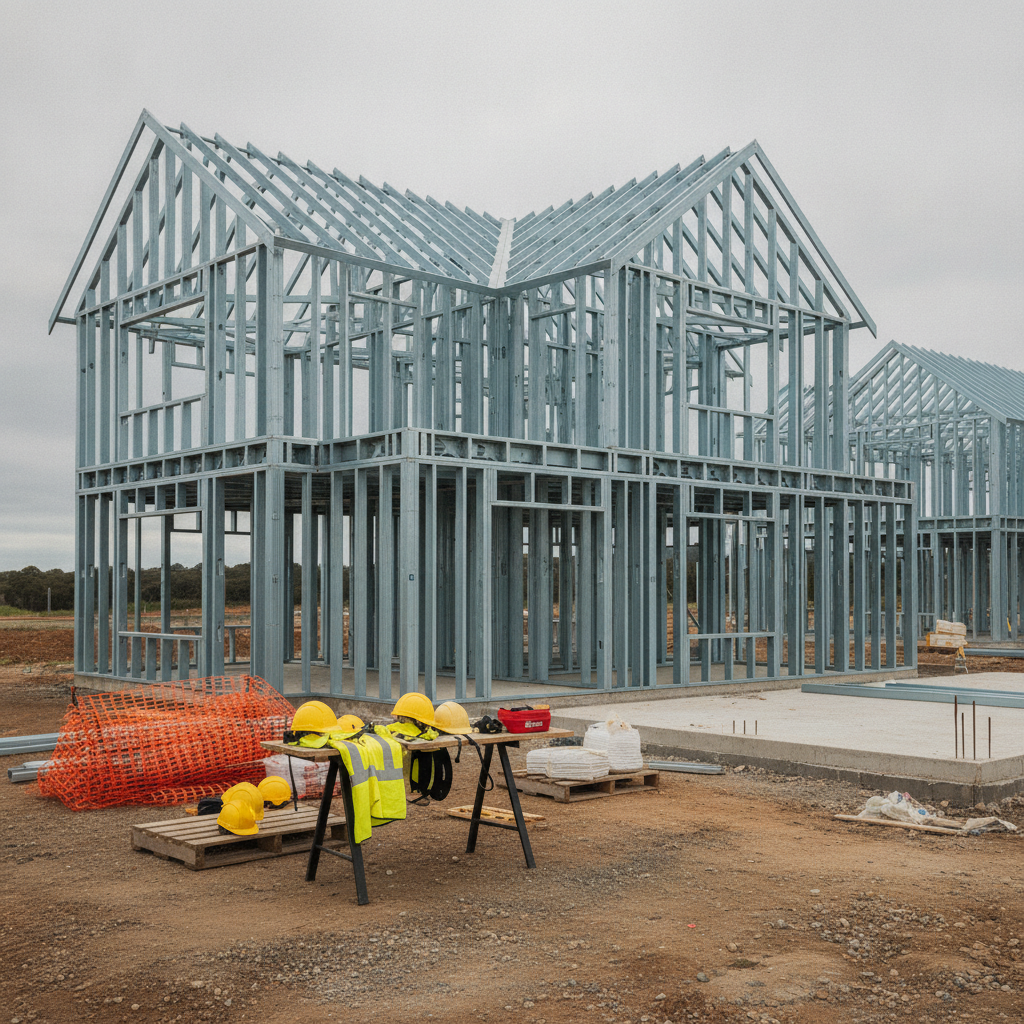
WHS Obligations for Owner-Builders in Steel Frame Kit Homes: A Comprehensive Guide
1. Introduction
Welcome, aspiring owner-builder! Embarking on the journey of constructing your own home, particularly a steel frame kit home, is an ambitious and rewarding undertaking. As an owner-builder, you're not just a project manager; you're also the primary controller of the worksite, which brings with it significant legal and moral responsibilities, especially concerning Work Health and Safety (WHS), often referred to as Occupational Health and Safety (OHS) in some states. This guide is specifically designed to equip you with the knowledge and confidence to meet your WHS obligations, ensuring a safe environment for everyone involved in your steel frame kit home project.
Building your own home offers unparalleled control over design, quality, and cost. However, this freedom comes with the duties typically shouldered by a professional builder. The Australian WHS framework is robust, and ignorance of the law is never an excuse. Failing to adhere to WHS regulations can result in severe penalties, including hefty fines and even imprisonment, not to mention the potential for serious injuries or fatalities on your site. This is not meant to scare you, but to impress upon you the importance of understanding and diligently applying WHS principles from day one.
This comprehensive guide will break down your WHS responsibilities, explaining general principles, specific requirements for steel frame kit homes (including those utilising products like TRUECORE® steel), and state-specific variations across Australia (NSW, QLD, VIC, WA, SA, TAS). We’ll cover everything from site inductions and risk assessments to safe work methods and emergency procedures. By the end of this guide, you will have a clear roadmap to create a compliant and safe building site, protecting yourself, your family, your volunteers, and any contractors you engage. This guide is written for beginner owner-builders, assuming no prior WHS knowledge, and aims to be both informative and empowering.
2. Understanding the Basics
Before delving into the specifics, let's establish a foundational understanding of key WHS concepts. As an owner-builder, you are considered a 'person conducting a business or undertaking' (PCBU) under WHS legislation in most Australian jurisdictions. This designation carries significant responsibilities.
2.1 What is WHS?
WHS stands for Work Health and Safety. It’s a legislative framework designed to protect the health, safety, and welfare of all workers and others who might be affected by work carried out on your site. This includes you, your family helping out, volunteers, and any contractors or subcontractors you engage. In Victoria, the term OHS (Occupational Health and Safety) is primarily used, but the principles and objectives are largely the same.
2.2 The Primary Duty of Care
Under the Work Health and Safety Act 2011 (Cth) (which forms the basis for state-specific WHS Acts in NSW, QLD, SA, TAS, ACT, NT), your primary duty of care as a PCBU is to ensure, so far as is reasonably practicable, the health and safety of:
- workers engaged, or caused to be engaged by your business or undertaking;
- workers whose activities are influenced or directed by you;
- other persons at the workplace.
'Reasonably practicable' means doing what is reasonably able to be done in the circumstances to eliminate or minimise risks to health and safety, considering factors like:
- The likelihood of the hazard or risk occurring.
- The degree of harm that might result from the hazard or risk.
- What you know, or ought reasonably to know, about the hazard or risk and ways of eliminating or minimising it.
- The availability and suitability of ways to eliminate or minimise the risk.
- The cost of eliminating or minimising the risk (this is always the last factor to consider and should not be used as an excuse to avoid necessary safety measures).
2.3 Key WHS Terminology
- PCBU (Person Conducting a Business or Undertaking): As an owner-builder, you are considered a PCBU. This is a broad concept covering any person (whether an individual, partnership, or company) who carries out work.
- Worker: This includes employees, contractors, subcontractors, apprentices, trainees, volunteers, and even people doing work experience. Importantly, it includes YOU and anyone helping you on your site.
- Workplace: Any place where a worker goes, or is likely to go, while at work, including your building site.
- Hazard: Something with the potential to cause harm (e.g., a trench, exposed wiring, a heavy steel component).
- Risk: The likelihood that a hazard will cause harm and the severity of that harm (e.g., a low likelihood of a trench collapsing but high severity if it does).
- SWMS (Safe Work Method Statement): A document that sets out the high-risk construction work activities to be carried out, the hazards arising from these activities, and the measures to be put in place to control the risks. Mandatory for identified high-risk activities.
2.4 The Hierarchy of Control
This is a fundamental principle in WHS for managing risks. It outlines the most effective to least effective ways to control hazards:
- Elimination: Physically remove the hazard (e.g., don't use a toxic chemical). This is the best option.
- Substitution: Replace the hazard with a safer alternative (e.g., use a non-toxic paint). For steel frames, this might involve using pre-fabricated, engineered components to minimise on-site cutting.
- Engineering Controls: Isolate people from the hazard or redesign the work environment (e.g., build a fence around a trench, use mechanical lifting aids for heavy steel beams, install guardrails for fall protection).
- Administrative Controls: Implement work procedures or safe work methods (e.g., signage, training, SWMS, rotating tasks to reduce exposure).
- Personal Protective Equipment (PPE): Provide individuals with equipment to protect them from the hazard (e.g., safety glasses, hard hats, gloves, hi-vis clothing, steel-capped boots). This is the least effective control and should only be used in conjunction with higher-level controls, or as a last resort.
As an owner-builder, you must always strive to use controls higher up the hierarchy wherever reasonably practicable.
3. Australian Regulatory Framework
The WHS landscape in Australia is primarily governed by state and territory legislation, all harmonised to varying degrees with the national model WHS Act. The National Construction Code (NCC) also plays a critical role, particularly in setting minimum performance requirements for health and safety in buildings themselves.
3.1 National Construction Code (NCC)
The National Construction Code (NCC), specifically Volume Two (Building Code of Australia – BCA Class 1 and 10 Buildings), sets out the minimum performance requirements for the design and construction of your kit home. While the NCC generally focuses on the safety of the finished building, it underpins safe construction practices by dictating standards for structural integrity, fire safety, access, and egress. For owner-builders, understanding the NCC requirements ensures that the safe work methods adopted contribute to a safe and compliant finished structure.
- NCC 2022, Volume Two, Part H1 (Structural Provisions): This section dictates the structural performance requirements, which directly impacts the safe handling and installation of steel framing components. Incorrect handling or installation could compromise structural integrity, creating a future hazard.
- NCC 2022, Volume Two, Part 3.5 (Structural Design and Construction): This general section refers to Australian Standards like AS/NZS 1170 series (Structural design actions) which are critical for engineers designing your steel frame.
3.2 Key Australian Standards (AS/NZS)
Australian Standards are crucial for ensuring safe work practices and the quality of materials. For steel frame kit homes, several standards are particularly relevant:
- AS/NZS 4600:2018 - Cold-formed steel structures: This standard covers the design of cold-formed steel structural members and connections, essential for the integrity of your steel frame kit home. Your kit home supplier's engineer will design to this, but safe installation practices must respect these design assumptions.
- AS/NZS 1170.x series (Structural Design Actions): These standards specify design loads for buildings (e.g., wind, snow, earthquake, dead and live loads). Understanding the wind loads (AS/NZS 1170.2) is critical for temporary bracing during the erection of steel frames, especially in cyclonic regions.
- AS/NZS 1554.1:2014 - Structural steel welding (Part 1: Welding of steel structures): If any on-site welding is required, this standard dictates the procedures. Note: Most kit homes are bolted, not welded on site.
- AS 1418.x series (Cranes, hoists and winches): If you use a crane for lifting heavy steel members (e.g., roof trusses), the operation must comply with these standards, and the operator must be suitably licensed.
- AS 1657:2018 - Fixed platforms, walkways, stairways and ladders – Design, construction and installation: Relevant for safe access and working at height.
- AS/NZS 1891.x series (Industrial fall-arrest systems and devices): Essential for working at height, covering harnesses, lanyards, and anchor points.
- AS/NZS 1668.2:2012 - The use of ventilation and air conditioning in buildings - Part 2: Mechanical ventilation for acceptability of indoor air quality: While seemingly unrelated, poor ventilation during painting or using chemicals can pose WHS risks.
3.3 State-Specific Variations & Regulatory Bodies
While the model WHS Act provides a harmonised framework, each state and territory has its own WHS legislation and regulatory body. Owner-builders must be aware of their specific state's requirements.
New South Wales (NSW):
- Regulatory Body: SafeWork NSW
- Legislation: Work Health and Safety Act 2011 (NSW), Work Health and Safety Regulation 2017 (NSW)
- Key specific: Owner-builders must apply for an owner-builder permit from NSW Fair Trading for homes over $10,000. Under clause 22 of the WHS Regulation, owner-builders undertaking construction work that totals $250,000 or more in value must notify SafeWork NSW.
Queensland (QLD):
- Regulatory Body: Workplace Health and Safety Queensland (WHSQ)
- Legislation: Work Health and Safety Act 2011 (Qld), Work Health and Safety Regulation 2011 (Qld)
- Key specific: Similar to NSW, owner-builders typically need to obtain an owner-builder permit from the Queensland Building and Construction Commission (QBCC). Construction work with a contract price of $250,000 or more (or if the fair market value of the work is $2 million or more) requires specific WHS notification to WHSQ to be considered a 'construction project'.
Victoria (VIC):
- Regulatory Body: WorkSafe Victoria
- Legislation: Occupational Health and Safety Act 2004 (Vic), Occupational Health and Safety Regulations 2017 (Vic)
- Key specific: Victoria uses OHS terminology. Owner-builders requiring a permit from the Victorian Building Authority (VBA) for work over $16,000. 'Construction projects' in Victoria (which means construction work lasting more than 30 days, or with an estimated cost of work exceeding $350,000) have specific OHS obligations, including the requirement for a WHS management plan (OHS Regulation 2017 Part 5.1).
Western Australia (WA):
- Regulatory Body: WorkSafe WA
- Legislation: Work Health and Safety Act 2020 (WA), Work Health and Safety Regulations 2022 (WA)
- Key specific: WA transitioned to the model WHS Act recently. Owner-builders need a permit from Building and Energy, Department of Mines, Industry Regulation and Safety (DMIRS). Construction projects over $250,000 require specific WHS management plans and notification.
South Australia (SA):
- Regulatory Body: SafeWork SA
- Legislation: Work Health and Safety Act 2012 (SA), Work Health and Safety Regulations 2012 (SA)
- Key specific: Owner-builder consent required from Consumer and Business Services (CBS) for work over $12,000. Construction projects exceeding $250,000 in value have specific notification requirements to SafeWork SA.
Tasmania (TAS):
- Regulatory Body: WorkSafe Tasmania
- Legislation: Work Health and Safety Act 2012 (Tas), Work Health and Safety Regulations 2012 (Tas)
- Key specific: Owner-builder permit from Consumer, Building and Occupational Services (CBOS) for work over $20,000. Construction projects (over $250,000) also require notice to WorkSafe Tasmania and a WHS management plan.
Always verify specific requirements with your state's regulatory body and building authority BEFORE commencing any work. Regulations can change, and interpretation can vary.
4. Step-by-Step Process for WHS Compliance
Implementing WHS effectively requires a systematic approach. This step-by-step guide walks you through the critical stages of your steel frame kit home project.
Step 1: Planning and Design (Pre-Construction)
This is where safety begins. Good planning prevents disasters.
Site Selection and Assessment:
- Identify Hazards: Before buying land, consider potential WHS hazards: steep slopes, unstable soil, asbestos in existing structures, overhead power lines, proximity to busy roads, waterways, or significant vegetation that might require complex removal.
- Access: Plan for safe access for deliveries (steel frame components often come in long lengths), personnel, and machinery. Will heavy vehicles damage access roads or driveways?
Owner-Builder Permit and Notifications:
- Apply for your owner-builder permit (see state variations above).
- Notify your state's WHS regulator if your project value exceeds the threshold (e.g., $250,000 in most states).
- Obtain all necessary council approvals and building permits before starting.
Develop a WHS Management Plan (WHSMP):
- For projects exceeding the value threshold (e.g., $250,000 in most states, $350,000 in VIC), a written WHSMP is legally required. Even if not legally required for smaller projects, creating one is best practice.
- Content of WHSMP:
- Names of persons with WHS responsibilities (primarily you).
- Arrangements for consultation with workers on WHS matters.
- Arrangements for managing incidents.
- Site-specific rules and arrangements for controlling risks (e.g., site security, amenities, emergency procedures, traffic management).
- Safe Work Method Statements (SWMS) for high-risk work.
- Procedures for ensuring WHS compliance by all persons on site.
Engage Professionals:
- Licensed Electrician/Plumber: Mandated by law for safety reasons. Never attempt this work yourself.
- Engineer: Essential for your steel frame kit home’s structural integrity. Your kit home supplier will usually provide engineered drawings (e.g., certified to AS/NZS 4600 and AS/NZS 1170.x). Follow them precisely.
- Surveyor: To correctly set out the foundations and ensure compliance with boundaries and setbacks.
Review Kit Home Documentation:
- Your steel frame kit home supplier (e.g., using TRUECORE® steel) will provide detailed erection manuals, engineering drawings, and potentially even WHS guidance. Study these meticulously. They often include specific safe handling and installation procedures for their components.
Step 2: Site Preparation and Set-up
This phase sets the foundation for a safe working environment.
Site Security:
- Erect a sturdy site fence around the entire perimeter of your construction site, especially if you have children or if the site is accessible to the public. Consider security signage.
- NCC 2022, Volume Two, Part 3.9.1.5 (Site safety): While brief, this section implies the need for site security to prevent unauthorised access.
Establish Site Facilities:
- Amenities: Provide access to clean drinking water, toilet facilities (e.g., portable toilet), and a designated rest area, protected from weather.
- First Aid: Equip a clearly marked first aid kit appropriate for the size and type of work, and ensure someone on site (you!) has basic first aid knowledge.
- Emergency Contact Information: Prominently display emergency contacts (000 for Police, Fire, Ambulance; local medical centre; your contact details).
Hazard Identification and Risk Assessment:
- Walk the site daily, before work commences, to identify new or changing hazards.
- Examples: Excavation hazards (collapse, falls), stored materials (trip hazards, falling objects), overhead power lines, traffic (on-site and adjacent), uneven ground, weather conditions (heat stress, lightning, wind affecting steel erection).
Underground Services:
- Before any excavation, contact Dial Before You Dig (1100) to identify underground utilities (electricity, gas, water, communications). This is a critical safety step to prevent electrocution, explosions, and service interruptions.
Step 3: Construction Phase – Erection of Steel Frame
This is a high-risk phase due to working at height, heavy lifting, and the use of power tools.
Site Induction:
- Before anyone (volunteers, contractors, visitors) starts work on your site, they must receive a site induction. This doesn't have to be formal, but it needs to cover:
- Site layout (entry/exit, amenities, first aid).
- Emergency procedures (evacuation points, fire extinguishers).
- Known hazards and their controls (e.g., specific areas to avoid, no-go zones).
- Requirement for PPE (everyone on site must wear appropriate PPE).
- Reporting of incidents, hazards, or near misses.
- Your WHS rules (e.g., no alcohol/drugs, no children).
- Keep a simple log of who was inducted and when.
- Before anyone (volunteers, contractors, visitors) starts work on your site, they must receive a site induction. This doesn't have to be formal, but it needs to cover:
Personal Protective Equipment (PPE):
- Mandate and enforce the use of essential PPE for everyone entering the active work zone:
- Hard hats: Crucial for protecting against falling objects or head impacts, especially during steel frame erection.
- Safety glasses/goggles: Protect eyes from dust, debris, and flying particles (e.g., cutting steel).
- Gloves: Protect hands from cuts, abrasions, and splinters, especially when handling steel.
- Hi-visibility clothing: Essential for being seen by machinery operators, especially during deliveries or crane use.
- Steel-capped boots: Protect feet from falling objects and punctures.
- Hearing protection: For noisy tasks like cutting, grinding, or using power tools.
- You, as the PCBU, are generally responsible for providing appropriate PPE to your workers and ensuring they use it.
- Mandate and enforce the use of essential PPE for everyone entering the active work zone:
Safe Work Method Statements (SWMS):
- SWMS are mandatory for 'high-risk construction work', which includes many activities involved in building a steel frame kit home:
- Work at height (e.g., installing roof trusses, working on scaffolding, using elevated work platforms – particularly relevant for steel frames).
- Work near energised electrical installations or services.
- Work involving structural alterations or demolition that could affect structural integrity (e.g., modifying pre-engineered steel components).
- Work in an area where there is any movement of powered mobile plant (e.g., cranes, excavators, forklifts).
- Work involving the use of hazardous chemicals (e.g., some coatings, glues).
- Excavation work (e.g., for footings, services).
- Work involving pre-cast concrete (or pre-fabricated steel) and tilt-up concrete.
- For steel frames, specifically, SWMS should cover aspects like:
- Unloading and storing steel components (which are often long and heavy).
- Erection of wall frames/trusses, especially working at height and using mechanical aids.
- Managing temporary bracing during erection to prevent collapse (critical for lightweight steel frames before cladding is applied).
- Working with particular types of steel (e.g., TRUECORE® steel, while excellent, still requires safe handling and cutting).
- You can often get generic SWMS templates, but they must be customised to your specific site, components, and methods. Ensure everyone involved in a high-risk activity understands and signs the relevant SWMS.
- SWMS are mandatory for 'high-risk construction work', which includes many activities involved in building a steel frame kit home:
Working at Height:
- Falls from height are a leading cause of fatalities and serious injuries in construction. For steel frame homes, this is particularly relevant when erecting walls, installing trusses, and working on the roof substructure.
- Control Measures (Hierarchy of Control):
- Eliminate: Can any work be done on the ground (e.g., assemble larger sections of wall frame on the slab)?
- Engineering: Use scaffolding, elevated work platforms (EWP), or safety nets. Edge protection and guardrails must comply with AS 1657:2018.
- Administrative: SWMS for working at height, training for ladder use.
- PPE: Fall arrest systems (harnesses, lanyards, anchor points) only when higher-level controls are not reasonably practicable. AS/NZS 1891.x series applies. Anchor points for fall arrest systems must be certified.
- Ladders: Only use industrial-rated ladders (AS/NZS 1892.x series). Maintain three points of contact. Never work from the top two rungs. Secure ladders against slipping.
- Scaffolding: Must be erected by a licensed scaffolder if over 4m in height (High-Risk Work Licence required). Inspect scaffolding daily before use.
Manual Handling and Mechanical Aids:
- Steel frame components, while often lightweight compared to timber, can still be long, awkward, and heavy.
- Control Measures:
- Use mechanical aids (cranes, forklifts, telehandlers, genie lifts) for lifting and positioning large or heavy members (e.g., roof trusses, wall sections). Ensure operators are appropriately licensed (High-Risk Work Licence).
- Team lifts: If manual lifting is necessary, ensure enough people are involved, communicate clearly, and lift with proper technique (bend knees, keep back straight).
- Minimise twisting, reaching, and repetitive movements.
- Store materials close to where they will be used to reduce transport distances.
Tool and Equipment Safety:
- All tools (power tools, hand tools) and equipment must be regularly inspected, maintained, and safe for use.
- Electrical Safety:
- All portable electrical equipment and extension leads must be 'test and tagged' by a competent person according to AS/NZS 3760:2022 (In-service safety inspection and testing of electrical equipment).
- Use Residual Current Devices (RCDs) for all power outlets used on site.
- Keep leads tidy to prevent trip hazards. Inspect for damage.
Temporary Bracing for Steel Frames:
- Lightweight steel frames, particularly before cladding and roofing are installed, can be vulnerable to wind loads.
- Follow your kit home supplier's engineering specifications for temporary bracing. This is CRITICAL.
- Ensure bracing is securely fixed and remains in place until permanent structural elements provide stability.
Hazardous Substances:
- Any chemicals on site (adhesives, sealants, paints, solvents) must have a Safety Data Sheet (SDS) readily available. Read and understand the SDS, especially regarding PPE, ventilation, and emergency procedures.
- Store chemicals securely and correctly, away from ignition sources and out of reach of children.
Step 4: Ongoing Site Management and Review
Safety is an ongoing process.
Site Cleanliness and Housekeeping:
- A tidy site is a safe site. Regularly clear waste, offcuts (steel offcuts can be sharp!), and debris to prevent trip hazards and fire risks.
- Designate specific areas for waste, materials storage, and walkways.
Emergency Preparedness:
- Ensure all workers know the emergency evacuation plan and meeting point.
- Keep first aid kits stocked and accessible.
- Have a fire extinguisher suitable for construction materials on site.
Incident Reporting and Investigation:
- Any incident (injury, near miss, dangerous occurrence) must be reported to you immediately.
- Investigate the cause to prevent recurrence. This helps you identify blind spots in your WHS plan.
- Seriously injurious incidents, or those with significant potential for harm, often require notification to your state WHS regulator.
Consultation and Communication:
- Regularly communicate with any contractors or volunteers about WHS matters. Listen to their concerns. They may identify hazards you've missed.
- Conduct toolbox talks or weekly safety briefings, even if informal.
Review and Update:
- Periodically review your WHSMP as the project progresses, or if new hazards arise. Update SWMS as tasks change.
5. Practical Considerations for Kit Homes
Steel frame kit homes offer unique advantages but also present specific WHS considerations for owner-builders.
5.1 Pre-fabrication and Modular Design
- Benefit: Many components are pre-cut and pre-drilled (e.g., TRUECORE® steel frames manufactured by a reputable supplier). This reduces on-site cutting, grinding, and welding, significantly lowering risks associated with sparks, noise, and manual fabrication. It also reduces waste and the risk of incorrect sizing.
- Consideration: While individual components may be lighter than timber, full wall or roof frame sections can be large and require mechanical lifting. Plan for crane or forklift access and competent operators.
5.2 Steel Handling and Storage
- Sharp Edges: Steel components can have sharp edges. Always wear cut-resistant gloves (AS/NZS 2161.3:2020 compatible) and appropriate long-sleeved clothing.
- Weight: Even lightweight steel sections can cause strain injuries if handled incorrectly. Plan lifts, use mechanical aids, or team lift.
- Storage: Store steel components on level ground, ideally on battens, to prevent rust and warping. Secure bundles to prevent tipping. Keep walkways clear.
- Wind: Long, lightweight steel sections can be easily caught by wind. Secure them immediately after unloading and during erection. Never leave unsecured sections on site.
5.3 Working with TRUECORE® Steel and BlueScope Steel Products
- BlueScope Steel is a leading supplier of steel products in Australia, including TRUECORE® steel for framing. They provide high-quality, engineered solutions.
- Documentation: BlueScope and fabricators using TRUECORE® steel provide extensive technical documentation. Crucially, they often include installation guides that cover best practices for safe handling, fastening, and erection. Adhere to these guides closely. They are developed based on extensive experience and engineering expertise.
- Material Specifics: TRUECORE® steel is a lightweight, high-strength cold-formed steel. While handling, be mindful of its rigidity and potential for 'spring-back' if bent or mishandled, which could cause injury.
- Fasteners: Use only specified fasteners (self-tapping screws, bolts) for joining steel components. Incorrect fasteners can compromise structural integrity and pose safety risks during installation. Check screw gun torque settings to avoid over-tightening.
5.4 Fire Safety for Steel Frame Construction
- Steel is non-combustible, offering inherent fire resistance for the frame itself. However, the construction site still poses fire risks.
- Hazardous Activities: Grinding, cutting with abrasive saws, and welding (if applicable) can produce sparks that ignite combustible materials (e.g., waste, timber offcuts, packaging).
- Fire Extinguishers: Have appropriate fire extinguishers (e.g., ABE dry chemical) readily available, particularly near 'hot work' areas. Ensure you know how to use them.
- Storage of Flammables: Store flammable liquids (paints, solvents, fuels) in accordance with their SDS and away from ignition sources.
6. Cost and Timeline Expectations
Integrating WHS into your project has associated costs and can influence your timeline. However, these are investments that prevent far greater costs and delays from incidents.
6.1 WHS Costs (Estimates)
| Item | Estimated Cost (AUD) | Notes |
|---|---|---|
| Owner-Builder Permit | $200 - $1,000 | Varies by state, based on project value. |
| First Aid Kit (Industrial) | $100 - $300 | Good quality, well-stocked, suitable for a construction site. |
| Portable Toilet Hire | $150 - $250 / month | Essential amenity. |
| Site Fencing (Temporary) | $500 - $3,000 | Purchase or hire. Depends on site perimeter. |
| Basic PPE (per person) | $150 - $300 | Hard hat, hi-vis, safety glasses, gloves, steel-cap boots. Replacements as needed. |
| Test & Tag Electrical Gear | $50 - $200 | Initial tagging, then annual or as needed. Might be included if hiring equipment. |
| SWMS Development (Template/Customisation) | $0 - $500 | Many free templates; professional customisation can cost. |
| Scaffolding Hire/Purchase | $500 - $5,000+ | Dependent on height, duration, and complexity. Hiring is common. Erection by licensed scaffolder extra. |
| EWP/Crane Hire (Operator Inc.) | $100 - $250 / hour | Minimum usually 4 hours, plus travel. Critical for heavy steel lifts. |
| Skip Bin Hire (Waste Management) | $200 - $800 / bin | Ongoing cost for regular waste removal (e.g., steel offcuts, packaging). |
| Safety Signage | $50 - $200 | Mandatory PPE, first aid, emergency, prohibition signs. |
| Public Liability Insurance | $500 - $1,500 / year | CRITICAL. Protects you against claims of injury/damage to third parties. Required for owner-builders. |
| TOTAL ESTIMATE | $2,500 - $10,000+ | This is a rough estimate and can vary significantly. Think of this as a non-negotiable expense. |
These costs are not optional; they are a necessary investment in safety and compliance. Cutting corners here is a false economy and can lead to far greater financial and human costs.
6.2 Timeline Impact
- Initial Planning: Developing a WHSMP, obtaining permits, and organising site setup will add 1-4 weeks to your pre-construction phase. This is time well spent.
- Daily Safety Checks: Daily site walks, toolbox talks, and ensuring PPE compliance add 15-30 minutes per day, but prevent hours or days of delay from incidents.
- Safe Work Method Implementation: Using scaffolding instead of ladders, employing mechanical lifts, and adhering to SWMS might appear slower initially, but they are significantly safer and more efficient in the long run, reducing re-work and accidents.
- Incident Response: An actual WHS incident can halt your project for days, weeks, or even months due to investigations, regulatory actions, and recovery. This is the biggest potential impact on your timeline.
7. Common Mistakes to Avoid
Owner-builders, especially first-timers, often fall into certain traps regarding WHS. Be aware of these to avoid them.
- Underestimating Your PCBU Responsibilities: Many owner-builders don't realise they carry the same WHS legal duties as a commercial builder. This 'ignorance is bliss' attitude is dangerous and illegal. You are ultimately responsible for the health and safety on your site.
- Lack of Formal Planning: Skipping the WHSMP, not conducting regular risk assessments, or failing to prepare SWMS for high-risk tasks are critical errors. A written plan forces you to think through potential hazards before they occur.
- Inadequate Site Inductions: Assuming contractors or volunteers 'know what they're doing' or just giving a verbal warning is insufficient. A structured site induction ensures everyone understands your specific site rules and hazards.
- Cutting Corners on PPE: Not enforcing mandatory PPE use for all on-site personnel (including yourself, family, and visitors) is a common and dangerous mistake. A hard hat only works if it's worn. Don't let complacency set in.
- Over-reliance on Volunteers/Unskilled Labour for High-Risk Tasks: While volunteers are great for general labour, tasks like erecting large steel roof trusses, significant excavation, or electrical work must be done by appropriately qualified and licensed personnel. Your duty of care extends to ensuring they are competent for the task.
- Poor Housekeeping: A messy site with scattered tools, materials, and waste is a major trip hazard and increases fire risk. 'She'll be right' often leads to 'she's not right'.
- Ignoring Temporary Bracing Requirements: For steel frames, especially before cladding, temporary bracing is non-negotiable. Skipping it or doing it inadequately can lead to partial or complete frame collapse, especially in windy conditions. Always follow the engineer's specifications.
- Inadequate Incident Reporting: Not reporting or investigating near misses means you miss valuable opportunities to learn from almost-accidents and prevent future incidents.
- Neglecting Public Liability Insurance: This is not a WHS requirement but a financial protection. As an owner-builder, you're responsible for any injuries to visitors or damage to neighbouring properties. Without adequate Public Liability insurance, you could face financial ruin from a single incident.
WARNING: The penalties for serious WHS breaches are severe. For an individual PCBU (like an owner-builder), they can include fines in excess of $500,000 and imprisonment for reckless conduct that exposes a person to risk of death or serious injury or illness. Protect yourself, and more importantly, protect others.
8. When to Seek Professional Help
While owner-building empowers you, there are many instances where professional advice or licensed expertise is not just recommended, but legally required and essential for safety.
High-Risk Construction Work requiring a licence:
- Scaffolding over 4m: Must be erected/dismantled by a licensed scaffolder.
- Operating certain Mobile Plant: Cranes, elevated work platforms (EWP), forklifts (e.g., high-reach telehandlers) require specific High-Risk Work Licences.
- Dogging/Rigging for complex lifts: If you're lifting large or complex steel sections, a licensed dogger/rigger might be required to ensure safe attachment and guidance of the load.
Trades Requiring Registration/Licensing:
- Electrical Work: Always use a licensed electrician. Never attempt this yourself.
- Plumbing Work: Always use a licensed plumber.
- Gasfitting Work: Always use a licensed gasfitter.
- Structural Engineering Advice: Essential for any modifications to your steel frame kit's pre-engineered design or if you encounter unexpected site conditions affecting structural stability.
WHS Consultancy/Advice:
- If you find the WHS regulations overwhelming or your project is particularly complex (e.g., unusual site, large project value), consider engaging a WHS consultant to help you develop your WHSMP, custom SWMS, or conduct a site safety audit. This is a small investment for peace of mind and compliance.
Asbestos Removal:
- If renovating or demolishing an existing structure that may contain asbestos, engage a licensed asbestos removalist. This is highly regulated and dangerous work that requires specialised training and equipment.
Excavation and Earthworks:
- For deep excavations that require shoring or are near existing structures, engage a competent excavator operator and consider specific geotechnical engineering advice.
9. Checklists and Resources
Here are some practical tools and resources to help you stay on track with your WHS obligations.
9.1 Pre-Construction WHS Checklist
- Applied for Owner-Builder Permit (State-Specific).
- Notified State WHS Regulator if project value above threshold.
- Obtained all necessary Council/Building Permits.
- Developed a comprehensive WHS Management Plan (WHSMP) (even if not strictly required, it's best practice).
- Contacted Dial Before You Dig (1100) for underground services.
- Reviewed kit home supplier’s technical manuals and WHS guidance.
- Obtained Public Liability Insurance.
- Arranged for essential site facilities (toilet, water, first aid).
- Planned for site security (fencing, signage).
- Located and understood all relevant Australian Standards (AS/NZS) mentioned in your kit home's engineering drawings.
9.2 On-Site Daily/Weekly WHS Checklist
- Conducted daily site walk to identify new hazards and check existing controls.
- Ensured all persons on site have received induction and understand site rules.
- Confirmed all workers are wearing mandatory PPE.
- Reviewed SWMS for all high-risk work being conducted.
- Checked temporary bracing for steel frame stability.
- Verified tools and equipment are safe, 'test & tagged', and RCDs are working.
- Ensured safe access for working at height (scaffolding, ladders).
- Maintained clear access/egress routes and emergency escape paths.
- Ensured site is tidy and clear of waste/debris.
- Checked emergency contact details are current and visible.
- Confirmed first aid kit is stocked and accessible.
- Held a short toolbox talk or communicated WHS updates.
- Investigated and documented any incidents or near misses.
9.3 Key Resources & Contacts
- Safe Work Australia: National policy body, provides excellent guidance material, codes of practice, and model WHS documents: www.safeworkaustralia.gov.au
- Your State WHS Regulator:
- NSW: SafeWork NSW (www.safework.nsw.gov.au)
- QLD: Workplace Health and Safety Queensland (www.worksafe.qld.gov.au)
- VIC: WorkSafe Victoria (www.worksafe.vic.gov.au)
- WA: WorkSafe WA (www.commerce.wa.gov.au/worksafe)
- SA: SafeWork SA (www.safework.sa.gov.au)
- TAS: WorkSafe Tasmania (www.worksafe.tas.gov.au)
- Dial Before You Dig: Crucial for identifying underground services: 1100 or www.1100.com.au
- Your State Building Authority: For owner-builder permits and building regulations (e.g., NSW Fair Trading, QBCC, VBA, DMIRS, CBS, CBOS).
- BlueScope Steel: For technical data and safe handling guides if using TRUECORE® steel. (Check fabricator documentation directly).
10. Key Takeaways
Your role as an owner-builder extends beyond project management to becoming a 'Person Conducting a Business or Undertaking' (PCBU) with significant WHS duties. Comprehensive planning, meticulous risk assessment, and consistent implementation of control measures are paramount. Always prioritise the 'Hierarchy of Control', starting with elimination of hazards, and ensuring appropriate PPE is always the last line of defence. For steel frame kit homes, pay special attention to safe handling, temporary bracing, and the specific guidance provided by your manufacturer and engineer. Never hesitate to seek professional, licensed help for high-risk or specialised tasks. By embracing your WHS obligations, you are not just complying with the law; you are building a safe, secure, and ultimately more successful home for yourself and your loved ones.
Remember, a moment of negligence can have lifelong consequences. Stay informed, stay vigilant, and make safety the cornerstone of your owner-builder journey. Your home, and everyone on site, deserves nothing less. Good luck with your build!
Topics
Share this guide