Salt air ruins everything. If you have spent five minutes on a balcony in Coffs Harbour or Torquay, you know exactly what I am talking about. That fine mist of spray feels great on your face during a February heatwave, but it is absolute murder on timber window frames and cheap fasteners. Building a coastal home in Australia is not just about catching a breeze or having enough room to store the surfboards. It is a constant battle against corrosion, humidity, and the blistering sun that peels paint off weatherboards faster than you can apply it.
The bones of a beach house
Most people start their kit home search by looking at floor plans. They want the big deck and the open-plan kitchen. But if you are building within a few clicks of the ocean, you need to start with what is inside the walls. I have seen too many old coastal shacks sagging because the termites moved into the damp subfloor or the timber frames warped in the humid air. That is why we use BlueScope TRUECORE steel for our frames. It does not matter how much moisture is in the air or how many termites are lurking in the sandy soil. Steel does not rot. It stays straight. When you are trying to line up a 6-metre run of sliding glass doors to face the Pacific Ocean, you want a frame that is millimetre-perfect. If that frame bows, those doors will jam by the second summer. It is as simple as that.
Plus, the high strength-to-weight ratio of steel frames lets us pull off those massive open spans people crave in modern beach houses. You can have that enormous living area without a forest of chunky timber posts blocking your view of the breakers. Building with steel in a C-class wind zone gives you a level of peace of mind that a stick-frame build just cannot match. It feels solid when the southerly busters start rattling the glass at 2am.
Layouts for the sand-in-toes lifestyle
Coastal design is about flow. Specifically, the flow of people coming back from the beach with wet towels and a bucket of bait. I always tell owner-builders to stop thinking about the front door and start thinking about the laundry or the 'wet entry'. You do not want the kids dragging half the beach across your polished floorboards. A smart coastal kit home layout puts the laundry or a secondary bathroom right near the back deck. Some of our customers even plumb in an outdoor shower before they even pour the slab. It is one of those small things that makes living in the house a joy rather than a constant cleaning chore.
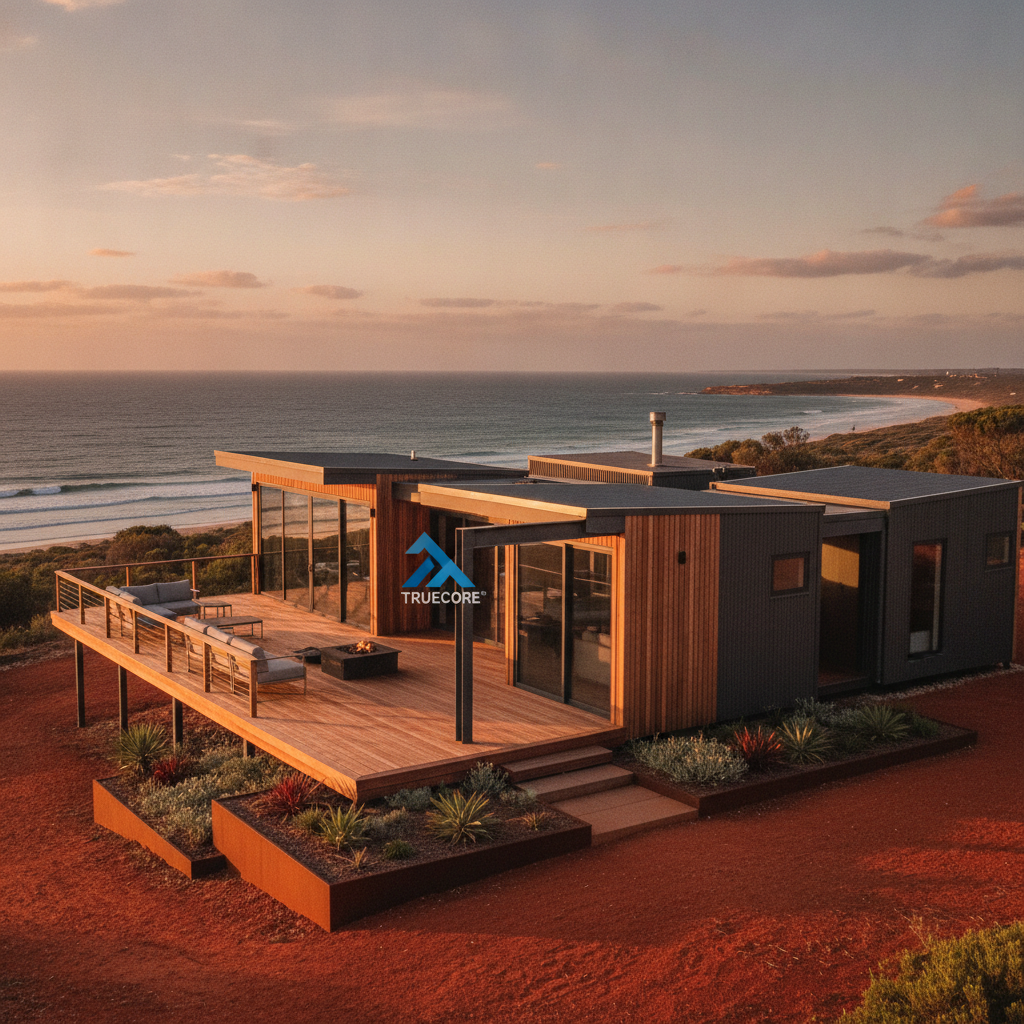
And let's talk about the deck. In a coastal kit home, the deck is not an addon. It is the primary living room. Because our kits use steel roofing and cladding, we can design wide eaves that shade the glass during the heat of the day. You want a deck that is at least 3 metres deep. Anything less and you are just shuffling chairs around every time someone wants to walk past the BBQ. If you are building on a sloping block to catch a glimpse of the water, you will likely be using a subfloor system rather than a slab. This is a massive win for ventilation. Getting air moving under the house keeps the whole place cooler and prevents that musty smell that plagues so many old beach houses.
Material choices for the salt spray
You cannot use standard materials on the coast. You just can't. If you chuck cheap galvanised screws into a deck 500m from the surf, they will look like rusty nails in six months. When we provide a kit for a coastal site, we look at the cladding and roofing carefully. Colorbond Ultra grade steel is the gold standard here. It has a thicker metallic coating designed specifically to handle the salt. It sounds like a small detail until you see a neighbor's roof starting to flake while yours still looks like the day the tradies finished the ridge capping.
Windows are another big one. We include high-quality windows in our kits, but you need to think about the hardware. Stainless steel stays are a must. Also, think about the wind loads. Coastal sites often fall under higher wind classifications like N3 or even C2. This impacts everything from the thickness of the glass to the spacing of the wall studs. It is not just about the house falling down; it is about the house 'whistling' in the wind. A stiff steel frame tucked behind quality cladding ensures the house stays quiet when the weather or the swell picks up.
Tips for the Owner-Builder at the beach
Managing a project on the coast has its own set of headaches. For one, the ground is often sandy or has a high water table. Before you get too excited about a particular design, get your soil test and site survey done. You might find you need deeper piers or a specific type of footing that costs a bit more. As an owner-builder, you are the project manager. You need to coordinate the earthworks and the slab before our truck even shows up with the steel frames.
Here are a few practical tips for the DIY-minded:
- Check your BAL rating. Even if you are near the water, many coastal areas are surrounded by scrub that carries a high bushfire risk. This dictates what kind of flyscreens and decking materials you can use under AS 3959.
- Plan your trades early. Good sparkies and chippies in coastal towns are usually booked out months in advance because they're all busy building multimillion-dollar holiday rentals.
- Orientation is king. Don't just face the house toward the view. Face it to catch the breeze but block the harshest afternoon sun. In Australia, that usually means shading your western windows like your life depends on it.
- Think about the AC unit. Salt air eats the coils in air conditioning condensers. Position them under cover or behind a screen to give them a fighting chance.
The look: Modern Australian Coastal
The trend right now is shifting away from that 'Hamptons' look with all the fussy white trim. People are leaning into a more industrial, raw coastal aesthetic. Think dark corrugated cladding, large glass spans, and natural timber accents on the eaves to soften the edges. Because our kits come with everything from the frames to the insulation, you have a blank canvas. You can go for a minimalist look with hidden gutters or a classic Australian verandah style that wraps around the whole building.
I reckon the best coastal homes are the ones that do not try too hard. They use materials that age gracefully. Steel is great because it gives you those clean, sharp lines that define modern architecture, but it is also incredibly practical. You aren't going to be spending every second weekend with a paintbrush in your hand. You'll be down at the beach, which is why you moved there in the first place.
Building a home yourself as an owner-builder is a massive undertaking. It is stressful. You will spend nights staring at the ceiling wondering if the plumber is actually going to show up on Monday. But when the scaffolding comes down and you're sitting on that deck with a cold drink, watching the sun dip down, it all makes sense. You have built a structure that is tough enough for the Australian coast but refined enough to be a genuine sanctuary. Just make sure you wash the salt off the windows every now and then. Even the best kit home needs a bit of love to keep it looking mint.