The Movement Problem Nobody Talks About
It's 2am in a new house. You hear a loud crack from the ceiling. Most people reckon it's just the house settling, but it's actually the timber frames losing moisture and twisting under your roof sheets. If you've ever tried to close a bathroom door that used to fit last summer but now sticks on the jamb, you've seen dimensional instability in action. Timber is basically a big sponge. It sucks up humidity in a tropical Queensland summer and bone-dries out during a Victorian winter. When that happens, the wood cells physically change size. This is a nightmare for kit homes where you want every piece of the puzzle to fit exactly how the CAD drawing said it would.
Steel is different. It's predictable. An 11-metre C-section rafter made from BlueScope TRUECORE steel is still going to be exactly 11 metres long in five years, whether it's sitting in the dust at Alice Springs or the damp air of the Otways. This matters because when your frame stays straight, everything else you do - from the cladding to the kitchen joinery - stays straight too. It makes the whole build heaps easier for a DIYer who doesn't have thirty years of experience shimmying out wonky walls.
Why Straight Walls Save Your Sanity During Fit-out
I've seen blokes spend three days just packing out timber studs so their plasterboard doesn't look like a mountain range. It's soul-destroying work. With a steel frame kit, the studs are punched and rolled with millimeter precision. When you run a long level across those studs, it sits dead flat. Because steel doesn't have knots, twists, or wane, you aren't fighting the material. You're just building. This is huge for the owner-builder who is probably doing their own internal linings on the weekend after a full week at their day job. You want to get the gyprock up and the joints set without noticing a big bulge in the hallway because a stud decided to bow outwards by 12mm.
And let's chat about the roof. We see a lot of kit home designs with long, sleek skillion roofs or wide open-plan living areas. Steel thrives here. Because of the strength-to-weight ratio, you get these massive spans without needing chunky internal load-bearing walls every two metres. Plus, since the steel won't shrink, you don't get those annoying nail pops in the ceiling where the plasterboard fixings pull through as the timber trusses cure. It's the difference between a finish that looks professional and one that looks like a weekend bodge job.
The Technical Bit: AS 4100 and Beyond
Australian Standards aren't just there to make life difficult for us. Following AS 4100 for steel structures ensures the house handles the loads it's supposed to. But beyond the regs, the physical reality of cold-rolled steel means the internal stresses are gone. Timber has grain. Grain has memory. If a tree grew with a slight lean, that timber wants to return to that lean. Steel is an engineered product. It does what it's told. This is especially vital in areas with high wind speeds or cyclonic regions where the integrity of every connection depends on the frame staying exactly where it was bolted down.
Managing the Challenges
I won't lie to you and say steel is perfect for every single thing. It's not. If you want to hang a heavy mirror or a flat-screen TV and you didn't plan your noggins, you can't just drive a wood screw in anywhere. You need to know where your studs are or use decent hollow-wall anchors. Some old-school blokes complain that steel is 'noisy', but that's usually down to poor installation or not using the right thermal breaks. If you install your kit home according to the manufacturer's specs - using the right insulation and isolation strips - it's as quiet as any other house. Better, even, because you don't have those structural 'groans' as the frame expands at different rates to the cladding.
Actually, let's talk about the cladding. Most kit homes use a mix of steel roofing and maybe some weatherboards or James Hardie panels. When your frame is steel, it has a similar thermal expansion coefficient to your metal roof. They move together. Timber moves at a completely different rate to metal, which is why you often see those crinkled flashings on older timber-framed sheds. Using a full steel system just makes more sense from a physics perspective.
Owner Builder Realities: The Slab and the Site
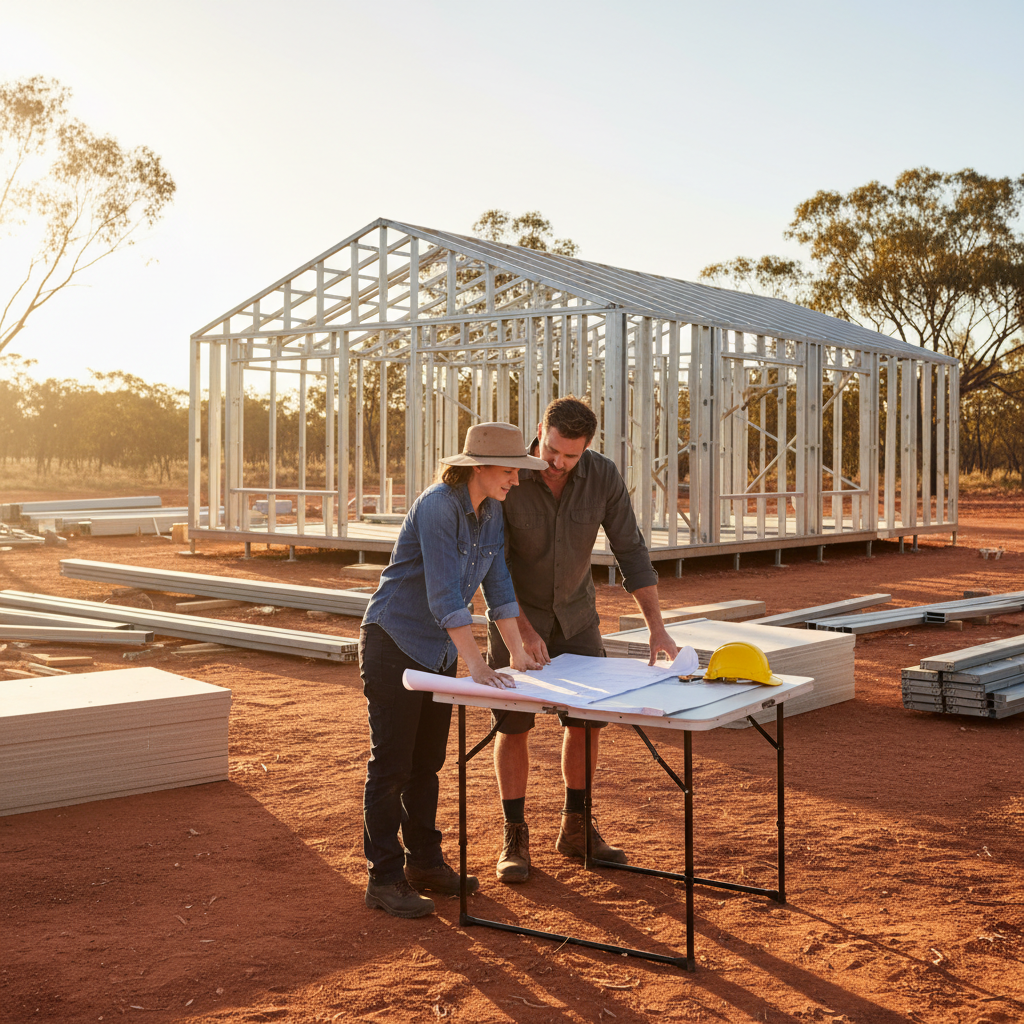
Before the kit even arrives on the back of a Hiab truck, you've got to get your site sorted. This is where most first-timers trip up. If your slab is out by 20mm, the steel frame is going to tell you about it immediately. Timber can be 'persuaded' with a chainsaw and a big hammer. Steel is less forgiving of a dodgy slab. So, when you're managing your trades, hold your concretor to a high standard. Tell them it's for a steel frame kit. They'll know they can't just 'near enough is good enough' the levels. It forces a higher quality of build from the ground up, which actually benefits you in the long run.
Another tip for the DIY crowd: get yourself a decent impact driver and a pack of high-quality Tekscrews. Don't buy the cheap ones from the bargain bin. You'll be driving thousands of these into your frames and trusses. A bit of extra coin on decent fasteners saves you hours of vibrating hands and stripped heads. Also, use a string line. Even though the frames are straight, your slab might have a dip. Always pull a line across your bottom plates to make sure you're starting off true. It's these little trade secrets that make the difference between a kit home that looks like a million bucks and one that looks like it was put together in the dark.
Sustainability and Longevity
People often ask about rust. We use TRUECORE steel because it's specifically designed for the Australian environment with a zinc/aluminium/magnesium alloy coating. It's not the old corrugated iron your grandad used for the chicken coop. This stuff is tech-heavy. It won't rot. It won't get eaten by termites. In a country where a termite colony can write off a timber-framed house in a few months, having a frame they literally can't chew is a massive weight off your mind. It's a permanent solution. You aren't going to be spraying poisons into your foundations every few years just to keep the walls standing.
Plus, when the house eventually reaches the end of its life - maybe 80 or 100 years from now - that steel is 100% recyclable. It doesn't end up as treated-timber landfill. That's a nice thought while you're sitting on the deck with a cold drink after a long day of bolting trusses together. You're building something that lasts, doesn't warp, and won't be a snack for the local wildlife.
Bottom line? If you want a house that stays as straight as the day you built it, steel is the only way to go. It makes the build faster, predictably accurate, and way less stressful when it comes time to finish the inside. Just make sure your slab is level and your screws are sharp.