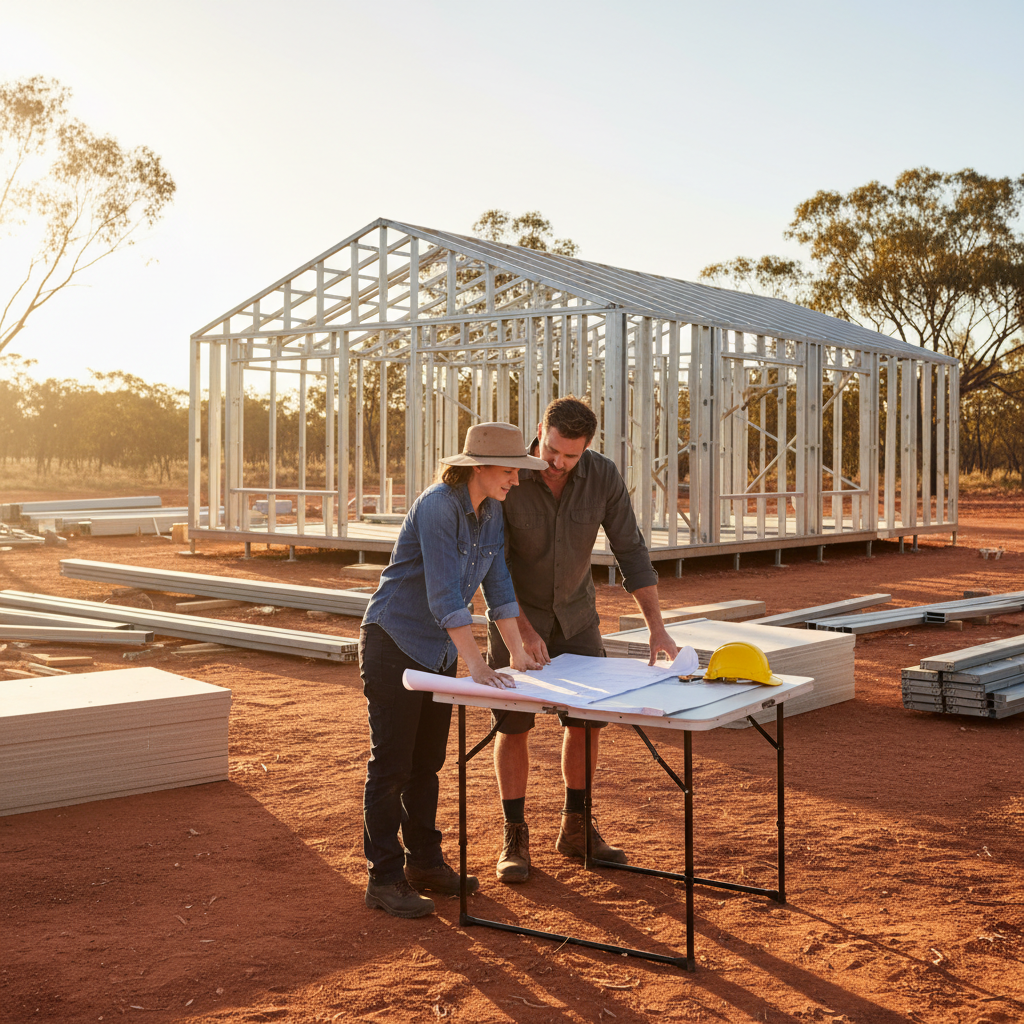
I have seen it a hundred times on sites from Gippsland to the Sunshine Coast. An owner builder stands in the middle of a freshly poured slab, scratching their head because the plumber missed the stack pipe for the ensuite by thirty millimetres. Now they are looking at a jackhammer and a very expensive afternoon. Kit homes give you a massive head start with precision-engineered steel frames, but the magic happens, or fails, in the rough-in stage. If you do not get your services sorted before the walls go up and the slab is dry, you are fighting an uphill battle.
The Slab is Final
Most kit homes in Australia sit on a raft slab or a waffle pod system. Because you are using BlueScope TRUECORE steel frames, your tolerances are tight. We are talking millimetres. Timber moves and bows, but steel is dead straight every time. This is a double-edged sword for your plumbing rough-in. If your waste pipes are out of position, you cannot just 'nudge' the wall over to cover the mistake. That steel track is going exactly where the plans say it goes. Before the concrete truck arrives, get your plumber to double check every single penetration against the frame layout. Not the architectural floor plan. The actual frame shop drawings. There is a difference.
Actually, check it yourself too. Grab a tape measure and verify the distance from the external edge of the slab to the centre of the toilet waste. If it is 300mm on the drawing, make sure it is 300mm on the ground. A lot of blokes get lazy and reckon 'near enough is good enough'. It is not. If that pipe is sitting under where a steel stud needs to be bolted down, you are in a world of hurt. You will be cutting steel or chipping concrete, and neither is a fun Saturday morning. Stop. Measure. Measure again.
Wiring Through Steel Frames
Sparkies who have only worked on old timber weatherboards sometimes moan about steel frames. They worry about sharp edges or earthing. It is nonsense if you know the right gear to use. Most modern steel kit frames come with pre-punched service holes. These are 32mm or 34mm grommet holes punched right into the studs at a standard height, usually around 300mm for power and 1050mm for switches. It makes running yellow tongue or TPS cable a breeze. You are not standing there with a spade bit drilling holes for six hours like you would be with timber.
But you have to use plastic grommets. Always. Every single hole where a cable passes through steel needs a snap-in grommet to protect the insulation from vibration or chafing. If your sparky tries to tell you they do not need them because the steel is 'hemmed', tell them to head back to the wholesaler. AS/NZS 3000 is pretty clear on protecting cables. Plus, it stops that annoying rattling sound when the wind picks up and the house settles. It is a small detail that makes a massive difference in the quality of the finish.
The NBN and Data Trap
Do not just think about power points. While the frames are open, run your data. WiFi is great, but if you are building out in a regional area or a new estate with thick insulation and steel cladding, that signal can struggle. Run Cat6 cable to where your TV will sit and where you plan to have a home office. It costs peanuts now compared to trying to fish it through a finished wall later. Also, think about where your NBN lead-in is coming. Most people just let the technician decide on the day, and they end up with a box in the middle of their nice hallway. Path the conduit yourself during the rough-in to a hidden spot in the pantry or a linen cupboard.
Plumbing and Noises
One thing people forget with kit homes is the acoustic side of plumbing. Steel is a great conductor of sound. If you have a bathroom wall backed onto a bedroom, and you use standard PVC pipes, you are going to hear every flush. It sounds like a waterfall behind your head at 2am. Spend the extra couple of dollars on acoustic lagging or 'quiet' pipe products like dBi for your waste lines. While the frames are exposed, wrap the pipes. It is easy work. Also, use plastic pipe clips with rubber inserts. If you lag the pipe but then hard-clip it to a steel stud, the vibration just jumps from the pipe into the frame anyway.
Gas lines are another one. If you are running LPG or natural gas, the lines must be protected when passing through the steel. Most gas fitters use a multi-layer composite pipe these days. It is flexible and easy to work with. Just make sure they are not kinking it around the steel corners. If you are doing a kitchen island bench on a slab, that gas line and the water feeds need to be pinpoint accurate before the pour. There is no 'fishing' a pipe through a slab later.
Wet Area Set-Downs
Modern Australian homes almost always feature 'stepless' entries into showers. It looks sleek. It is great for accessibility. But it requires planning. You need to talk to your slab pourer about a set-down in the bathroom areas. This is where the concrete is slightly lower, maybe 20mm or 30mm, to allow for the fall of the tiles and the screed. If you miss this, you end up with a big 'hob' at the bathroom door that everyone trips over. Because your kit home arrives with fixed-height doors and frames, you cannot easily adjust the floor height later without it looking like a dog's breakfast. Get that slab height right for your wet areas during the rough-in.
The Air Conditioning Integration
Are you putting in a split system or ducted air? If it is ducted, you need to look at your roof pitch and the space between the ceiling joists. Most steel kit homes have plenty of room in the plenum, but you need to identify where the return air grille is going. This usually requires a larger opening than a standard stud spacing. You can box this out during the frame assembly. If you wait until the plasterboard is up, you will be cutting through structural members, and then you have a real problem on your hands. Talk to your AC installer while the frames are still on the truck.
For split systems, run the 'pair coil' (the copper pipes) and the drain line inside the wall during the rough-in. Seeing a plastic duct running down the outside of beautiful Colorbond cladding is a tragedy. It looks cheap. If you rough it in, the pipes come out behind the unit and everything is hidden. Just make sure the drain line has a consistent fall. Gravity does not take days off.
A Note on Insulation and Services
When you start stuffing bulk insulation into your walls, do not crush your electrical cables or plumbing lines. If you squash an R2.5 batt against a hot water pipe, you are losing thermal efficiency. And for the love of all things holy, keep your insulation clear of any downlights unless they are IC-4 rated. Even then, give them some breathing room. I reckon the best way is to take a photo of every single wall in the house once the rough-in is done but before the insulation goes in. Hold a tape measure in the photo so you know exactly where the pipes are. Three years from now when you want to hang a heavy mirror, you will thank me. You will know exactly where not to drive a screw.
Building a kit home is about being the conductor of an orchestra. You do not have to be the best plumber or the best sparky, but you do have to make sure they are talking to each other and looking at the same set of plans. The steel frame is your grid. It is perfect. As long as the services inside that grid are placed with the same level of care, the rest of the build will feel like a walk in the park. Or at least a very manageable stroll through the bush.