The Foundation of Success: Preparing Your Site for a Kit Home
There is a unique kind of excitement that comes with ordering a kit home. You have spent weeks or months pouring over floor plans, selecting finishes, and dreaming about the day the truck rolls up with your new life packed on the back. However, before those steel frames arrive, there is a critical phase of the project that happens on the ground, literally. Site preparation is the unsung hero of the building process. Get it right, and your build will flow like a dream. Get it wrong, and you could face delays, extra costs, and physical hurdles that slow your progress.
From a building techniques perspective, site prep is about creating a safe, level, and accessible environment. Because Australian kit homes often utilise high quality steel frame construction, precision is key. Steel does not warp or twist like timber, meaning your foundation needs to be spot on from day one. This guide will walk you through the essential steps to ready your land for delivery and construction.
Understanding Your Soil and Slope
Before any machinery touches your dirt, you need to know what you are working with. In Australia, our soil vary wildly from reactive clays in the suburbs to sandy coastal patches or rocky outcrops in the bush. The first step for any owner builder is a soil test, often called a Geotechnical Report.
A soil engineer will take samples to determine the soil classification (such as Class A, S, M, H, or E). This classification dictates how your slab or footings must be designed to handle potential ground movement. If you are building with a steel frame kit, you want that stability. Steel frames are lightweight yet incredibly strong, but they still require a solid base that won't shift and cause issues with your wall linings or doors down the track.
If your site is sloped, you will also need to consider a cut and fill or a raised floor system on stumps. A level building pad is non-negotiable for a smooth frame assembly. If the site is not level, you will find yourself fighting gravity every time you try to square up a wall panel.
The Importance of Site Access
One of the most overlooked aspects of kit home building is how the materials actually get to the building pad. Remember, your home will arrive on a large truck, sometimes a semi-trailer or a crane truck, depending on the size of the kit. If your property is at the end of a narrow, winding dirt track with low hanging branches, the delivery driver is going to have a hard time.
Assess your access point carefully. Is there enough room for a heavy vehicle to turn around? Is the ground firm enough to support a truck weighing several tonnes, especially after rain? You may need to lay down some temporary road base or crushed rock to ensure the delivery vehicle does not get bogged. It is also wise to check for overhead power lines or low eaves on existing structures that could obstruct a crane or hiab arm.
Setting Up a Secure Staging Area
When the delivery arrives, you don't just want the components dumped in a pile. You need a designated staging area. This area should be dry, level, and located as close to the building footprint as possible to minimize how far you have to carry heavy items.
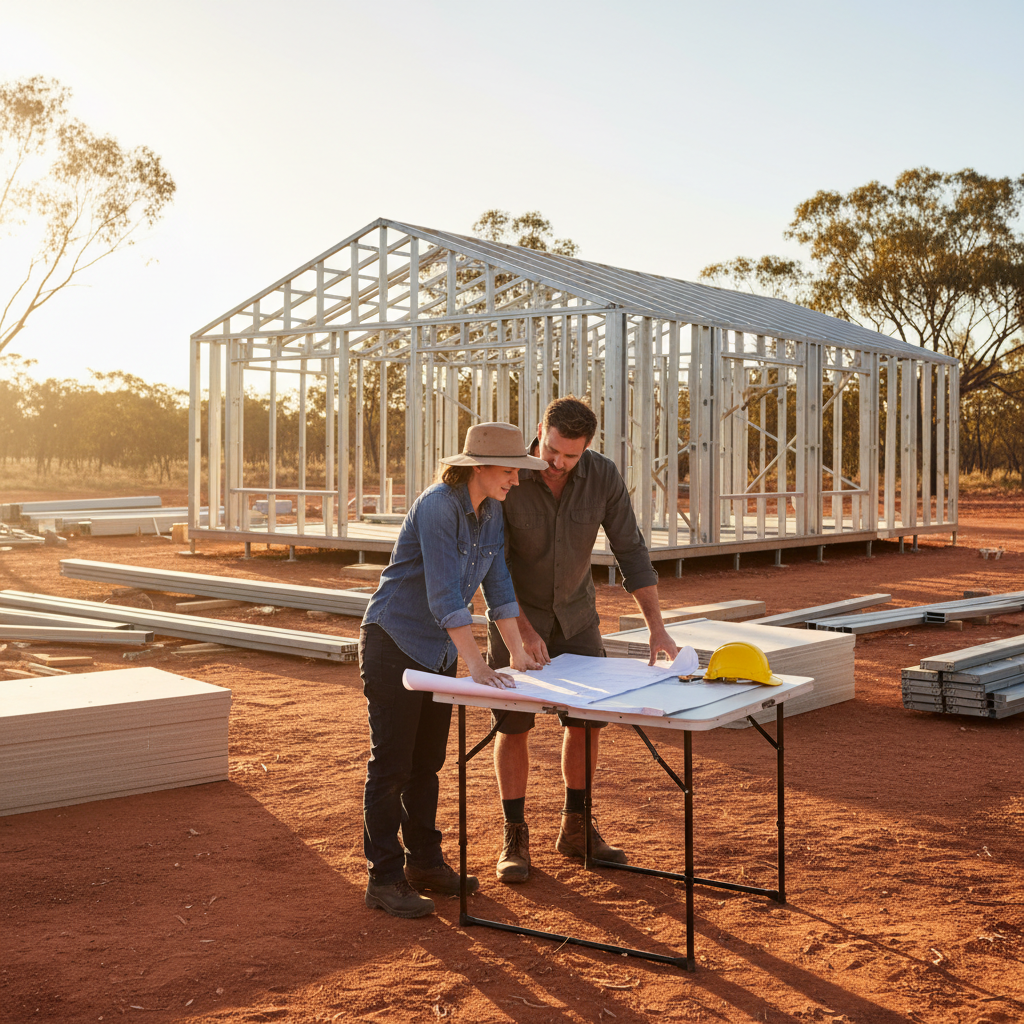
For steel frame kits, such as those made with BlueScope TRUECORE steel, the frames usually arrive pre-assembled or in easy to manage sections. You will want to have some dunnage (timber sleepers or pallets) ready to keep the steel and your cladding off the wet ground. Even though steel frames are resilient and termite proof, keeping your materials organized and clean makes the assembly process much faster and safer.
Plumbing and Underground Services
Before the slab is poured or the footings are set, your 'rough-in' for underground services must be completed. This includes your sewer pipes, water connection, and electrical conduits. Coordination is vital here. As an owner builder, you will need to manage your licensed plumber and electrician to ensure these pipes come up exactly where the floor plan dictates.
Precision is especially important with steel frame construction. Because the frames are manufactured to millimetre accuracy in a factory environment, there is very little 'wiggle room'. If your plumbing pipe is 100mm out of place, it might end up right under a steel floor joist or a wall stud. Double check your dimensions against your technical drawings before the concrete is poured. It is much easier to move a pipe in the dirt than it is to jackhammer a slab later.
The Slab: A Precision Base for Steel
Most Australian kit homes are built on a concrete slab on ground or a raised steel flooring system. If you are going with a slab, its importance cannot be overstated. The slab is the most technical part of your site prep. It must be perfectly level and square.
When working with steel frames, we often recommend a 'rebated' slab edge or specific slab dimensions that match the wall tracking. Because steel does not shrink or move like timber, your frame will be perfectly straight. If your slab is wavy or out of square, you will spend days using shims and packers to try and get your walls vertical. Take the time to work with a quality concretor who understands the accuracy required for kit home construction.
Managing Drainage and Runoff
In Australia, we often deal with extreme weather. During site prep, you must consider where water will go when it rains. Cutting into a slope to create a flat building pad creates a 'cut-back' that can channel water directly toward your new foundation. You should install agricultural drainage lines (ag pipe) and potentially a retaining wall to divert water away from the site.
Keeping the site dry is also a safety issue. A muddy site is a slippery site. Installing basic silt fences and managing runoff will not only keep your site clean but will also keep you in the good books with your local council and neighbors.
Final Checklist Before Delivery Day
As your delivery date approaches, do a final sweep of the site. Here is a quick checklist of building techniques to remember:
- Clear all debris, stumps, and large rocks from the building zone.
- Ensure there is a clear path from the street to the staging area.
- Have your temporary fencing and site toilet in place (this is often a legal requirement).
- Organize a waterproof area or a garden shed for smaller items like screws, brackets, and insulation that shouldn't be left in the rain.
- Check the weather forecast, if a big storm is coming, you might want to have some heavy duty tarps ready to cover your cladding and roofing.
The Reward of Preparation
It might feel like a lot of work before the 'actual' building starts, but thorough site preparation is what separates a stressful project from an enjoyable one. By focusing on site access, soil integrity, and foundation precision, you are setting yourself up for a successful build. When that truck arrives and you see your steel frames being unloaded, you can move forward with the confidence that your land is ready to support your new home for decades to come.
Being an owner builder is a journey of learning and doing. Embracing these technical preparation steps will give you a deeper understanding of your home and a great sense of pride when the project is complete. Now, clear those tracks, check those levels, and get ready for the arrival of your new Australian home.