Steel vs. Timber: Why Kit Home Frames Don't Warp or Shrink with BlueScope TRUECORE®
Listen, if you’ve ever slapped a level on a wall frame only to see a banana bend staring back, you know the frustration. Timber moves. It’s what it does. And for owner-builders across Australia, that movement – the warping, the shrinking, the twisting – can turn a straightforward build into a head-scratcher. But what if your frame stayed exactly where you put it? That’s where a good steel frame, like the ones we make using BlueScope TRUECORE® steel, changes the whole ballgame for your kit home.
We’ve been in this game, selling kit homes for 15 years, and seen countless owner-builders wrestle with every part of the build. One of the biggest advantages, often overlooked until you’re deep into sheeting and fit-out, is the sheer dimensional stability of steel. It just doesn’t carry on like timber does. This isn’t just some marketing blurb; it’s a fundamental difference in how the material behaves under Australian conditions, from the humid tropics to the dry inland.
The Problem with Timber: It Never Stops Moving
Anyone who’s worked with timber for more than five minutes knows its quirks. Cut a piece, leave it in the sun, come back an hour later – it’s bowing. Stack a pile in the shed over winter, and by spring, some of those studs have done their best impression of a corkscrew. This movement is all about moisture content. Timber, being a natural product, breathes. It absorbs moisture from the air when it’s wet, and it releases it when it’s dry. When it takes on water, it swells. When it dries out, it shrinks. And it rarely does this evenly, leading to all those twists and cups.
Think about a typical Australian summer. Hot, dry winds one week, then a massive downpour the next. Your timber frame, sitting exposed before cladding goes on, is going to react. Sometimes it’s subtle, just a millimetre here or there. Other times, it’s enough to make squaring up your wall sheets a nightmare. I’ve seen owner-builders chase bowed studs for days, trying to plane them straight or pack them out just to get a flat surface for plaster. That’s time, and frankly, it’s a pain you don’t need when you’re already juggling a thousand other tasks.
Steel Frames: Stability You Can Bet On
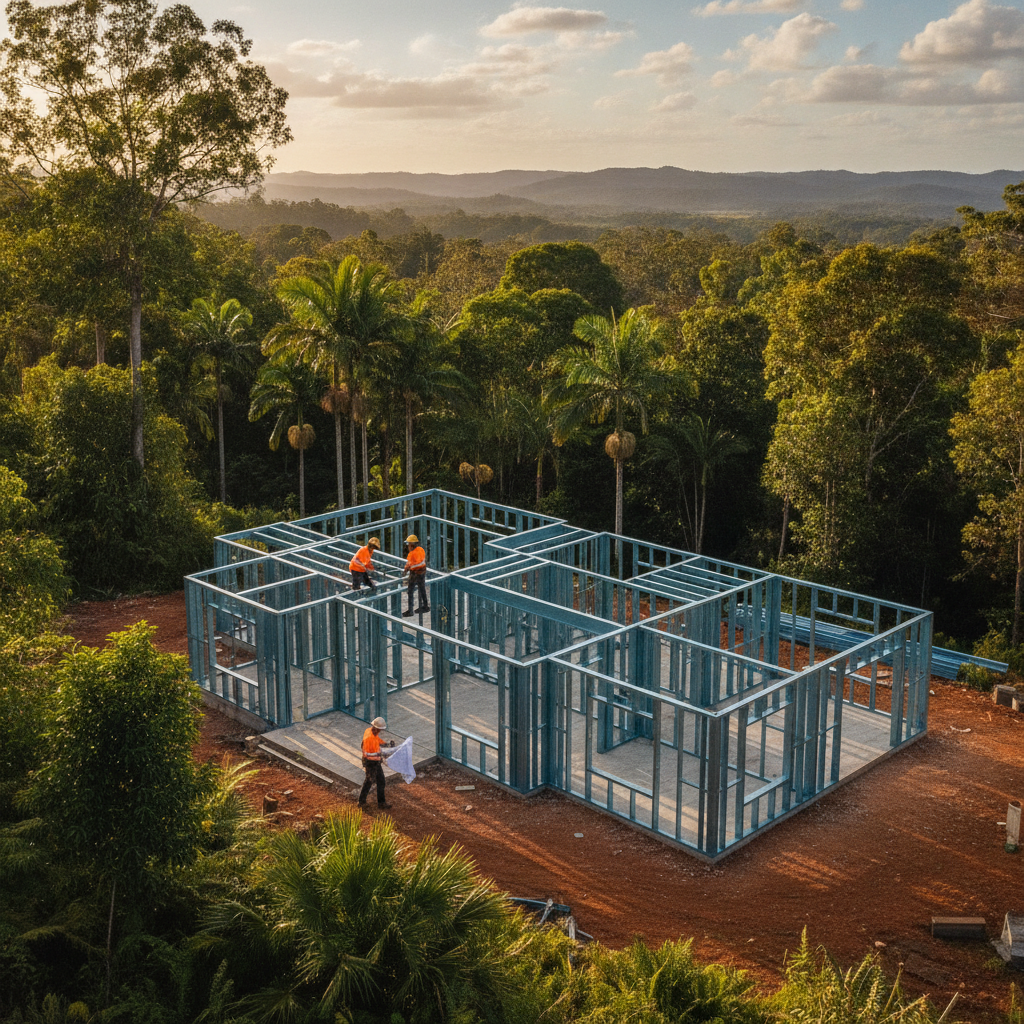
Now, steel, especially light gauge steel like TRUECORE®, is a different beast entirely. It’s an engineered product. It doesn’t absorb water. It doesn’t swell. It doesn’t shrink when it dries out. Once it’s rolled and formed into your C-sections and top hats, that’s pretty much its final shape. We use BlueScope TRUECORE® steel for our frames, and that stuff is made to a high standard, designed specifically for residential construction in Australia.
This dimensional stability is massive. Imagine you put your walls up, plumb, level, and square. With steel, they pretty much stay that way. You can come back a week later, a month later, and those frames will still be true. This means:
- Easier Sheeting: Plasterboard, fibre cement, whatever you're screwing on, it sits flat. No bumps, no gaps, no stress trying to make a wavy sheet meet a wavy stud.
- Precise Openings: Windows and doors fit snug. You cut your opening, and the frame holds its shape, so your window or door frame slips right in without needing to be forced or adjusted.
- Straighter Finishes: Skirting boards, architraves, cornices – they all look better when the walls and ceilings they’re attached to are dead straight. Less filler, less fiddling, a far more professional finish.
- Reduced Cracking: Movement in a frame, over time, can lead to cracks in plasterboard or cornices. A stable steel frame minimises this, giving you a more durable finish that lasts.
It’s about confidence. When you’re an owner-builder, every decision you make impacts the final product. Knowing your frame isn’t going to play silly buggers gives you one less thing to worry about, and that’s gold.
Temperature Fluctuations: A Common Misconception
A common thing people ask is, “Doesn’t steel expand and contract with temperature?” And yeah, it does, absolutely. Every material does, to some extent. But here's the kicker: the thermal expansion of light gauge steel within a typical residential frame is so minimal, and the frame itself is designed to handle it, that it doesn’t cause the kind of structural issues or cosmetic problems that timber movement does. We’re talking tiny fractions over the length of a stud, not enough to cause visible bowing or impact finishes.
Timber’s movement is primarily moisture-driven, which is far more significant and unpredictable than steel's thermal movement in a framed building. Plus, once your insulation, cladding, and internal linings are in, the steel frame is largely protected from extreme temperature swings anyway. It's a non-issue for the sort of performance an owner-builder expects from a kit home.
Practical Tips for Owner-Builders with Steel Frames
So, you’ve picked a steel frame kit home. Smart move. Now, how do you make the most of that stability? Here are a few pointers:
-
Check Square and Plumb Early: Even though steel is stable, always double-check your frame components as you’re assembling them. A good, square slab is your best friend here. Make sure your base plates are laid out precisely. Use a good quality laser level and a long spirit level. Early accuracy pays off massively.
-
Protect from the Elements (Still a Good Idea): While steel won’t warp like timber when wet, protecting your frame with a roof and wrapping as soon as practical is just good building practice. It keeps the elements out of your internal space and protects other materials that might be stored on site.
-
Learn Your Screw Types: Different steel gauges need different self-drilling screws. Make sure you’re using the right ones for your battens, noggins, and any fixings. This isn't timber where you can just ram a nail in. Steel needs proper fastening, and understanding the specs for your specific frame components is key. Our instruction manuals cover this in detail, so read them.
-
Plan for Heavy Fixings: While a steel frame is dead straight, you can’t just whack a picture hook anywhere like you might with timber studs. For heavy items – big TVs, wall-mounted shelving units, kitchen cabinetry – you’ll need to plan for noggins or blocking during frame erection. Our frames are designed with pre-punched service holes, but for specific heavy loads, extra backing plates or noggins are a good idea. Think ahead to where your kitchen cupboards or laundry shelves will go.
-
Termite Protection (Less of a Worry): This isn’t about dimensional stability, but it’s a massive side benefit. Termites don't eat steel. Full stop. In Queensland or Northern NSW, where those little munchers are relentless, a steel frame drastically reduces your worries about structural damage from pests. You still need proper perimeter protection for other timber elements in your house, but the main structure is safe.
The TRUECORE® Advantage: Quality You Can Trust
When we say our frames are BlueScope TRUECORE® steel, it actually means something. It's not just any old steel. BlueScope is an Australian company, and TRUECORE® is specifically designed and tested for Australian conditions. It’s got that galvanised coating for corrosion protection, which is vital here. You want a frame that’s going to stand up to the weather, not just for a few years, but for the lifetime of your home. The quality and consistency of TRUECORE® are why we choose it; it gives you, the owner-builder, a foundation you can truly rely on.
And let's be honest, building a home is a big undertaking. Anything that simplifies a process, anything that removes a common headache, is a win. The inherent stability of a steel frame kit home does exactly that. It means less time correcting, less wasted material, and ultimately, a better, straighter home at the end of it all. No more fighting with timber that’s decided to have a mind of its own. Just a solid, true frame, ready for you to make it your own.
Thinking Beyond the Frame: A Long-Term View
Consider the long-term implications, too. A stable frame means less movement in the entire structure, which contributes to a tighter, more energy-efficient home. Less movement means less chance of air gaps opening up around windows and doors over time. Your insulation, which we supply in the kit, works better when it’s not being compromised by a shifting frame.
This stability also plays into the overall integrity of your home for decades. We've all seen older homes where walls have settled, doors stick, or floors creak because the timber frame has slowly moved over time. With a steel frame, you're building in resilience from day one. You're setting yourself up for a home that requires less maintenance in terms of structural alignment and finishes. It's a sensible investment, not just in the immediate build, but in the enduring quality of your Australian kit home.
So next time you’re wrestling with a bowed timber stud, just remember: there’s a better way. A steel frame from a quality supplier, built with materials like BlueScope TRUECORE®, gives you peace of mind and a straightforward build. It means you can spend more time on the exciting parts of your home – the fit-out, the finishes – and less time fighting with a frame that just won’t sit still. That's a good deal for any owner-builder.