You are lying in bed at 2 am and you hear it. A sharp, loud crack from somewhere in the ceiling. It sounds like a gunshot or maybe someone dropping a heavy book on the floorboards upstairs. It is not a ghost. It is just your house moving. If you built with timber, that noise is the sound of your structural members shrinking, twisting, or bowing as they lose moisture to the dry night air. Timber is a biological product. It remembers being a tree. It wants to breathe, swell, and contract based on whether it rained in Brisbane yesterday or if a dry wind is blowing across the Nullarbor today. Steel does not have that memory. It does not care about the humidity. It stays exactly where you bolted it.
The Physics of the Banana Stud
Walk onto any traditional building site and you will see a stack of 90x45mm pine sitting in the dirt. It starts out mostly straight. Then the sun hits it. By day three, half those studs have turned into boomerangs. This is the reality of dimensional instability. Timber has a grain, and that grain holds onto water. When that water leaves, the wood fibres pull together and the whole length of the timber curls. If you are building a kit home yourself, this is your worst nightmare. You spend half your time trying to sort through the stack to find the straightest bits for your corners, and the rest of the time you are using a power plane to shave down the bows so your plasterboard does not look like a series of rolling hills. It is a massive waste of time. It is frustrating. And it is entirely avoidable.
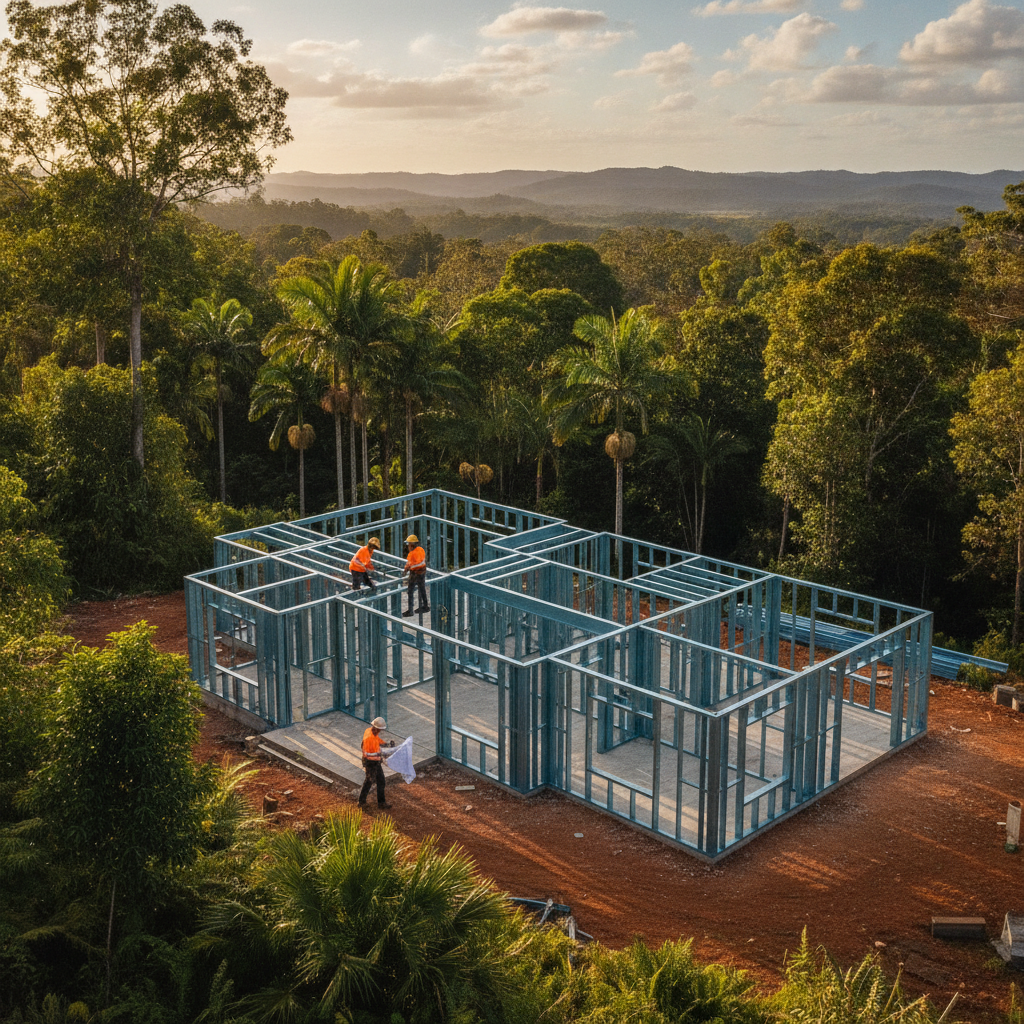
Steel frames like the BlueScope TRUECORE we use are engineered. They are cold-rolled from high-strength strips of steel that have been manufactured to precise tolerances. When we send a kit out, those frames are millimetre perfect. Because steel is an isotropic material, it has the same properties in all directions. It does not have a grain to warp along. If a steel stud is 2400mm long and perfectly straight when it leaves the factory, it will be 2400mm long and perfectly straight when you stand it up on your slab. It will still be that way in fifty years. That is the kind of reliability an owner-builder needs when they are balancing a spirit level in one hand and an impact driver in the other at 4 pm on a Sunday.
The Hidden Cost of Movement
People often think about the frame as just the skeleton. They forget that everything else in the house hangs off that skeleton. When the frame moves, everything else has to move with it. Or it breaks. This is where the real headaches start for kit home owners who opt for older construction methods. If your timber studs shrink by even three or four millimetres, which is common as they dry out over the first year of a house's life, you start seeing the symptoms. The most common one is the sticking door. You know the one. It worked fine in winter, but now that it is summer, you have to shoulder-charge the thing just to get into the bathroom. That is not the door's fault. It is the frame above it dropping or twisting.
Then you have the plasterboard. Plaster is brittle. It does not like to bend. When a timber stud bows behind a sheet of Gyprock, it puts immense pressure on the fixings. Eventually, the head of the screw or nail pops right through the paintwork. You get those ugly little circular bumps all along your walls. Or worse, the tape on the internal corners starts to crinkle and tear. You spend your weekends with a tub of top coat and a sanding block trying to hide the fact that your house is literally pulling itself apart. Steel frames do not do this. They provide a stable, flat substrate. Your cornices stay straight. Your mitres stay tight. Your walls stay flat. It makes you look like a much better builder than you actually are. Which is a win in my book.
Precision in the Kit Home Context
When you are an owner-builder, you are usually working with a limited tool kit and a lot of determination. You do not want to be site-measuring and recutting every second piece of material. Our kit homes are designed so the steel frames click together with a level of precision that timber just cannot match. We are talking about pre-punched holes and exact lengths. Because the steel does not warp while it is sitting on your site waiting for the slab to be poured, the holes always line up. You are not fighting the material. You are just assembling it. It is more like a high-end mechanical assembly than a traditional carpentry job. You are working to AS 4600 standards for cold-formed steel structures, which is a far more predictable world than trying to figure out which way a piece of radiata pine is going to jump.
Kitchens and Wet Areas
If you want to see where dimensional stability really matters, look at your kitchen. You spend thousands on stone benchtops and high-gloss cabinetry. You want those lines to be sharp. If your wall studs are bowing, your cabinet maker is going to have a heart attack trying to get the overheads to sit flush. They will have to use massive filler pieces to hide the gaps. It looks cheap. Because a steel frame stays plumb and square, your cabinetry install is faster and the finish is infinitely better. The same goes for tiling in your bathroom. Large format tiles are the trend right now, but they are unforgiving. If the wall moves, the grout lines crack. If the wall is straight because it is built with TRUECORE steel, your tiles stay put. No cracked grout. No leaking shower trays because the wall pulled away from the floor. Just a solid, stable build.
Last Tuesday night at 11pm, there you were again. Pinching and zooming on floor plans while the kettle boiled for the third time. You were probably worrying about the layout or the BAL rating for your block. But you should also be thinking about the long-term maintenance. A house that does not move is a house that does not need constant patching. In Australia, we deal with some of the harshest temperature swings on the planet. One day it is 42 degrees in the shade, the next it is a freezing southerly buster. Steel handles those thermal stresses with much more grace than timber. While steel does expand and contract with heat, it does so predictably and uniformly. We build expansion joints into the design to handle it. Timber, on the other hand, moves inconsistently because every piece of wood is different. One stud might bow left, the one next to it might bow right. It is chaos.
Termites and Beyond
It is impossible to talk about steel frames in Australia without mentioning the white ants. Termites. They are the silent assassins of the Australian suburbs. I have seen timber frames in regional NSW that looked fine from the outside, but when you tapped the studs, they sounded like empty eggshells. The termites had eaten the core out of the house. Now, obviously, steel is 100 percent termite proof. They can not eat it. They can not nest in it. This means you do not have to pump your slab full of heavy chemicals every few years just to keep your house from falling down. It is a massive relief for an owner-builder. You have enough to worry about with the council DA and the plumber's invoice without adding 'total structural collapse due to insects' to the list.
The Myth of the Noisy Steel House
I hear this one a lot from the old-school chippies. They reckon steel houses are noisy and click all night long. That is old news. Back in the day, when people did not know how to insulate or fix steel frames properly, you might get some thermal bridge noise. But with modern kit home designs, we use thermal breaks and high-quality insulation. We use specific screws and brackets designed to allow for a tiny bit of movement without the noise. Ironically, a well-built steel frame is often quieter than a timber one. You do not get the groans and squeaks of wood rubbing against wood. You do not get the floorboards creaking as you walk down the hall because the joists have shrunk and pulled away from the flooring. It is a solid, silent structure. Plus, it is straight. Did I mention that? It is really, really straight.
So, when you are looking at your options for a kit home, do not just look at the floor plan. Look at what is under the skin. If you want a house that stays square, where the windows do not bind in their tracks and the plaster stays smooth, steel is the only way to go. It makes the building process easier for you as an owner-builder and it makes the living experience better for you as a homeowner. You are not just building a shed to live in. You are building a high-performance structural system that uses the best of Australian steel technology to beat the Australian climate. And that is a pretty good place to start your project.