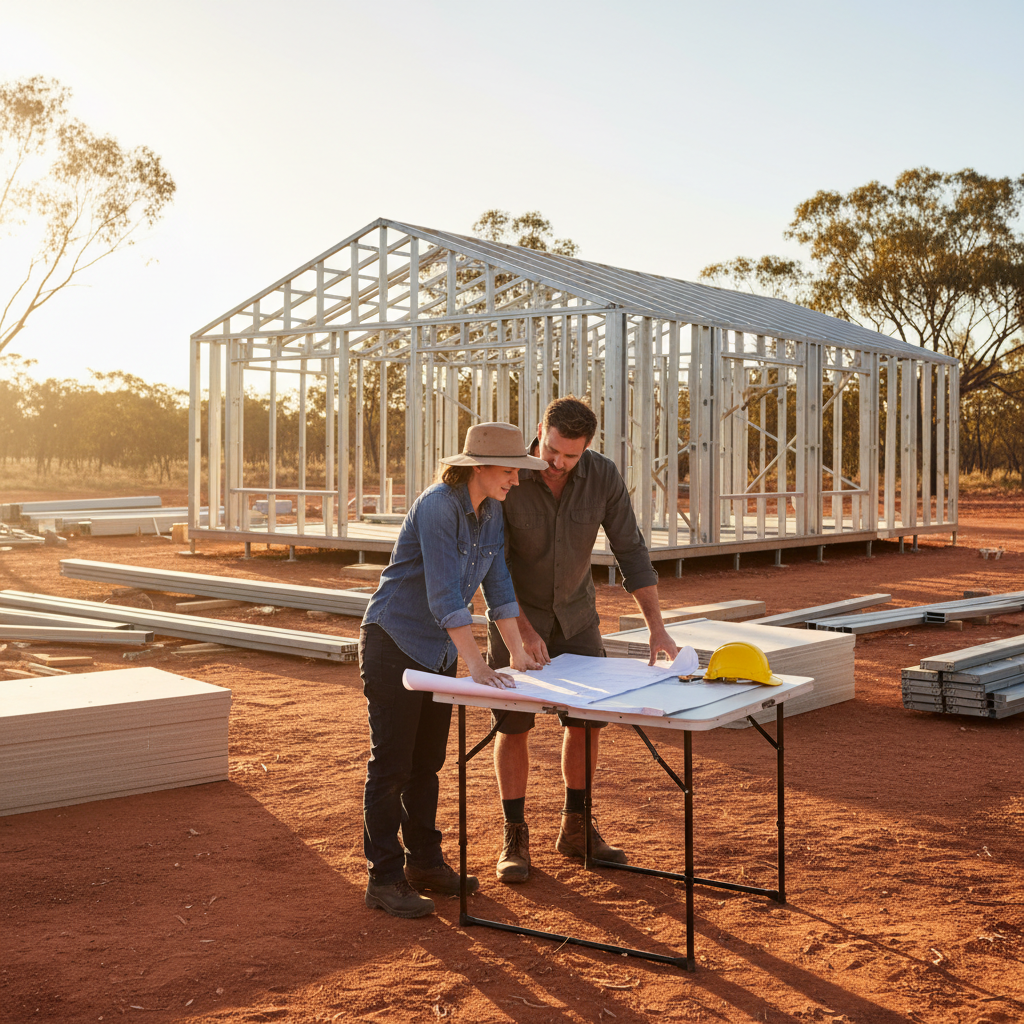
The Roadmap to Your New Home
There is a unique thrill in unrolling a set of house plans for the first time. For an Australian owner-builder, those crisp lines and detailed symbols represent the culmination of dreams and the beginning of a hands-on journey. However, for the uninitiated, a set of kit home plans can look less like a dream home and more like a complex puzzle.
Understanding these documents is one of the most vital skills you can develop. It is the bridge between your vision and the reality of the physical build. When you are standing on a slab in the middle of a rural block, you need to know exactly what those dashed lines and abbreviations mean. In this guide, we will break down how to read and interpret your kit home plans and specifications, with a particular focus on the robust steel frame systems that form the backbone of modern Australian kit homes.
1. The Anatomy of a Plan Set
A standard set of kit home plans is not just one drawing, but a comprehensive package of different views. To get the full picture, you need to understand what each page is trying to tell you.
The Site Plan
This is your birds-eye view. It shows where the house sits on your block of land. It includes boundary setbacks, the orientation of the home (essential for taking advantage of the Australian sun), and usually the location of your water tanks or septic systems. Always check the North point on this page to ensure your living areas are positioned for the best natural light.
The Floor Plan
This is the most common drawing people look at. It is a horizontal cut through the house (usually at about waist height) looking down. It shows the layout of rooms, the position of doors and windows, and the location of internal walls. On a steel frame kit home plan, you will notice that wall thicknesses are precisely marked to accommodate the high-strength steel studs.
Elevations
Elevations are flat, 2D views of the outside of the house from the North, South, East, and West. These are crucial for understanding how the home will look from the street. They show the roof pitch, the height of the windows, and the cladding profiles. If your kit includes specific cladding like Colorbond steel or weatherboards, the elevations will indicate where these materials are applied.
Sectional Drawings
Imagine slicing your house down the middle with a giant knife and looking at it from the side. That is a section. It shows the internal height of ceilings, the thickness of the floor slab, and how the roof trusses connect to the wall frames. For those using BlueScope steel frames, this is where you see the engineering excellence of the TRUECORE steel components coming together.
2. Decoding Symbols and Abbreviations
Architects and drafters use a shorthand language to keep plans from becoming cluttered. Here are a few common ones you will encounter in the Australian kit home world:
- RL (Relative Level): Refers to the height of a point relative to a fixed datum point. Crucial for ensuring your slab is at the right height.
- N/S (Nosing): Usually seen on stair drawings.
- DP (Downpipe): Shows where your guttering will drain.
- U/G (Underground): Usually refers to services like plumbing or electricity.
- WIC (Walk-in Robe): A favorite in modern Australian designs.
Window and door codes are also vital. You might see a code like "1218" next to a window. In Australia, this traditionally means the window is 1200mm high and 1800mm wide. Understanding these small details prevents ordering errors when you are coordinating with your trades.
3. Understanding Specifications: The 'What' of Your Build
If the plans are the "where" and "how," the specifications (or 'specs') are the "what." The specification document is a written description of the materials and workmanship required for the project. For a kit home, this is where you find the nitty-gritty details of what is actually included in your package.
A typical high-quality kit might specify materials like TRUECORE steel for the framing. This is significant because it tells you the frames are termite-proof, straight, and true. The specs will also outline the type of roofing, such as Colorbond steel, and the grade of insulation included. When reviewing specs, look for details on the windows (are they double-glazed?), the entry doors, and the type of fixings provided for the steel frames. Having a clear specification list ensures there are no surprises when the truck arrives at your site.
4. The Steel Frame Advantage in Planning
When you are looking at kit home plans, the use of steel frames offers some distinct advantages that are reflected in the documentation. Steel has a much higher strength-to-weight ratio than timber, which often allows for larger open-plan living areas without the need for bulky internal load-bearing walls or massive headers over doors.
In your plans, you will notice that steel frames are engineered with extreme precision. Because steel does not warp, twist, or shrink, the measurements on your plans are exactly what you will get on-site. This makes the job of an owner-builder much easier when it comes to the internal fit-out. Your plasterboard will be straighter, and your kitchen cabinets will fit into corners that are actually square.
Furthermore, steel frame plans often include detailed assembly layouts. These act like a giant Meccano set, where each piece of the frame is numbered and corresponds to a specific location on the layout. This level of detail is a godsend for the DIY enthusiast.
5. Practical Tips for Reviewing Your Plans
Before you sign off on your plans and begin the council approval process, take these practical steps:
Do a Virtual Walkthrough
Sit down in a quiet place and imagine walking through the front door. Use the floor plan to navigate. Is there enough room to open the fridge? Does the bathroom door swing into a way that blocks the vanity? Visualizing your daily routine within the plan can reveal small layout issues that are easy to fix on paper but expensive to change after the steel is rolled.
Check the 'Inclusions' vs. 'Exclusions'
This is the most important part of reading kit home documentation. A kit home provider generally supplies the exterior shell: the frames, roofing, cladding, and windows. The site works, the concrete slab, the internal plumbing, electrical wiring, and the final fit-out (like kitchens and tiling) are usually arranged by the owner-builder. Ensure your plans clearly show what you are responsible for so you can obtain accurate quotes from local trades.
Scale and Measurement
Never assume the plans are printed to a specific scale unless you check the scale bar. Most plans are A3 or A2 size. If you print an A2 plan on a standard A4 home printer, the scale will be wrong. Always rely on the written dimensions rather than measuring the paper with a ruler.
6. Communicating with Trades
As an owner-builder, your plans are your primary communication tool. When you talk to a plumber or an electrician, they will ask to see your plans. Because your kit home utilizes a steel frame, you should highlight this to your trades early. Electricians, for example, will need to use grommets when running wire through the pre-punched holes in the steel studs. Plumbers will also appreciate knowing they are working with steel so they can bring the appropriate tools and fixings.
Conclusion
Reading kit home plans and specifications is a skill that pays dividends throughout the life of your build. It empowers you to make informed decisions, helps you manage your site more effectively, and ensures that the final result is exactly what you envisioned. By understanding the language of the drawings and the structural integrity of materials like BlueScope steel, you are not just building a house, you are mastering the craft of the owner-builder.
Take your time with the documentation. Ask questions if something is unclear. Remember, every line on that page has a purpose, and once you know how to read them, you are well on your way to turning those plans into a beautiful Australian home.