Keeping Your Kit Home Grounded: A Deep Dive into Australian Wind Ratings
When you start planning your dream kit home in Australia, your mind is likely filled with floor plans, kitchen finishes, and the perfect veranda placement. However, before the first piece of steel is bolted together, there is a critical technical factor that dictates how your home must be engineered: the wind rating. In Australia, we have some of the most diverse and sometimes extreme weather conditions in the world. From the calm valleys of the Great Dividing Range to the cyclone-prone coastlines of Northern Queensland and Western Australia, the wind loads your house must withstand vary significantly.
Under the Australian Standard AS 4055 (Wind Loads for Housing), every residential site is assigned a wind classification. For an owner builder, understanding these codes is not just about ticking a box for the local council, it is about ensuring the structural integrity and safety of your future home. In this guide, we will break down the N and C classifications and explain why high quality materials like BlueScope steel frames are a preferred choice for building in high wind areas.
Decoding the Language of Wind: N vs C Classifications
The Australian wind rating system is generally split into two categories: Non-Cyclonic (N) and Cyclonic (C). The rating assigned to your property is determined by several factors, including the region of Australia you are in, the terrain around your site, and how much protection is provided by surrounding buildings or trees.
The N Ratings (Non-Cyclonic)
Most suburban and inland areas of Australia fall into the N category. These ratings range from N1 to N6, though it is rare to see residential builds above N4 in non-cyclonic zones.
- N1 and N2: These are the most common ratings for sheltered suburban areas. If you are building in a flat area surrounded by other houses, you will likely fall into this category. The wind speeds here range from 34 to 40 metres per second.
- N3: This is often referred to as 'Coastal' or 'High Wind'. If your site is on a hill, near a cliff, or in an open rural area with few trees, N3 is the likely requirement.
- N4: This rating is for very exposed sites. It requires significant attention to tie-down points and structural bracing.
The C Ratings (Cyclonic)
If you are building in Northern Australia or specific coastal regions of Western Australia, you will be dealing with C ratings. These ratings assume that the structure will be subjected to the extreme pressures of tropical cyclones.
- C1: The entry-level cyclonic rating. This is roughly equivalent in wind speed to an N4 rating but includes stricter requirements for debris impact and pressure shifts.
- C2, C3, and C4: These represent severe and extreme cyclonic conditions. A C4 rating is reserved for areas like Exmouth or the Top End where wind speeds can exceed 86 metres per second (over 300km/h).
The Factors That Determine Your Site Rating
You might wonder why your neighbor has an N2 rating while your block requires N3. Wind ratings are not just about geographical regions, they are highly site-specific. Geotechnical engineers and surveyors look at four key elements:
- Wind Region: Australia is divided into four regions (A, B, C, and D) based on historical weather patterns. Region A is the majority of the continent, while Region D covers the most severe cyclone zones.
- Terrain Category: This describes the surface roughness of the land. A site in a dense forest (Category 4) has much more wind protection than a site on the edge of a large open lake or beach (Category 1).
- Topography: Is your house on a hill, a slope, or a flat plain? Wind speeds up as it travels over hills and ridges, meaning a house on a crest needs much stronger engineering.
- Shielding: This considers whether nearby structures or permanent natural features will block the wind. New estates often have 'partial shielding' as the area is still being developed.
Building Techniques: Why Steel Frames Excel in High Wind Zones
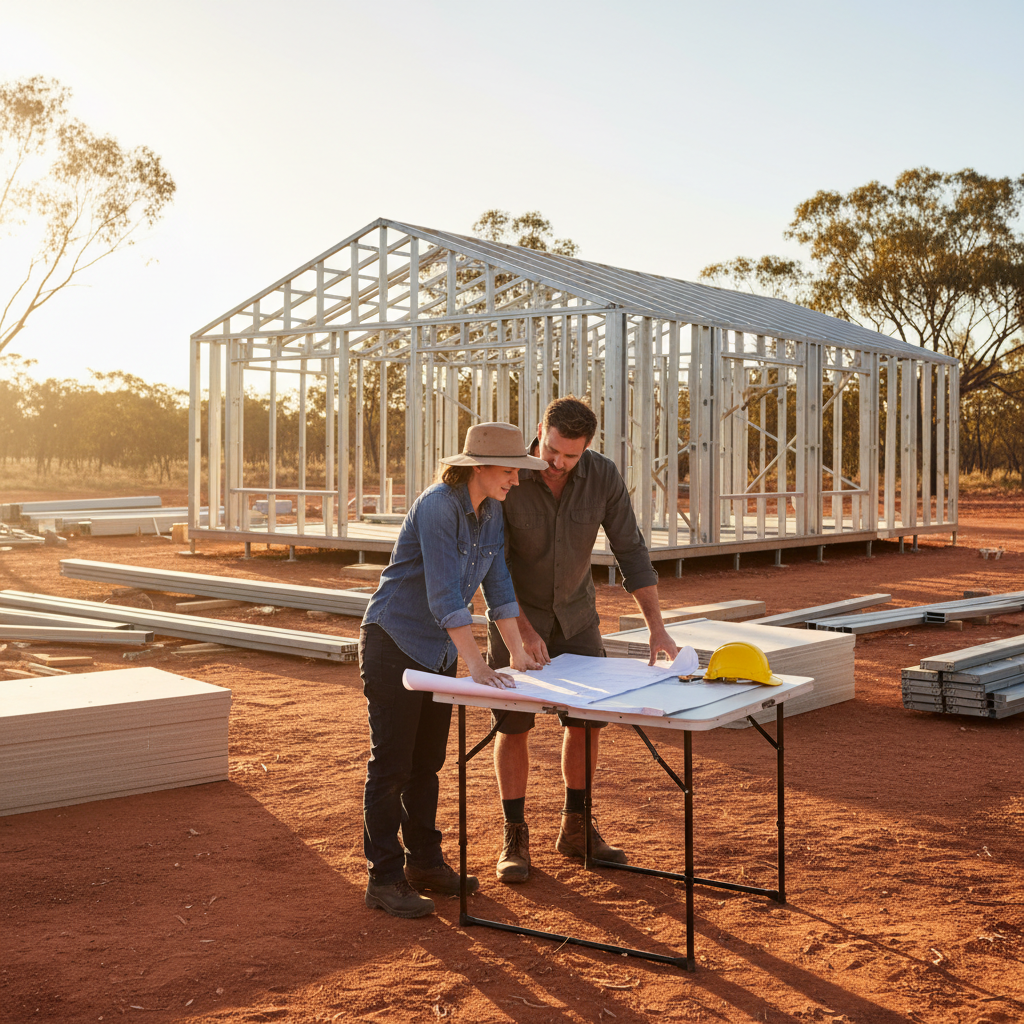
When you are dealing with N3 ratings and above, the structural design of your kit home becomes incredibly important. This is where steel frame construction, specifically using TRUECORE steel, offers a distinct advantage for owner builders. Building with steel allows for precision engineering that is difficult to replicate with traditional materials.
In high wind scenarios, the 'uplift' force is often the biggest threat. This is where the wind tries to lift the roof off the walls and the walls off the slab. Steel frames are designed with integrated tie-down systems. Because the frames are manufactured using computer controlled technology, every screw hole and connection point is exactly where it needs to be to meet the engineering specifications for your specific wind rating.
Furthermore, steel has a high strength to weight ratio. This means you can achieve the required structural integrity for a C2 or C3 rating without needing excessively thick or heavy walls. For an owner builder, this makes the assembly process more manageable while providing the peace of mind that the home is built to withstand localized pressures.
Essential Tips for Owner Builders Managing Wind Requirements
If you are taking the lead on your kit home project, here are some practical steps to ensure your build meets the necessary standards:
1. Get a Site-Specific Wind Rating Early
Do not guess your wind rating based on what the person down the road said. You should engage a qualified professional to provide a wind classification report for your specific lot. This report will guide the engineering of your entire kit, ensuring you don't under-build (which is dangerous) or over-build (which adds unnecessary complexity).
2. Focus on the Tie-Downs
The wind rating dictates your tie-down schedule. This refers to how the roof is attached to the wall frames, and how the wall frames are anchored to the concrete slab or sub-floor. In high wind areas, you will notice more frequent and heavier-duty brackets, bolts, and straps. These are non-negotiable components of your kit.
3. Consider Your Openings
Windows and doors are often the weakest points in a building's envelope during a storm. If you are in a cyclonic zone, your kit will come with windows and glass doors that are specifically rated for those conditions. Ensure you follow the manufacturer's installation instructions to the letter to maintain the integrity of these ratings.
4. Don't Ignore the Cladding and Roofing
It is not just the frame that needs to be strong. The way your COLORBOND steel roofing and external cladding are fastened is also dictated by the wind rating. Higher ratings require closer screw patterns to prevent the sheets from 'peeling' in high winds. Your kit instructions will detail the specific fastening patterns required for your site.
The Importance of Insulation and Sealing
While we often think of wind ratings in terms of strength, they also impact the comfort of your home. High wind areas often prone to 'wind driven rain'. When building your kit home, paying attention to the quality of your weather seals and insulation is vital. Using high quality glass wool or polyester batts alongside reflective sarking helps create a thermal barrier that also acts as a secondary line of defense against drafts that can occur in high pressure environments.
Owner Builder Tips: Documentation is Key
As an owner builder, you are the project manager. When the building inspector visits, they will want to see that the tie-down systems match the engineering drawings provided with your kit. Take plenty of photos of the bracing and anchoring before you cover them with internal linings. This documentation is invaluable for both Council approvals and future insurance purposes.
Conclusion
Understanding wind ratings might seem like an overly technical hurdle, but it is one of the most important aspects of building an Australian home that lasts a lifetime. Whether you are building a quiet retreat in an N1 suburban street or a rugged coastal dwelling designed for C3 conditions, the principles remain the same: respect the environment and use the right materials for the job.
By opting for a kit home with a precision engineered steel frame and high quality Australian steel components, you are giving yourself a significant head start. These systems are designed to take the guesswork out of structural integrity, allowing you to focus on the rewarding process of bringing your new home to life. Remember, a house is more than just a place to live, it is a shelter against the elements, and in Australia, that means being ready for whatever the wind may blow your way.