Sustainability is more than a sticker on a window
I was standing on a site out near Mudgee last August, wind whipping through the frame, and the owner-builder was telling me how he wanted a 'green' house. He had these fancy Italian taps picked out and some bamboo flooring. But the house was pointed south-west. He was going to bake in summer and freeze in winter regardless of his floorboards. In the kit home world, sustainability isn't about the gadgets you buy at the end. It starts with where you put the slab and how you handle the sun. You've got to think about the building envelope before you think about the decor.
Most people get hung up on the wrong things. They want solar panels on day one but they're using single-glazed windows because they're 'fine for the climate'. They aren't. Not anymore. If you're building in Australia, you're fighting a battle against extreme heat and occasionally biting cold. A well-designed kit home using a TRUECORE steel frame gives you a straight, true skeleton to work with, but what you skin it with and how you orient it makes the difference between a home that's a sanctuary and one that costs a fortune to run.
The North-Facing Rule is Non-Negotiable
Stop looking at the view for one second. Look at the sun. Your main living areas, where you'll spend your Sunday arvos and Tuesday nights, need to face north. It's the golden rule of Australian design. In winter, the sun sits low and creeps into your living room, heating up the floor. In summer, the sun is high and stays on the roof, where your insulation and eaves can deal with it. If you put big glass windows on the west, you're toast. Literally. I've seen western-facing bedrooms hit 35 degrees by 4pm while the rest of the house is manageable. It's a disaster.
Work with your kit provider to tweak the floor plan. If the 'standard' layout puts your master bedroom in the firing line of the afternoon sun, flip it. Mirror the plan. Shift a window. It's easy at the design stage and impossible once the steel is up. And don't forget eaves. A good 450mm or 600mm eave is a low-tech hero. It shades the glass when you need it and lets the light in when you don't. Simple physics.
Insulation: Spend Now or Pay Later
The National Construction Code (NCC 2022) has upped the ante on energy efficiency for a reason. Gone are the days of chucking a few thin batts in the ceiling and calling it a day. Because steel frames don't warp or twist, they provide a very stable base for your thermal envelope, but you need to understand thermal bridging. You should be using a thermal break between your steel frame and your external cladding. It's basically a layer that stops heat from moving directly through the steel studs into your home. It's required by law in many zones now, but do it anyway.
Go for R-2.5 batts in the walls and R-5.0 or higher in the ceiling. Throw in some reflective sarking under the Colorbond roof. It reflects the radiant heat back out before it even hits your insulation batts. Think of it like a silver sunshade in a car windscreen. It works. Plus, make sure your window frames are high quality. Aluminum is common but it's a great conductor of heat. Look for thermally broken aluminum frames or high-quality uPVC if the budget allows. If you stick with standard aluminum, at least get double glazing. It's becoming the standard in Australia for a reason. It cuts noise and keeps your expensive air con inside the house.
Thermal Mass and the Slab
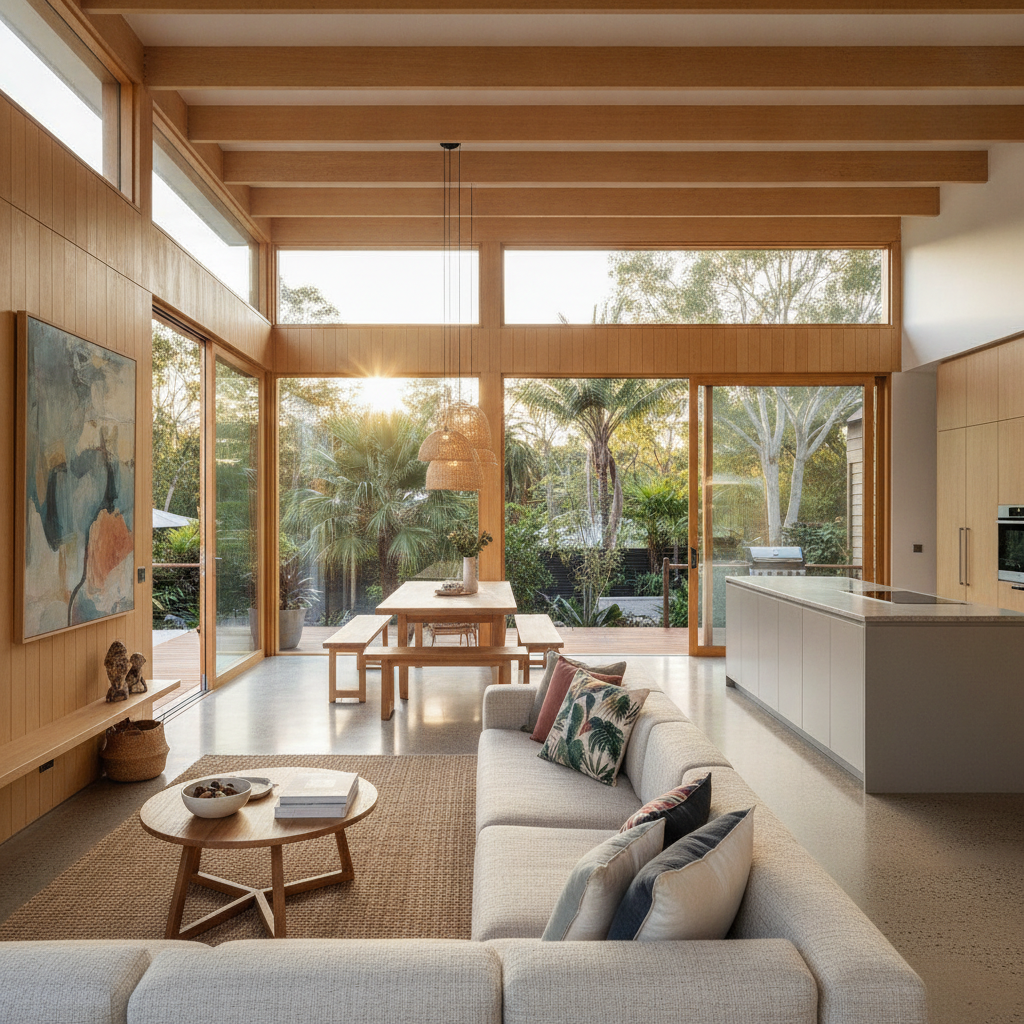
Most kit homes are built on a concrete slab. That's your secret weapon. Concrete has high thermal mass, meaning it's slow to heat up and slow to cool down. If you keep the sun off it in summer, it stays cool and helps regulate the air temperature. In winter, if the sun hits that concrete through north-facing windows, it soaks up that warmth and radiates it back out at night. It's free heating. But here's the kicker: if you cover that slab with thick carpet, you lose the benefit. Consider polished concrete or tiles in your northern living zones. It looks sharp and it's smart engineering.
Owner-Builder Tip: The Gap-Sealing Obsession
You can buy the best insulation in the world, but if your house leaks air like a sieve, it won't matter. When you're at the fit-out stage, be obsessed with gaps. Use expanding foam around window frames. Use high-quality seals on external doors. Check the spots where plumbing pipes come through the floor or walls. Air leakage is one of the biggest drivers of energy loss in Australian homes. It's a tedious job, but spend a Saturday with a couple of cans of foam and a caulking gun. Your power bill will thank you in three years.
Sustainable Water Habits
If you're building a bit further out, you're likely on tank water. Even if you're in the suburbs, a tank is a dead-set winner. Use it for the toilets and the laundry. A 5,000-litre tank is a good start, but if you've got the space, go bigger. 10,000 or 20,000 litres gives you a real buffer during those long, dry Australian summers. It's about resilience. While you're at it, look at your tapware. WELS 4-star ratings or higher are the way to go. You won't notice the difference in your shower pressure, but you'll notice the difference in your tank levels.
Choosing Materials That Last
Sustainability isn't just about energy; it's about longevity. If you have to replace your cladding in 15 years because it rotted in the humidity, that's not sustainable. That's why we use BlueScope steel. It's durable, it's termite-proof, and it won't burn. In BAL (Bushfire Attack Level) rated areas, this is non-negotiable. Using non-combustible materials like steel frames and fiber cement cladding isn't just a design choice—it's a lifestyle protection strategy. You want a house that survives the elements without needing constant chemical treatments for pests or heavy-duty maintenance.
Also, think about the end of the life cycle. Steel is 100% recyclable. If someone knocks the house down in 100 years, that frame isn't going to landfill. It's going back into the furnace to become something else. Compare that to treated timber which is full of chemicals and usually ends up as toxic waste. It's a big-picture way of looking at your footprint.
Lifestyles Change, Your Home Should Too
One trend we're seeing across NSW and Queensland is the 'forever home' mentality. People are building kit homes with a focus on 'aging in place'. This means wider doorways, level thresholds, and reinforced walls in bathrooms so you can add grab rails later if you need to. It's sustainable because it saves you from needing to renovate or move in twenty years. It's smart, proactive design. You're building a home that grows with you. Plus, an open-plan layout doesn't just feel more spacious; it allows for better cross-flow ventilation. Open a window at the front and one at the back, and let the breeze do the work of a five-kilowatt air conditioner.
Building an owner-builder project is a massive undertaking. It's a slog. You'll be tired, you'll have dust in your coffee, and you'll probably argue about paint colors. But when you're sitting in a house that stays 22 degrees on a 40-degree day because you got the orientation and insulation right, you'll know it was worth the effort. It's about taking control of the process and making decisions that benefit your wallet and the planet at the same time. No dramas.