Engineering Resilience for the Australian Tropics
Australia is a land of extremes, and for those living along the northern coastlines, tropical cyclones are a seasonal reality. If you are planning to build a kit home in these regions, your primary concern is likely the structural integrity of your future sanctuary. When the wind speeds pick up and the rain turns horizontal, you want to know that your home has been engineered with precision and built with materials that won't buckle under pressure.
In the world of Australian kit homes, steel frames have emerged as the superior choice for high-wind and cyclone-rated areas. Utilizing advanced technology, these frames offer a strength-to-weight ratio that timber simply cannot match. This article explores the benefits of using steel frames, specifically BlueScope TRUECORE steel, and how they provide the ultimate peace of mind for owner-builders in extreme weather zones.
Understanding Wind Ratings and Cyclone Zones
Before diving into the nuts and bolts of steel engineering, it is important to understand how Australian building codes categorize wind speeds. Most of Australia is classified into wind regions, ranging from Region A through to Region D, which represents the most severe cyclonic conditions found in parts of Western Australia.
When you purchase a kit home, the engineering must be site-specific. This means the thickness of the steel, the spacing of the studs, and the configuration of the bracing are all calculated to withstand the specific pressures of your block. Steel frames are particularly well-suited for this because they are manufactured with millimetre precision. Unlike natural materials that can have hidden knots or grain weaknesses, every piece of steel is a known quantity with predictable performance characteristics.
The Superiority of BlueScope TRUECORE Steel
For Australian owner-builders, the brand of steel matters just as much as the design of the house. TRUECORE steel, developed by BlueScope, is specifically engineered for the Australian environment. It features a distinctive blue finish and is backed by a reputation for durability. But why is it the go-to for cyclone zones?
Firstly, steel is inherently non-combustible, which is a vital consideration in many cyclone-prone areas that also face bushfire risks during the dry season. Secondly, steel frames are termite-proof. In the humid, tropical environments where cyclones occur, termite activity is often at its peak. Using a material that termites cannot eat ensures that the structural integrity of your home remains uncompromised over decades, meaning the wind-load capacity you have on day one is the same capacity you have twenty years later.
Precision Engineering: The Key to Wind Resistance
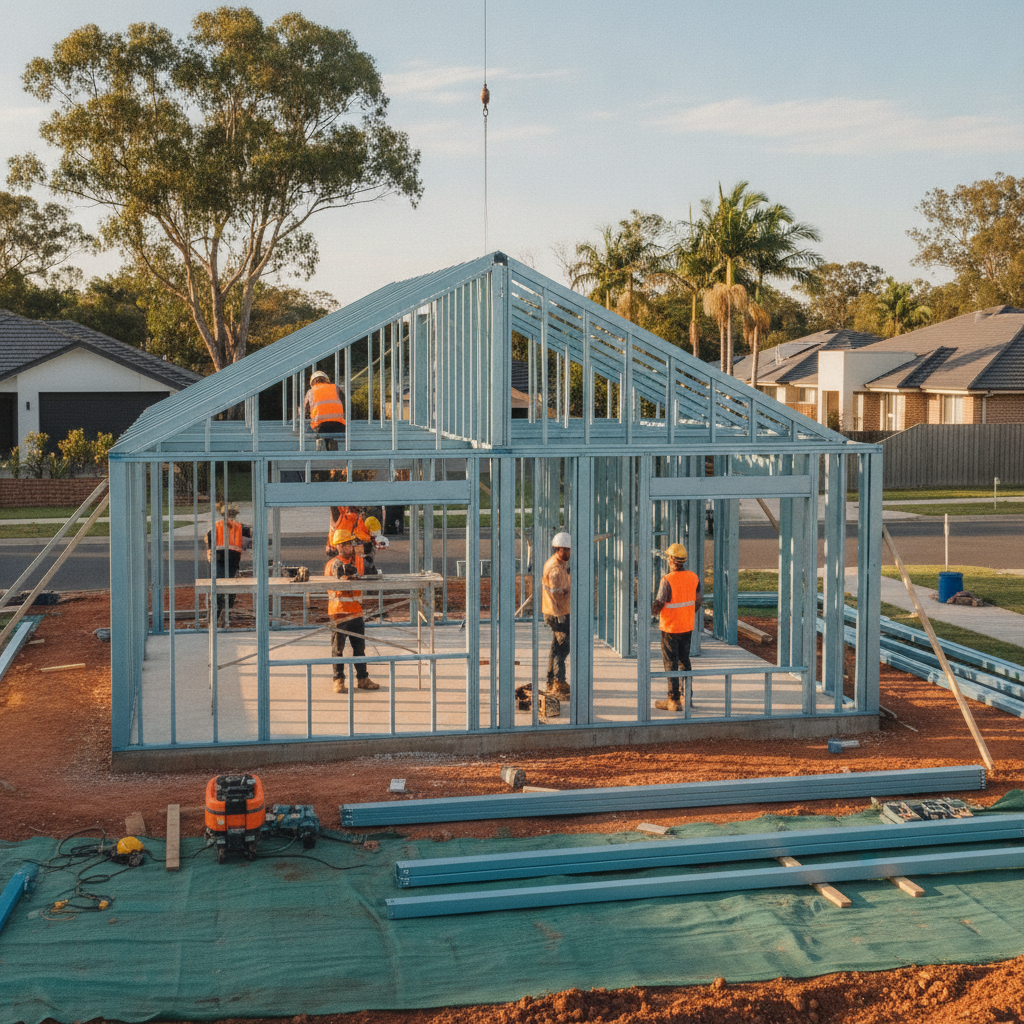
The secret to a cyclone-resilient kit home lies in the connection points. In a high-wind event, a house is subject to massive uplift and lateral forces. The wind essentially tries to peel the roof off and push the walls over. Steel frames use a sophisticated system of brackets, bolts, and screws that create a continuous load path from the roof down to the concrete slab.
When you are assembling a steel frame kit, you will notice that the components are pre-punched and clearly marked. This precision ensures that every fastener is exactly where the engineer intended it to be. For an owner-builder, this takes the guesswork out of the construction process. You aren't relying on a hand-cut joint that might be off by a few degrees, you are assembling a system that has been computer-modeled to withstand specific wind velocities.
The Concept of the 'Tight' Building Envelope
In a cyclone, the failure of one window or door can lead to the rapid pressurization of the interior, which often leads to the roof being blown off. Because steel frames are incredibly stable and do not warp, shrink, or twist over time, they provide a very consistent substrate for windows and doors. This stability helps maintain the seal of the building envelope. When everything stays square and true, your high-performance windows and doors can do their job effectively, keeping the pressure outside where it belongs.
Practical Tips for Owner-Builders in Cyclone Regions
If you are taking on the role of an owner-builder in a high-wind area, here are some practical steps to ensure your project is a success:
- Check Your Wind Rating Early: Before you even select a design, talk to your local council or a private certifier to confirm the exact wind classification for your specific lot.
- Focus on the Roof Geometry: This isn't just about aesthetics. Hip roofs (where all sides slope down to the walls) generally perform better in high winds than gable roofs. Steel frames allow for complex roof designs to be executed with ease.
- Insulation Matters: Even though we are talking about strength, don't forget the thermal performance. Steel frames allow for the easy installation of high-quality insulation and bulkheads, which are essential in the tropical climates where cyclones are common.
- Work Closely with Your Concreter: The connection between the steel wall plates and the slab is the most critical part of the cyclone-proofing process. Ensure your anchor bolts are placed exactly according to the engineering plans.
Durability Beyond the Storm
While we often focus on the extreme events, the day-to-day benefits of steel frames shouldn't be overlooked. In coastal regions, the salt air can be brutal on building materials. TRUECORE steel has a protective alloy coating that resists corrosion, ensuring that the 'bones' of your home stay strong even in salty environments. Furthermore, because steel frames are lightweight, they are much easier to handle on-site during the assembly phase. This reduces the physical toll on the owner-builder and often speeds up the 'lock-up' stage of the project.
Environmental Considerations
Building with steel is also a responsible choice for the modern homeowner. Steel is 100 percent recyclable. In the manufacturing process, computer-aided design ensures that there is very little waste. Every piece of the kit is cut to length, meaning your site stays clean and you aren't paying for offcuts that end up in a skip bin. For the environmentally conscious owner-builder, this efficiency is a major drawcard.
Common Myths About Steel Frames
Some people worry that a steel-framed home might be loud during a storm or that it will interfere with Wi-Fi signals. In reality, once the cladding, insulation, and plasterboard are installed, a steel-framed home is just as quiet as any other structure. As for electronics, the framing is spaced such that it has no discernible impact on modern wireless internet or mobile phone reception. What you do get is a home that doesn't creak and groan as the temperature changes, as the steel is dimensionally stable.
The Peace of Mind Factor
At the end of the day, building your own home is an emotional and financial investment. For those in North Queensland, the Northern Territory, or the WA coast, that investment needs to be protected against the forces of nature. Choosing a steel-framed kit home means you are choosing science and engineering over tradition and guesswork.
When you stand back and look at your completed home, knowing that it is tied together with high-tensile steel and backed by BlueScope's rigorous testing, you can sleep a little easier. You have built a structure that isn't just a house, it is a fortress designed to keep your family safe during the worst that the Australian climate can throw at it.
Conclusion
Steel frames represent the pinnacle of modern kit home construction, especially when engineering for extreme weather. From the termite-resistant properties to the millimetre-perfect manufacturing, the benefits are clear for any owner-builder. By choosing a kit that utilizes TRUECORE steel and follows strict Australian engineering standards, you are setting yourself up for a successful build and a lifetime of security. Whether it is a category one breeze or a category five cyclone, a well-constructed steel frame home is built to stand its ground.