The Foundation of a Straight Home: Understanding Dimensional Stability
When you start the journey of building your own home in Australia, you are usually focused on the big picture: the floor plan, the kitchen finishes, and where the deck will go to catch the afternoon breeze. However, the most important factor in the long term quality of your home is something you will eventually cover up with plasterboard. We are talking about the structural frame.
For Australian owner-builders, the choice often comes down to traditional timber or modern steel. While both have their place in construction history, there is one technical advantage that puts steel in a league of its own: dimensional stability. In simple terms, this means that the material stays the exact same shape and size from the day it leaves the factory to fifty years down the track. In the volatile Australian climate, where humidity and temperature can swing wildly in a single day, this stability is the difference between a home that ages gracefully and one that develops annoying quirks.
Why Timber Moves and Steel Stays Still
To understand why steel is such a game changer for kit homes, we have to look at the science of the materials. Timber is a biological product. It is cellular and designed by nature to move water. Even after it is kiln dried and treated, timber remains hygroscopic, meaning it absorbs and releases moisture from the surrounding air. When the humidity is high, timber expands. When the summer sun bakes the landscape, timber shrinks.
This constant movement is what causes many of the common headaches in Australian houses. You might have noticed doors that stick in winter but swing freely in summer, or cracks appearing in the plaster above door frames. These are the physical symptoms of a frame that is literally moving behind your walls.
Steel, specifically high quality BlueScope TRUECORE steel used in modern kit homes, is an engineered product. It is inorganic and completely unaffected by moisture levels. Whether you are building in the humid tropics of Queensland or the dry heat of the Victorian interior, a steel stud will remain perfectly straight, level, and true. It does not warp, it does not twist, and it certainly does not shrink.
The Owner-Builder Advantage: Easier Installation
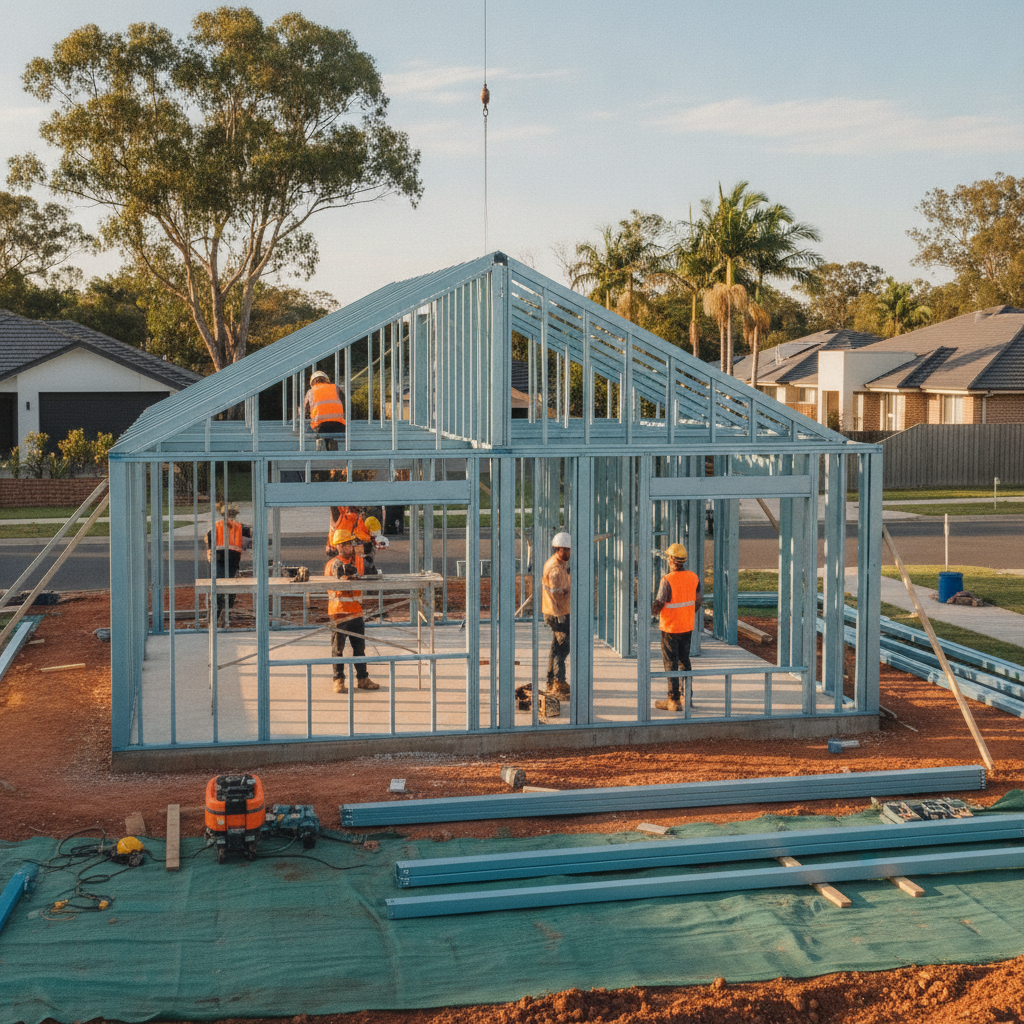
If you are taking the path of an owner-builder, you want a construction process that is as logical and straightforward as possible. This is where the dimensional stability of steel becomes your best friend on site. Because steel frames are manufactured to millimetre-accurate specifications, every piece fits together exactly as it should.
When you work with materials that can warp or bow while sitting on a pallet, you spend half your time "straightening up" or working around imperfections. With steel kit homes, the components arrive on site straight and stay straight. This leads to a much faster assembly process. You aren't fighting with a piece of wood that has developed a "crown" or a twist since it was delivered. For a DIY enthusiast, this precision takes a lot of the stress out of the structural phase of the build.
Say Goodbye to Plaster Cracks and Nail Pops
One of the most frustrating things for any homeowner is finishing a beautiful build, only to see small cracks appear in the cornices or walls six months later. In timber-framed homes, this is often caused by "timber shrinkage." As the wood loses its initial moisture content, the frame settles and shifts, putting pressure on the rigid plasterboard sheets.
By choosing a steel frame for your kit home, you are effectively future-proofing your interior finishes. Because the frame does not shrink or settle, the plasterboard stays exactly where you put it. This leads to:
- Perfectly flat walls that look professional under downlights.
- Square corners that make tiling and cabinetry installation much easier.
- A significant reduction in "nail pops," where the plaster screw pushes through the surface because the stud behind it has moved.
The Impact of the Australian Climate
The Australian environment is notoriously tough on building materials. We deal with intense UV radiation, periods of extreme flooding, and prolonged droughts. These conditions accelerate the natural movement of biological materials. Steel is uniquely suited to this landscape. It is non-combustible, which provides peace of mind in bushfire-prone areas, and it is 100 percent termite-proof without the need for additional chemical treatments.
However, the stability benefit is most evident during those seasonal shifts. In many parts of Australia, we experience "diurnal temperature swings," where it might be 30 degrees during the day and drop to 10 degrees at night. Steel frames move very slightly with temperature (standard thermal expansion), but because the entire system is engineered to move together and returns to its exact original state, it does not suffer the permanent warping that timber can experience after a wet winter followed by a scorching summer.
Long-Term Value and Low Maintenance
A kit home is a significant investment, and savvy owner-builders look at the total cost of ownership, not just the initial price. A dimensionally stable home is a low-maintenance home. When the frame stays square, there is less stress on window seals, door hinges, and roof flashings. This means fewer leaks, fewer sticking windows, and less time spent on repairs over the decades.
Furthermore, when it comes time to sell, a home that handles the test of time looks better to prospective buyers. A house with straight walls and no signs of structural movement suggests a high quality build, which can positively impact the resale value.
Practical Tips for Working with Steel Frames
If you are planning to build a steel frame kit home, here are a few practical tips to help you make the most of that dimensional stability:
1. Preparation is Key: Because steel frames are so precise, your slab or sub-floor needs to be spot-on. Take the extra time to ensure your base is level. Steel does not allow for much "shaving down" if your foundation is uneven.
2. Use the Right Tools: You will need a good quality impact driver and specific self-drilling screws designed for steel. The accuracy of the pre-drilled holes in your kit makes the assembly feel like a giant Meccano set, which is very satisfying for a DIY builder.
3. Plan Your Services: Steel frames often come with pre-punched service holes for electrical and plumbing. Because the studs will never move, your cables and pipes are protected from being pinched or stretched over time.
4. Think About Insulation: While steel is stable, it is a conductor of heat. Always ensure you include a high quality thermal break and insulation as part of your kit package. This ensures your stable frame also contributes to a comfortable, energy-efficient home.
Conclusion: Peace of Mind for the Owner-Builder
Building a kit home is a rewarding way to create a space that perfectly fits your lifestyle and budget. By choosing a steel-framed system, you are removing one of the biggest variables in construction: material movement. The dimensional stability of BlueScope TRUECORE steel ensures that the vision you have on paper translates perfectly to the real world, and stays that way for a lifetime.
No more worrying about sticking doors, wonky walls, or the silent threat of termites. Instead, you can focus on the joy of building and the satisfaction of knowing your Australian home is built on a foundation of precision and durability. When you build with steel, you aren't just building a house, you are building a legacy that will stay straight and true through every season the Australian climate can throw at it.