Built Tough: Why Steel Frames are Your Best Mate Against Bushfire in a Kit Home
Last summer, that scorching week before Christmas, while everyone else was stressing about getting the Christmas ham cooked, I was watching the sky, dark with smoke from the hills behind us. You see enough of that, you start looking at your own place differently. What's it made of? How well will it stand up if things really go pear-shaped? For owner-builders like us, especially those putting up a kit home, these aren't just hypotheticals. These are real questions, particularly when you're talking about bushfire resistance. And that's where a steel frame kit home really earns its keep.
Most folks know steel frames are brilliant for keeping termites out, right? And they don't warp or twist like timber. But the big one, the critical advantage, especially in fire-prone parts of Australia, is how they behave when the heat really gets turned up. This isn't just theory. This is about certified fire resistance, something every owner-builder needs to understand when they're planning a build in a Bushfire Attack Level (BAL) zone.
Understanding BAL Ratings and What They Mean for Your Build
If you're building anywhere outside a major city centre, chances are your block has a BAL rating. This isn't some council bureaucracy for the fun of it. This is a life-or-death classification, and it dictates a whole lot about how you're allowed to build. From BAL-Low, all the way up to BAL-FZ (Flame Zone), each level specifies stricter requirements for construction materials and techniques.
Now, a lot of owner-builders get bogged down in the specifics of BAL ratings, and fair enough, it's complex. But here's the kicker: your framing material plays a huge part in meeting those higher BAL requirements. With a traditional timber frame, once you hit BAL-29 or above, you're usually looking at adding a heap of fire-resistant sarking, specific cladding, and internal linings, all just to protect that timber. It can get expensive, fast.
Steel, on the other hand? It's non-combustible. Full stop. It won't ignite. It won't add fuel to a fire. This is a massive leg up right from the start. That doesn't mean your whole house becomes fireproof just by having a steel frame - fireproofing is always about the entire system. But it means the core structure, the bones of your home, isn't going to contribute to the fire spread. And that's a damn good place to start.
Steel's Strength in the Face of Fire: It's Not Just About Burning
When you talk about timber in a fire, everyone thinks about it catching alight. True, timber burns. But even before that, timber loses strength rapidly as it heats up. It chars, it shrinks, it twists. A structural timber frame can start to fail pretty quickly, even if it hasn't fully ignited, simply because the intense heat degrades its load-bearing capacity.
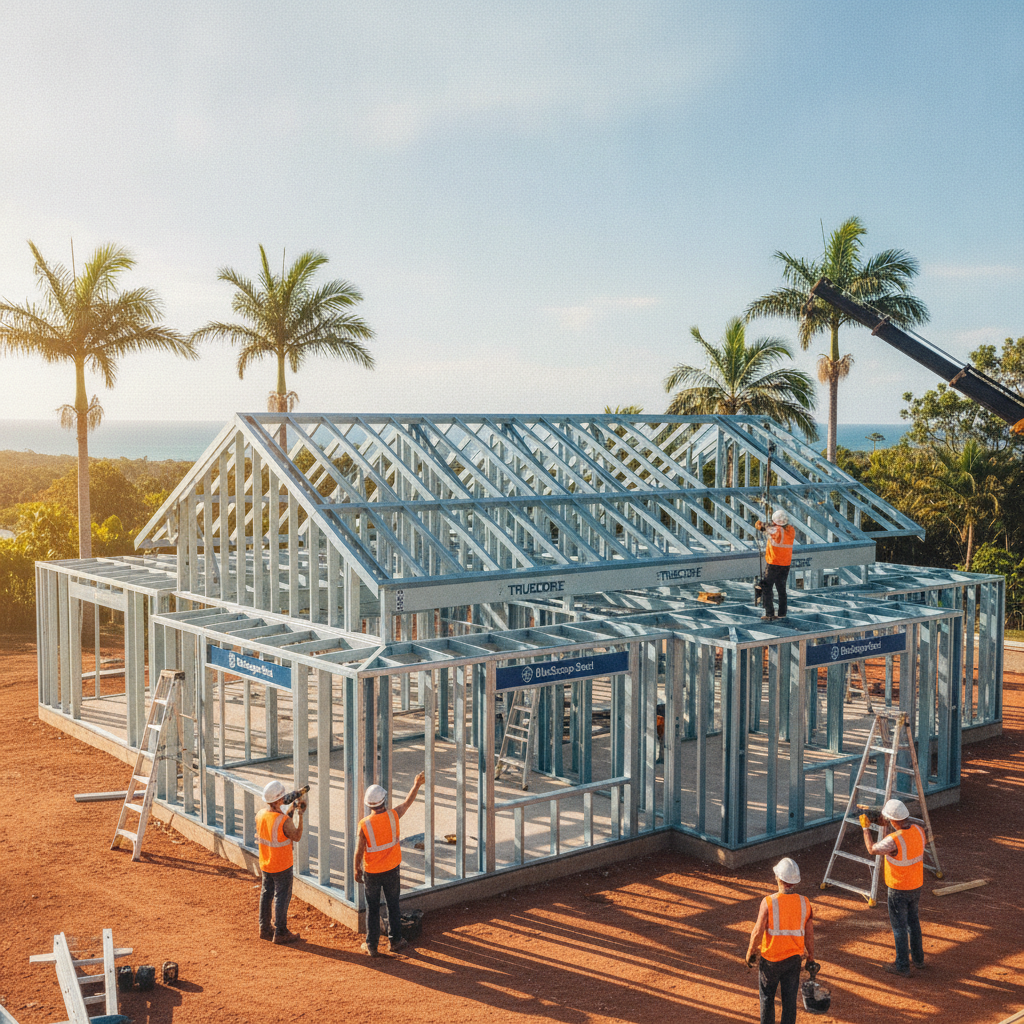
Steel behaves differently. It doesn't combust. It doesn't char. It maintains its structural integrity at much higher temperatures than timber. Now, I'm not saying steel is invincible; nothing is in a bushfire. At extreme temperatures, steel can eventually soften and lose strength. But we're talking about temperatures far beyond what causes timber to fail. And importantly, BlueScope Steel, which we use for our TRUECORE frames, has excellent performance characteristics under heat.
What this means practically is that your steel-framed kit home has a far greater chance of remaining structurally sound during and after a bushfire event. This can be the difference between losing everything and having a core structure that can be repaired. And for an owner-builder, that's not just about money, it's about not having to start from absolute scratch.
The System Approach: Steel Frames Work Better with Other Fire-Resistant Materials
Think of your home's bushfire defence as layers. The frame is the foundation layer. Then you've got your external cladding, your roofing, your windows, and your subfloor system. When your core frame is steel, it makes all those other layers work harder and more effectively.
Because the steel frame doesn't need as much intrinsic protection from fire, you've got more flexibility with your other choices. You'll still need to pick fire-resistant cladding - things like cement sheeting, specific timbers rated for BAL zones, or brick veneer. And your roof will need to be non-combustible, like COLORBOND® steel, which is another BlueScope product that pairs perfectly with our TRUECORE frames.
Windows are a massive vulnerability in bushfires, no matter the frame. You'll need toughened glass, often specified to a certain minimum thickness, or even fire-rated shutters. But with a steel frame, you know that the walls holding those windows aren't going to be the first thing to give way. It's about cumulative advantage.
Practical Tips for Owner-Builders in Bushfire Zones
- Get Your BAL Assessment Early: Don't leave this till you've got your plans drawn up. Get a proper BAL assessment for your specific block before you even start dreaming about floor plans. It dictates everything.
- Choose Your Kit Supplier Wisely: Make sure your kit home supplier understands BAL requirements and offers systems that meet them. We design our kits with these challenges in mind, using materials like TRUECORE steel for the frame and COLORBOND steel for the roof precisely because they perform so well.
- Focus on the Entire Envelope: A steel frame is crucial, but don't forget the rest. Your cladding, roof, windows, doors, even your gutters and downpipes, all need to be part of your bushfire defence strategy. Look at things like enclosed subfloors if you're on stumps, and ember guards on vents.
- Landscaping Matters Just As Much: This isn't construction, but it's vital. Maintain your immediate surrounds. Clear out leaf litter, keep grass short, have a clear zone around the house. Fuel reduction is your first line of defence. It doesn't matter how fire-resistant your house is if it's surrounded by a pile of kindling.
- Talk to Your Certifier: Your building certifier is your best friend here. They'll interpret the NCC (National Construction Code) and AS 3959 (Construction of buildings in bushfire-prone areas) for your specific build. Don't guess. Ask.
The Fire Resistance Rating (FRR) and How Steel Stacks Up
When you're looking at specific components for your build, you might come across terms like 'Fire Resistance Level' (FRL) or 'Fire Resistance Rating' (FRR). These are measures of how long a building element - a wall, a floor, a column - can withstand fire under test conditions, maintaining its structural adequacy, integrity, and insulation properties.
For load-bearing walls, steel frames offer a significant advantage because their inherent non-combustibility means they don't contribute to the fire load. When combined with fire-rated plasterboard (like specific types of Gyprock) and appropriate insulation, a steel-framed wall system can achieve impressive FRRs. This is critical in areas like shared walls in duplexes or where specific code requirements for fire separation apply.
You'll often find that achieving a 60-minute or 90-minute FRR is much more straightforward and cost-effective with a steel frame compared to timber, where you'd need multiple layers of specialized fire-rated board and often, specific timber treatments. This isn't just about meeting the minimum; it's about building in an extra margin of safety and resilience.
Maintenance and Longevity: Less Worry After the Fire Season
After a bushfire passes, even if your house survived, timber can be prone to charring and hidden damage, requiring extensive checks and potential replacement of structural elements. Steel, being non-combustible, generally doesn't suffer the same kind of degradation. While severe heat can still affect it, the visible signs of damage are usually more apparent, and hidden charring isn't a concern.
This means less post-fire remedial work on the structure itself. It's not a silver bullet, no. But it certainly helps with the mental load and the practical load of getting your life back on track. Plus, with the inherent resistance to termites and rot that steel offers, you're building a home that's going to stand strong for decades, through fire season and beyond.
Final Word for Owner-Builders
Building your own kit home is a massive undertaking, a real badge of honour. You want to make sure you're doing it right, not just to pass inspection, but to build a home that's safe for your family, especially in a country like Australia where bushfires are just a fact of life. Choosing a steel frame isn't just a material choice; it's a statement about resilience. It's about building with confidence, knowing that the bones of your home are as tough as they come, ready to face whatever the Aussie environment throws at it. So, when you're flipping through those designs, just remember that steel isn't just straight and strong, it's also fire's worst enemy. A good mate to have when the going gets hot.