Built Tough: Why Steel Frames Are Your Best Mate in Cyclone Country
Listen, if you're building a home anywhere from Exmouth to Cairns, or even down on the exposed parts of the South Coast, you've got to think about more than just a nice view. Cyclones, severe storms, the kind of wind that strips paint off a ute – that's our reality here in Australia. And when it comes to standing up to that sort of punishment, timber just doesn't cut it like steel. We've been seeing it for years, folks.
It’s not just about a bit of a breeze. We’re talking about Category 3, 4, even 5 cyclones ripping through, with gusts over 200 km/h. That’s enough to make a brick house shudder, never mind anything less. That’s why, when you’re looking at a kit home, especially one for a rural block where shelter’s scarce, a steel frame isn't just a good idea, it's a non-negotiable for peace of mind. Your home, your family – they deserve the best shot at staying safe.
Engineered for the Brutal Stuff: What Steel Does Differently
Right, so why steel? It comes down to a few core things that timber can’t match, especially when the weather goes truly feral. We’re talking about the fundamental properties of the material, how it’s put together, and what it means when that big low pressure system starts spinning offshore.
Strength and Rigidity: It Doesn't Twist and Bend
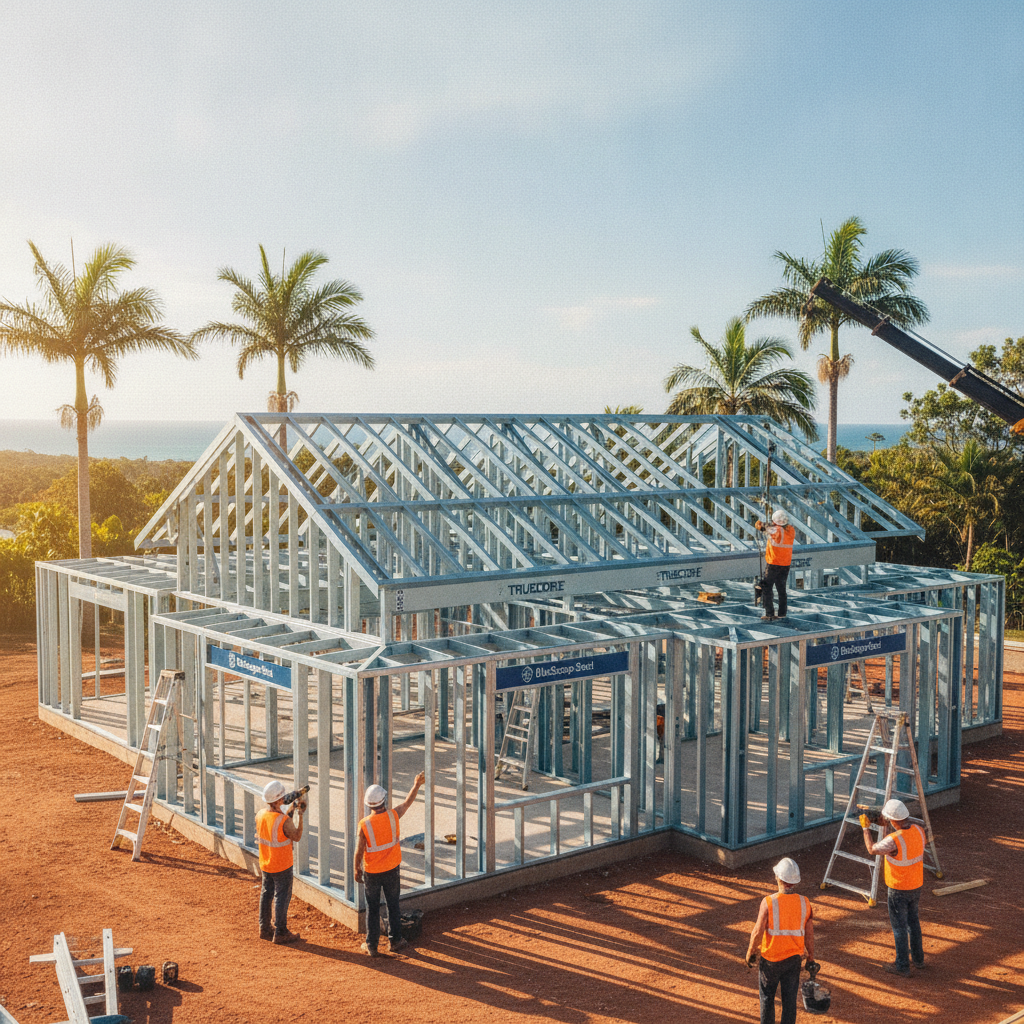
Steel has an incredible strength-to-weight ratio. What does that mean in real terms? It means you can have a lighter frame that’s significantly stronger than a heavier timber one. This isn't just marketing talk. Under extreme wind loads, a steel frame holds its shape. It doesn't twist, it doesn't warp, it doesn't buckle in the same way timber can when it's pushed to its limits. Think about it: a house is essentially a box. You want that box to stay a box, not turn into a parallelogram when the wind tries to rip the roof off. BlueScope Steel, especially the TRUECORE stuff we use, it’s engineered to a standard. It's consistent.
And those connections, the way the frame pieces join up? They're bolted, screwed, and riveted with precision. None of this nailing that can work loose over time or under repeated stress. Every joint is designed to distribute the load evenly, making the whole structure a single, robust unit. That's a big deal when wind wants to find the weak link in your chain.
Non-Combustible: A Lifesaver in Bushfire Zones Too
Okay, this isn’t strictly cyclone related, but it’s a massive win for rural properties, and many cyclone zones are also bushfire prone. Steel is non-combustible. It won’t catch fire, and it won’t contribute to the fuel load if a fire rips through. While the contents of your house might burn, the frame itself will still be standing. This is a huge factor for insurance in BAL (Bushfire Attack Level) rated areas. We've had customers up in places like Townsville and Yeppoon, they’re thinking about both cyclones and the dry season fires. Steel tackles both those headaches pretty well, I reckon.
Precision Engineering: Every Piece Fits Exactly
Timber frames, you're always dealing with variations – knots, twists, bowing. That’s just nature. But with steel, every stud, every truss, every rafter is rolled to exact specifications. Computer-aided design means your frame is cut and punched precisely. When you're putting it together as an owner-builder, this precision makes a huge difference. You're not trying to square up a bowed stud; everything just slots into place. This accuracy isn't just for ease of build, it ensures the structural integrity exactly matches the engineering design. In high-wind areas, this isn’t a nice-to-have, it’s essential. Because if the frame isn’t true, it’s not going to perform as expected when the wind really starts howling.
Cyclone Ratings: Understanding What Your Home Needs
When you’re building in a cyclone-prone area, your local council or certifier will specify a wind rating for your home. This isn’t a suggestion; it’s the law, and it’s there for a reason. These ratings, like C1, C2, C3, and C4, tell you how much wind pressure your home’s structure, cladding, and roof need to withstand. A C4 rating means you’re in a serious cyclone zone, and your home needs to be built like a fortress.
Steel frames are inherently better suited to achieve these higher ratings without needing massive, bulky sections. The engineering for a steel frame in a C3 or C4 zone will specify thicker gauges, more robust connections, and specific bracing systems that are all factored into the design right from the start. Our kit homes, using TRUECORE steel, are designed to meet or exceed these Australian Standards (AS/NZS 1170.2, for those who want the technical details) for high-wind regions. You want that peace of mind.
Bracing and Hold-Downs: The Invisible Protectors
It’s not just the frame itself; it’s how it’s tied down. In cyclone country, the focus is on preventing the roof from lifting off and the walls from racking (leaning sideways) or collapsing. Steel frames allow for incredibly strong connections from the roof trusses, down through the wall frames, all the way to the slab. We're talking about heavy-duty strapping, hold-down bolts, and specific bracing elements that are integrated into the frame design. You often won't even see these once the house is finished, but they're working hard, silently, keeping everything together. They're critical for passing inspections in high-wind zones, and frankly, for keeping your house from becoming a statistic.
Practical Tips for Owner-Builders in Cyclone Zones
So, you've decided on a steel frame kit home for your remote block. Good call. Now, here's some practical advice from someone who's seen a few builds, and a few cyclones, come and go.
- Get Your Site-Specific Wind Rating Locked In Early: Before you even look at plans too seriously, talk to your local council or a private certifier about the exact wind rating for your block. Don’t guess. It can change even a few kilometres down the road. This dictates everything.
- Follow the Plans Religiously: With high-wind engineering, every single screw, every bit of bracing, every connection is there for a reason. Do not deviate. The engineers have spent a lot of time calculating those loads. If the plans say 14g screws at 300mm centres, that's exactly what you do. No cutting corners, mate.
- Check Your Materials Deliveries: When your kit arrives, double-check that every piece listed on the manifest is there, and that any specific cyclone-rated components (special screws, straps, bracing) are present. Trying to track down a missing box of fasteners when the frame's half-up is a nightmare.
- Don't Skimp on the Slab and Footings: The strongest frame in the world is useless if it's not tied to a solid foundation. Make sure your slab is engineered for your specific wind rating and soil conditions. It’s the anchor for your whole house.
- Consider Your Cladding and Roofing Carefully: A steel frame is only part of the equation. Your roofing iron and wall cladding also need to meet those cyclone ratings. Colorbond steel roofing and cladding, for instance, is a popular choice because it's tested to withstand extreme weather. Make sure it's fixed correctly, too. High-wind zones often require more fasteners, closer together.
- Storage During Construction: If you're building in the wet season or cyclone season, think about how you'll secure materials on site. Stacked frames, cladding sheets – they can become missiles if a sudden squall comes through. Tie everything down. Seriously.
Beyond the Wind: Other Rural Kit Home Considerations
Even though we're focusing on cyclones, a rural kit home has other challenges. Steel frames help with a bunch of them:
- Termites: Massive problem out in the sticks. Steel frames? Termites hate 'em. Can't eat steel. Reduces a huge headache for you, no need for chemical treatments in the frame itself.
- Bushfire Resistance: As I mentioned, being non-combustible is a big plus in many rural areas, especially during the dry.
- Durability and Longevity: Rural properties often face harsher conditions – more sun, more dust, bigger temperature swings. Steel frames don’t rot, shrink, or warp due to moisture or extreme heat, meaning your home stays strong for decades with less maintenance. Less mucking around for you down the line.
The Bottom Line
Building a home, especially a kit home as an owner-builder, is a huge undertaking. But doing it in a cyclone-prone rural area adds another layer of complexity, and responsibility. Choosing a steel frame isn't just a construction decision; it’s a safety decision, a durability decision, and a smart long-term investment. It's about knowing that when the wind picks up and the rain starts lashing, your home, built with the strength of BlueScope TRUECORE steel, is standing firm. You’ve put the effort in, you deserve a home that can take whatever the Australian weather throws at it. Don’t settle for anything less when it comes to keeping your family safe. Get it right the first time, mate. You won't regret it.