The Great Australian Balancing Act
So, you have decided to take the plunge. You have got the land, you have picked out a stunning steel frame kit home design, and your owner builder permit is framed on the wall. There is just one small detail: you still have a 38-hour-a-week job to attend to. For many Australians, the dream of building their own home only becomes a reality by balancing the build with a full-time career. It is a marathon, not a sprint, and your most valuable resource isn't your hammer or your drill, it is your calendar.
Building a kit home as an owner builder is an empowering experience. You get to oversee the quality, manage the site, and take pride in the physical progress. However, when you are juggling site deliveries and trade coordination with office meetings and commutes, things can get hectic. The key to success lies in ruthless organization and leveraging the efficiency of modern building materials like BlueScope TRUECORE steel frames. Here is how you can manage your time effectively while keeping your sanity intact.
1. Leverage the Speed of Steel
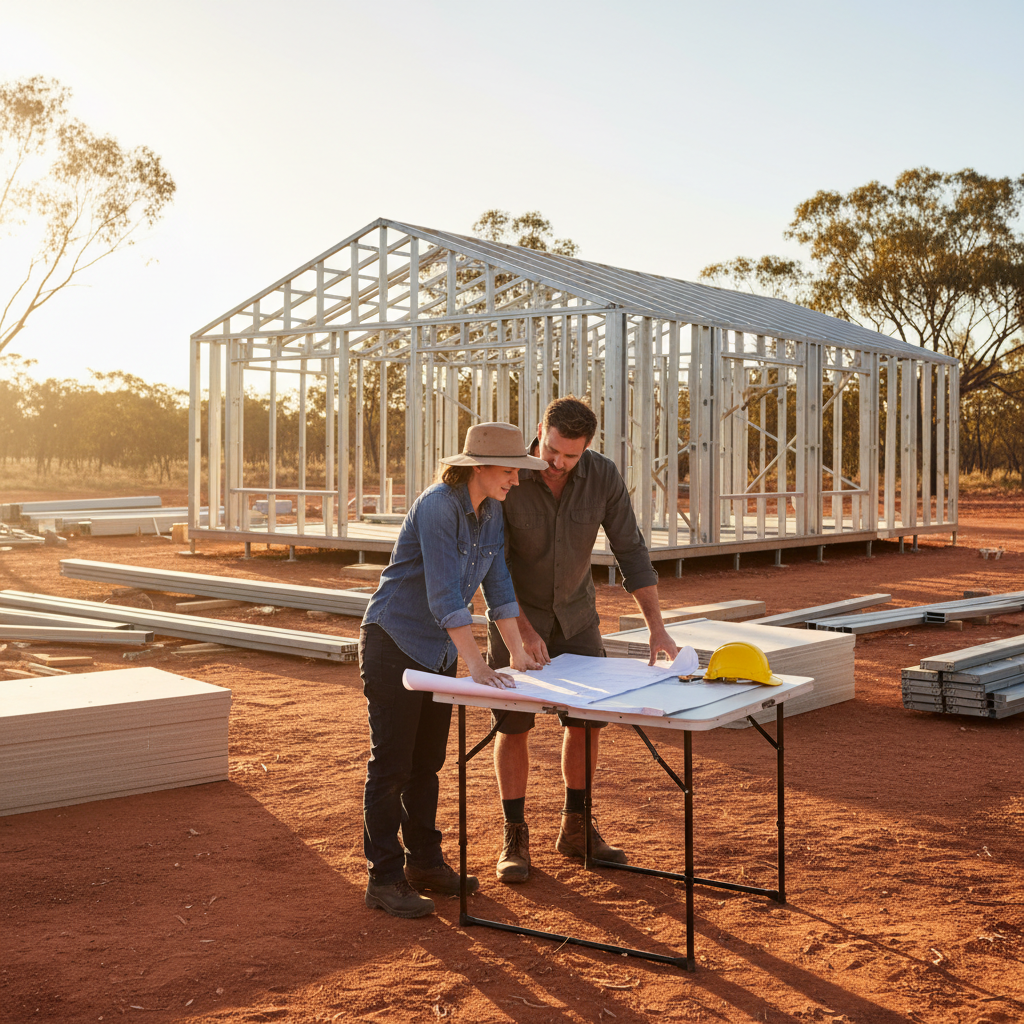
Time management starts with choosing the right building system. One of the reasons steel frame kit homes are a favorite for working owner builders is the speed of the initial shell construction. Unlike traditional timber framing which might require significant on-site measuring and cutting, steel frames arrive pre-punched and ready to bolt together. Since the frames are straight and true, you won't spend your precious weekends planning out wonky walls or shaving back studs to get your plasterboard to sit flush.
By using a steel kit, you significantly reduce the 'on-site' labor time during the structural phase. This is a massive win for someone who only has Saturdays and Sundays to make major physical progress. Because the components like the roofing, cladding, and windows are designed to fit the precision-engineered frame, the entire 'lock-up' phase is streamlined.
2. The 'Golden Hour' Rule
You do not need to be on-site for eight hours a day to keep a project moving. When you are working full-time, the most effective tool in your kit is the 'Golden Hour'. This is the one hour before you go to work or the one hour immediately after you get home. Use this time for administrative tasks that keep the momentum going.
Morning tasks might include calling trades to confirm they are still coming on Thursday or checking that your insulation delivery is on track. Afternoon tasks involve walking the site with a headlamp if necessary to check the day's progress, cleaning up debris to ensure the site is safe for the next day's trades, or updating your project timeline. Consistency beats intensity every single time.
3. Treat Your Build Like a Second Business
If you treated your job as loosely as some people treat their home builds, you probably wouldn't stay employed for long. Apply professional project management principles to your kit home. Use a dedicated digital calendar or a project management app. Use it to track every milestone: from the slab pour and the arrival of your steel frames to the final electrical fit-out.
Schedule your trades well in advance. In the current Australian building climate, good trades are booked out weeks or months ahead. If you wait until the windows are in to call a plasterer, you might find yourself stuck in a three-week stalemate with no progress. Always look two steps ahead. If the cladding is going on this weekend, you should already be confirming the internal plumbing rough-in for the following week.
4. Master the Art of Late-Night Procurement
Your weekends should be reserved for physical work or on-site supervision. Do not waste a sunny Saturday morning wandering around a hardware store looking for boxes of screws or internal door handles. All of your procurement should happen online or over the phone during your lunch breaks or in the evenings.
Most major Australian suppliers allow for 'click and collect' or scheduled deliveries. If you have your kit home components ready to go, make sure you have all the supplementary tools and consumables staged on-site before the weekend arrives. When Saturday morning rolls around, you should be able to step out of your car and start working immediately.
5. Communication is Your Secret Weapon
When you aren't on-site during the day, your communication with trades must be crystal clear. Tradespeople are used to working with site managers. As an owner builder, that is your role. Since you aren't there in person at 10:00 AM on a Tuesday, leave clear instructions. Some owner builders use a site diary kept in a waterproof box near the entrance, or they use marking chalk on the slab to indicate exactly where they want certain fixtures.
Be the person who answers their phone. If a plumber has a question about a drainage point, and you are in a meeting, that plumber might sit idle or move on to another job. If your workplace allows it, stay accessible. A quick thirty-second phone call can save you a week of delays.
6. The 'Small Wins' Strategy
Burnout is a real risk for the working owner builder. Looking at a whole house that needs finishing can be overwhelming when you have just finished a stressful week at the office. Break the project down into micro-tasks. Instead of saying, 'I need to finish the cladding,' say 'I am going to complete the north wall this weekend.'
Completing these smaller sections gives you a sense of achievement and keeps motivation high. Remember, kit homes are designed to be logical and systematic. Follow the assembly manuals and focus on the current stage. Whether it is installing the insulation batts or fitting the internal doors, focus on the task at hand rather than the mountain still to climb.
7. Managing Your Energy, Not Just Your Time
You cannot work 40 hours at the office and then 30 hours on-site indefinitely. Identify which tasks are 'high energy' and which are 'low energy'. Heavy lifting, like standing up steel wall frames or moving cladding sheets, should be done when you are fresh on a Saturday morning. Sunday afternoons might be better suited for lighter tasks like site clean-up, silicon work, or organizing the skip bin.
It is also vital to schedule 'no-build' days. It might sound counter-intuitive when you are in a rush, but taking every second Sunday off to spend with family or just to rest will prevent the mental fatigue that leads to mistakes. A mistake on an owner builder site usually costs both time and money to fix.
Conclusion: The Reward is Worth the Hustle
Being an owner builder is one of the most rewarding ways to create a home in Australia. By choosing a steel frame kit home, you are already ahead of the game with a system that is engineered for precision and ease of assembly. While balancing the build with a full-time job requires discipline, it is a temporary season of hard work for a lifetime of reward.
Organize your schedule, communicate clearly with your trades, and utilize the efficiency of pre-cut steel components. Before you know it, you will be handing back the keys to your rental and moving into a home that you didn't just buy, but one that you truly helped create. Keep the momentum going, one 'Golden Hour' at a time.