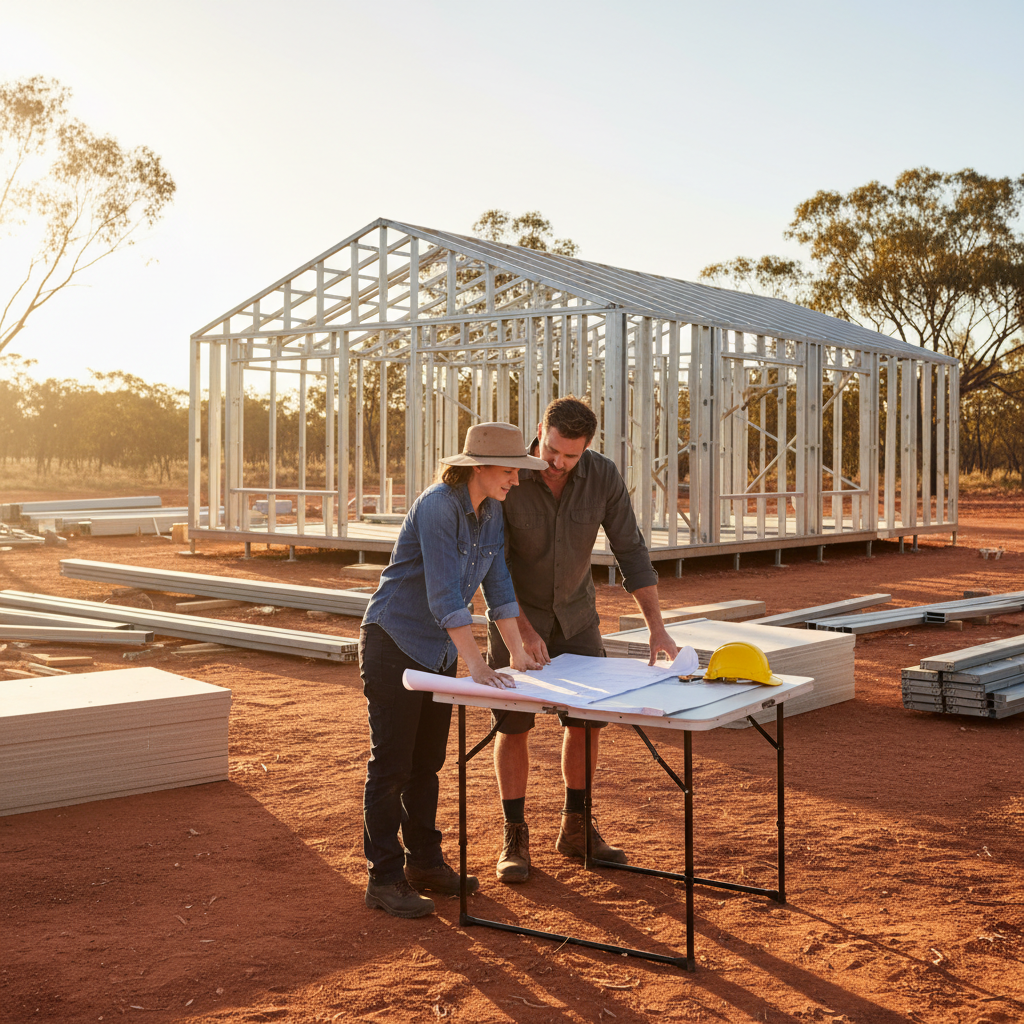
Most blokes and ladies getting into the owner-builder game spend months staring at glossy brochures before they ever see a real set of working drawings. Then the day comes. You get a PDF or a physical roll of plans, and suddenly it's not all sunshine and lifestyle photos. It's a mess of lines, abbreviations, and numbers that look like Morse code. If you don't know your way around these documents, you'll end up ordering the wrong windows or worse, staring at a slab that doesn't match your frame layout. Let's get stuck into how you actually read these things so you aren't guessing when the truck arrives.
The Floor Plan is Just the Start
People think the floor plan is the holy grail. It isn't. It's just a top-down view showing where the walls go. What you really need to be hunting for are the elevations and the section drawings. Elevations show you the height side-on. They'll tell you if your roof pitch is 22.5 degrees or something steeper. This matters because if you're up in at a high wind speed site near the coast, that pitch dictates how your TRUECORE steel frames are braced. Check the RLs (Reduced Levels). They tell you the height of the floor above a certain point. If you see a number like RL 10.450, that's your finished floor level. Don't ignore those little symbols that look like a circle with a tail. They point to where a 'section' has been cut through the house. You find that corresponding page, and you'll see exactly how the ceiling meets the wall and where the insulation sits. It's the 'X-ray' vision of your house.
Understanding the Steel Frame Layout
Since we're talking kit homes, the frame layout is where the real work happens. You aren't just looking at studs and noggins. You're looking at a puzzle. In a kit using BlueScope steel, the plans will show you specific wall codes. Each panel has a name. Maybe it's W1-A or something similar. When you're standing on your slab with a cup of tea on a Tuesday morning, trying to figure out which piece goes where, those codes are your best mates. Pay attention to the 'U' values and the thickness of the steel. Usually it's 0.75mm or 0.55mm for the light stuff, but heavily loaded areas or big spans might jump up to 1.2mm. If your plan shows a double stud, it's there for a reason. Probably to support a trimmers beam over a wide sliding door. Don't try to get clever and skip a stud just because it looks crowded. Engineering doesn't care about your convenience.
The Schedule of Finishes
This is where the 'kit' part of 'kit home' gets defined. The schedule is a big table. It lists every window size, every door type, and what kind of cladding you've picked. If the schedule says 'Colorbond Monoclad', but you were thinking 'Custom Orb', you've got a problem. The plans usually name things by their width first, then height. A 1218 window is 1200mm wide and 1800mm high. Simple, right? But wait until you see the 'RO' (Rough Opening). That's the hole in the frame. It's always slightly bigger than the window itself so you can level the thing up and shim it. Total amateur move is ordering windows based on the frame opening size without leaving room for the reveals. Don't do that. You'll be back at the shop with a very expensive mistake and it'll take weeks to fix.
Don't Ignore the General Notes
I know, I know. Sitting down and reading three pages of tiny 8-point font text sucks. But the General Notes page is the legal backbone of your build. Because it lists the Australian Standards that apply to your house. You'll see references to AS 4100 for the steelwork or AS 1170 for wind loads. If you live in a bushfire prone area, this page will specify your BAL (Bushfire Attack Level) rating. If it says BAL-29, all your windows need to be toughened glass with specific seals. If you ignore that note and buy standard windows from a guy on Gumtree, the council inspector will knock you back before you've even finished the cladding. It's a nightmare you don't want. The notes also tell you what grade of concrete you need for the slab. Usually N25, but check because it might be higher if you're on reactive clay.
The Difference Between Kit Components and On-Site Work
Here is an honest truth. A kit provider gives you the bones and the skin. We're talking the frames, the roof, the cladding, and the windows. But your plans will show things we don't supply, like the kitchen cabinets or the toilet. Why? Because the plumber needs to know where to stick the pipes in the slab months before the frames turn up. When you're looking at the plans, look for the 'dotted lines'. Frequently, these represent items not in the kit. You're the owner-builder. It's on you to coordinate the sparky and the plumber. They'll want to see the electrical layout, which shows where your light switches and power points go. If you want a double GPO (general purpose outlet) in the kitchen island, make sure it's on the plan before the concrete is poured. Chasing pipes through a cured slab is a job for someone who loves pain. I'm guessing that isn't you.
Reading the Roof Framing Plan
Steel trusses are light and easy to handle, but the plan looks like a spider web. You'll see 'top chords' and 'bottom chords'. The most important bit? The bracing. Look for the 'speed brace' lines. These are thin strips of steel that run diagonally across the tops of the trusses. They stop the whole roof from folding like a deck of cards when a big wind hits. If the plan shows a cross-brace on the third and eighth truss, put it there. And keep an eye on the 'overhangs'. That's how far the roof sticks out past the wall. If you decide to change that on the fly because you want more shade, you'll change the wind lift on the edges. Stick to the engineering.
Common Traps for New Players
Scale is the big one. Your plans might be 1:100 on an A3 sheet. If you print them out on your home printer on A4 paper, that scale is now useless. Don't take a ruler to a home-printed plan. Use the written dimensions. If the plan says 4500mm and your ruler says something else, trust the number. Also, look at the orientation. The North point isn't just there for decoration. It tells you where the sun will be hitting the house. In Australia, you want your living areas facing North to stay warm in winter. If your site plan shows the house facing the wrong way because the driveway was easier to build, you'll be paying for it in air-con bills for thirty years. Plus, your eaves need to be the right depth to block that harsh summer sun but let the winter sun in. Check that on the section drawings we talked about earlier.
Understanding these documents isn't about being an architect. It's about being prepared. When the delivery truck rolls up to your site in places like the Hunter Valley or the Sunny Coast, and the driver starts unloading bundles of blue-tinted steel, you should already have the plan memorized. You should know exactly where the first corner starts. It takes a bit of time, and yeah, your eyes might go blurry after the tenth page of engineering specs. But that's the difference between a project that runs smooth and one that becomes a money pit. Grab a highlighter, sit down at the kitchen table, and don't stop until you can walk through the house in your head without tripping over a line you didn't understand.