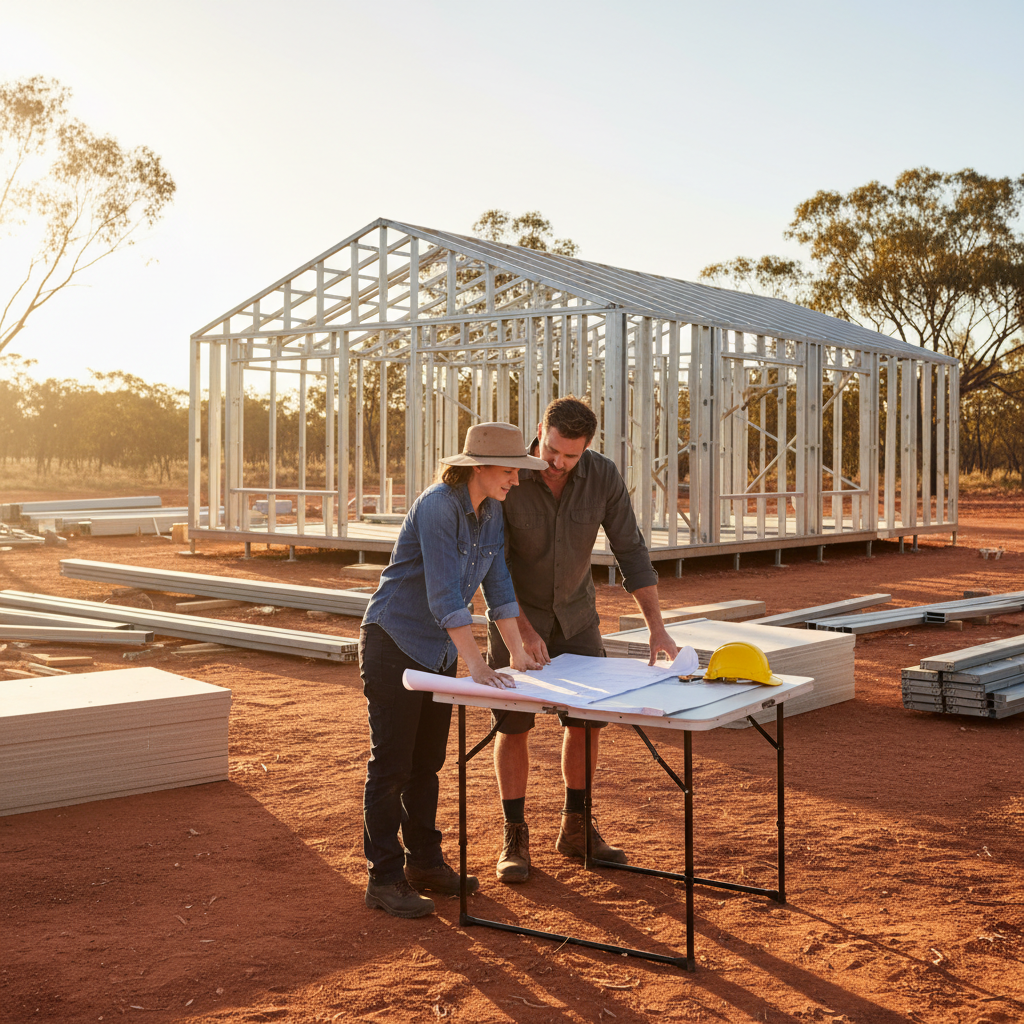
I saw a guy in Gympie last year standing on a freshly poured slab with a set of council-approved plans in one hand and a look of pure confusion on his face. He’d bought a kit, but he hadn't actually read the engineering specifications properly. He thought the wall frames would just 'sort of fit' around his plumbing stack. They didn't. He ended up spending three days with a grinder and a very expensive plumber to fix a mistake that was clearly marked on page five of his structural drawings. Don't be that guy.
The Gap Between the Pretty Picture and the Reality
Most people start their kit home search by looking at glossy floor plans on a website. These are great for dreaming about where you'll put the toaster, but they aren't the plans you build from. A real set of kit home plans is a dense, sometimes overwhelming stack of Paper. It's got floor plans, sure, but also section drawings, elevations, and the all-important frame layouts. Most kits we deal with use BlueScope TRUECORE steel, and that means your frame drawings will look like a complex 3D puzzle. Because they are. If you see a line on a plan, it's not just a suggestion. It represents a physical piece of steel or a structural requirement. Architects and engineers don't doodle for fun. They mark out load-bearing points and wind bracing because without them, your roof ends up in the neighbor's pool during the first big blow of the season.
Understanding the Bill of Materials (BOM)
Your kit arrives on a truck, usually in several deliveries. If you don't know how to read your inclusions list against your plans, you're flying blind. Most Australian kits cover the 'shell'. We're talking the steel wall frames, roof trusses, the Lysaght roofing iron, and your external cladding. Plus your windows and doors. But here's where people trip up. You need to look for what isn't there. Does your spec include the flashing? Does it include the thermal break strips required by the NCC Volume 2 for steel-framed houses? If you're building in a bushfire-prone area with a high BAL rating, your specs need to reflect specific glass types and shielding. Read the fine print twice. Then read it again while drinking a coffee so you stay awake for the boring bits.
Elevations and Why They Matter to Your Trades
The floor plan is a bird's eye view. Elevations are what the house looks like from the side. You'll see four of them: North, South, East, and West. These tell your window heights and where your cladding starts. If you’re an owner-builder, your sparky is going to want to know the slab-to-ceiling height before he even thinks about quoting. Most kit homes have a standard ceiling height of 2.4m or 2.7m. Check your section drawings. These show a vertical 'slice' through the house. It'll show you the pitch of the roof, the thickness of the insulation batts, and how the wall frames sit on the slab edge. This is vital for water-proofing. If you get the slab rebate wrong because you misread a section drawing, you'll be dealing with damp carpets for the next decade. No one wants that.
The Magic of Wind Ratings and Site-Specific Engineering
Australia is a big place with some nasty weather. A house built in a sheltered gully in suburban Melbourne has very different structural needs than a home sitting on a ridge in North Queensland. Your plans will mention a wind rating like N2, N3, or even C3 for cyclonic regions. This changes everything. It dictates the spacing of your screws, the type of tie-downs used in your steel frames, and the thickness of your window glass. When you're looking at kit specs, make sure the engineering matches your specific lot. Don't just buy a 'standard' kit and assume it works everywhere. You need a site-specific soil report first. Because if you’ve got reactive clay (Class H1 or H2), your slab design needs to be bulked up to stop the house from cracking as the ground moves. The kit manufacturer provides the house, but you provide the context.
Reading the Symbols
Plans are covered in shorthand. It looks like a secret code. S/D usually means sliding door. O/H might mean overhead cupboards. But keep an eye out for 'Noggins'. These are the horizontal members in your wall frames. In steel kits, these are pre-punched. If you want to hang a heavy 75-inch TV or a massive kitchen cabinet, you need to know where those noggins are. Or better yet, tell the manufacturer you need extra blocking in certain walls before the frames are manufactured. It's much harder to add support to a steel stud once it's already standing and clad. Plan ahead. Think about where your towel rails go. Think about the wall-hung vanity in the ensuite. Steel is incredibly strong, but it's not as simple as whistling a nail into a piece of pine whenever you feel like it.
Owner-Builder Responsibility: The Slab Layout
This is the big one. The moment of truth. Most kit home companies provide a slab layout drawing. This is the blueprint for your concreter. It shows the exact dimensions of the concrete footprint, including any 'set-downs' for wet areas like bathrooms. If your slab is out by 20mm, your steel frames—which are manufactured to millimetre precision—won't fit. You can't just 'stretch' a steel frame. You'll be left with a massive headache. When your concreter says "she'll be right," don't believe him. Get the tape measure out yourself. Check the diagonals. If the diagonals aren't equal, your slab isn't square. If your slab isn't square, your roof won't fit. It's a domino effect of misery that starts with not reading the slab layout properly.
And let's chat about services. Your plumbing and electrical 'rough-in' happens before the concrete is poured. Your plans will show where the pipes need to pop up. If the plumber puts the toilet waste 100mm to the left because he didn't look at the frame thickness on the plans, your toilet will end up inside a wall. Use the architectural plans and the structural frame layouts together. They're two sides of the same coin.
Inclusions vs. Exclusions
Every kit provider has a different idea of what a 'full kit' means. For us, it's the structural guts and the skin of the building. But you're the one in charge of the fit-out. Your plan might show a beautiful kitchen island, but is that in the kit? Probably not. Usually, you're sourcing your own kitchens, flooring, paint, and light fixtures. This is actually a win for you. It means you aren't stuck with some builder-grade laminate that looks like it's from 1994. You get to go to the local tile shop or hit up a specialist lighting store. But, you have to ensure your choices fit the space. If your plans show a 900mm cavity for a fridge, don't go buying a 920mm French door unit because it was on sale at Harvey Norman. The house won't grow to accommodate your bargains.
Final Check Before You Sign
Before you sign off on your manufacturing drawings, sit down in a quiet room. No TV. No kids screaming. Just you and the drawings. Trace the flow of the house with your finger. Imagine walking through the front door. Is the light switch behind the door? Is the hallway wide enough to get your favorite armchair through? These are the things blueprints won't scream at you, but they'll annoy you every single day once you move in. Steel frame kits are a brilliant way to get a precision-engineered home on your own terms, but the quality of the finish starts with your ability to understand the black and white lines on the page. Take your time. Ask the 'stupid' questions. Because in the building game, the only stupid question is the one you didn't ask before the concrete truck arrived.