The Roadmap to Your New Australian Home
There is a unique thrill that comes with receiving your first set of kit home plans. Whether you are planning a sweeping rural homestead or a compact secondary dwelling, those printed sheets represent the future of your lifestyle. However, for many first-time owner-builders in Australia, opening a full set of architectural drawings and technical specifications can feel like trying to read a foreign language.
Understanding these documents is not just about knowing where the walls go. It is about ensuring your vision aligns with the physical reality of the build. In the world of kit homes, clarity is your best friend. Clear plans reduce errors on site, help you coordinate trades more effectively, and ensure that the finished product is exactly what you expected. In this guide, we will break down the components of Australian kit home plans and specs, giving you the confidence to navigate your project like a pro.
The Anatomy of a Kit Home Plan Set
When you sit down to review your kit home documentation, you are usually looking at a multi-page document. Each page serves a specific purpose, and understanding the hierarchy of these drawings will help you find information quickly during the construction process.
1. The Floor Plan (The Big Picture)
The floor plan is the most familiar part of the set. It is a birds-eye view of your home, showing the layout of rooms, the location of doors and windows, and the general flow of the space. In a kit home context, the floor plan will also usually indicate the dimensions of the steel frame sections. Look closely at the wall thicknesses and the swing direction of the doors, as these impact how you will place furniture and move through the home.
2. Elevations (The External View)
Elevations are 2D drawings that show what the house looks like from the outside once the cladding and roofing are installed. Usually, you will have four elevation drawings: North, South, East, and West. These are vital for understanding the height of the building, the pitch of the roof, and how the external finishes, such as your windows and doors, sit within the facade. They also help you visualise how the home will sit on your block of land.
3. Cross-Sections (The Inside Look)
Imagine taking a giant saw and cutting the house in half vertically. That is a cross-section. These drawings are incredibly important for owner-builders because they show the internal structure. You will see the relationship between the floor system, the wall frames, and the roof trusses. For a kit home using high-quality steel frames made from BlueScope TRUECORE steel, the section will show how these components integrate to create the skeletal structure of the dwelling.
Mastering the Symbols and Abbreviations
Architectural drawings are dense with shorthand. While most plans include a legend, knowing common Australian building symbols will save you significant time. Here are a few you will likely encounter:
- RL (Relative Level): This refers to the height of a specific point relative to a fixed datum point on your site. It is crucial for ensuring your slab or floor system is at the correct elevation.
- Nosing: Often found in stair details if your kit home is two-storey.
- DP (Downpipe): Shows where the rainwater will exit your gutters. This is vital for your plumber when they are planning the site drainage.
- W (Window) and D (Door): These are usually followed by a number that corresponds to a schedule, which lists the exact sizes of the aluminium windows and doors included in your kit.
Understanding the Specifications (The 'What' vs 'Where')
If the plans tell you WHERE things go, the specifications tell you WHAT those things are. In the Australian kit home industry, the 'Specs' are a detailed list of the materials and standards of quality for your build. For an owner-builder, this is your inventory checklist.
The Framing System
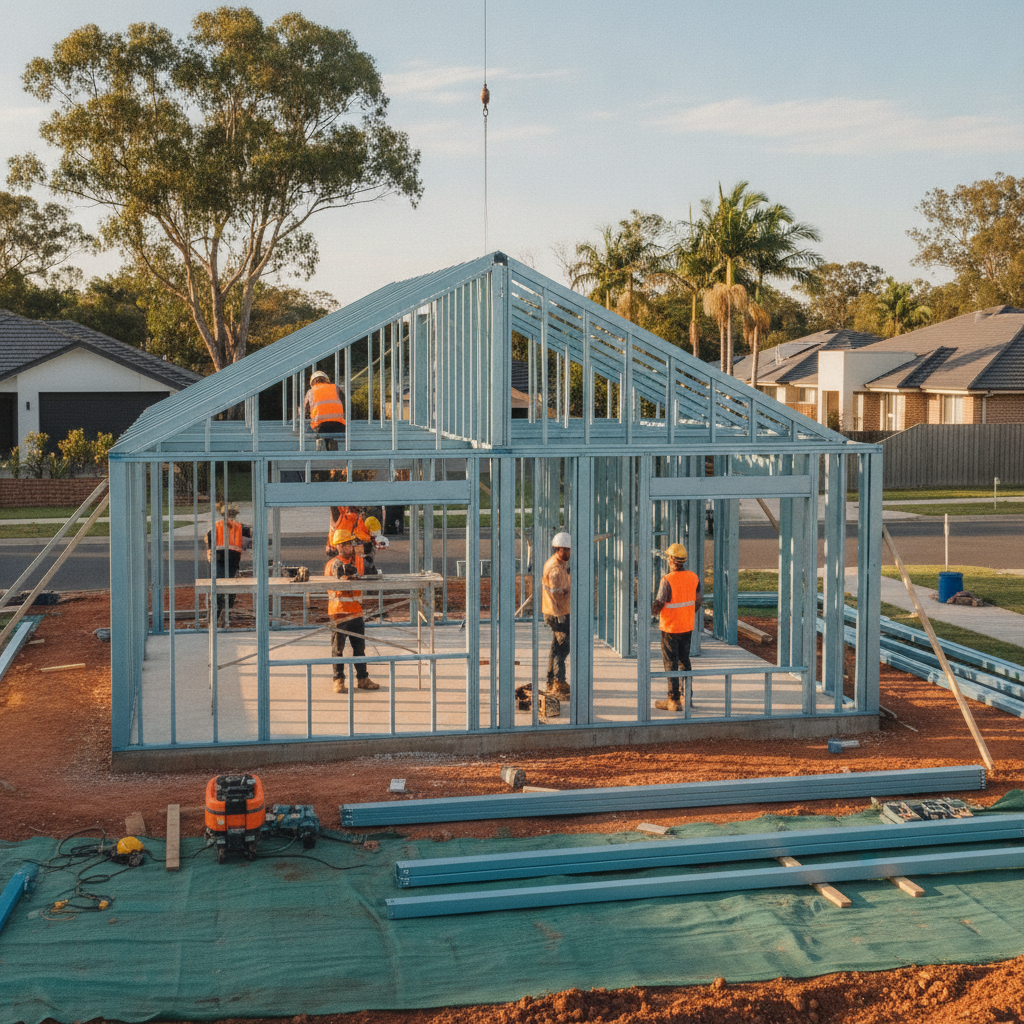
A central part of your specifications will be the framing. In many modern Australian kits, this will specify light-gauge steel framing. Because these frames are engineered to strict tolerances, the specs will often detail the coating of the steel, such as genuine BlueScope TRUECORE, which is specifically designed for Australian conditions. This tells you that your frame is termite-proof and won't warp or twist over time.
Roofing and Cladding
The specs will outline the type of roof sheeting provided. Usually, this involves a high-quality Australian steel like COLORBOND, which is synonymous with the Australian landscape. It will list the profile (like Corrugated or Trimdeck) and the thickness of the steel. Similarly, the external cladding specifications will tell you if you are receiving fibre cement sheets, timber weatherboards, or steel wall cladding.
The Inclusions: Windows, Doors, and Insulation
One of the most common mistakes owner-builders make is assuming what is in the kit. Always check the window and door specifications. Are they double-glazed? What are the frame colours? The insulation section is equally important, as it specifies the R-value of the batts or blankets provided. In Australia, meeting the National Construction Code (NCC) energy efficiency requirements is mandatory, so ensuring your specs match your energy rating report is a key step.
Practical Tips for Reviewing Your Plans
Before you sign off on your kit and begin the manufacturing process, take these practical steps to ensure everything is in order:
Check Your Setbacks and Site Fit
Even though a kit home provider produces the building plans, you as the owner-builder (or your surveyor) must ensure the house fits on your site according to local council regulations. Check the distance from the boundary to the walls. Make sure there is enough room for your eaves and downpipes without encroaching on easements.
The 'Walkthrough' Test
Print out your floor plan on a large sheet of paper. Physically walk around your vacant site or even a large park and try to 'feel' the dimensions. Is the hallway wide enough? Is the kitchen bench situated where the morning light hits? Sometimes seeing the numbers 3000mm x 4000mm on a page doesn't translate to the physical feel of a bedroom until you visualise it in a real space.
Verify the Window Placements
In Australia, we love our views and our breezes. Look at your site orientation on the plans. Are your largest windows facing North to catch the winter sun? Are there smaller windows on the West to block out the harsh summer afternoon heat? Adjusting a window location on a plan is easy, but once the steel frames are manufactured and on-site, changes become much more complicated and costly.
Why Precision Matters in Steel Framing
One of the advantages of kit homes that utilise steel frames is the level of precision in the plans. Traditional timber framing often involves a lot of 'on-site adjustment.' However, steel kits are pre-engineered. This means the holes for your electrical wiring and plumbing are often pre-punched into the studs exactly where the plans say they should be. When you understand your plans, you can communicate these exact locations to your trades before they even arrive on site, leading to a much smoother assembly process.
The Importance of Version Control
During the planning phase, it is common to go through several revisions. A vital tip for any owner-builder is to check the 'Revision Date' or 'Revision Number' in the title block (usually the bottom right corner of the page). Always ensure you, your plumber, your electrician, and your slab layer are all looking at the same version of the plans. Using an outdated set of drawings is one of the leading causes of construction errors in the kit home industry.
Conclusion: Knowledge is Construction Power
Reading kit home plans and specifications might seem daunting at first, but it is a skill that pays massive dividends. By taking the time to understand the symbols, checking the detailed material specifications, and ensuring your site requirements are met, you take full control of your project. Remember, as an owner-builder, you are the conductor of the orchestra. The clearer you are on the sheet music (your plans), the better the final performance will be.
A well-prepared kit home, built with quality Australian materials like BlueScope steel and designed with careful attention to detail, offers a rewarding path to home ownership. So, grab a highlighter, spread those plans out on the kitchen table, and start familiarising yourself with every line and label. Your future home is right there on the page, waiting to be brought to life.