The Importance of Understanding Wind Ratings in Australia
When you start planning your dream kit home, it is easy to get caught up in the fun stuff like floor plans, kitchen islands, and the color of your cladding. However, before a single piece of steel is cut, there is a technical hurdle every Australian owner builder must clear: the wind rating. In a country known for everything from gentle coastal breezes to ferocious tropical cyclones, your home must be engineered to stand its ground.
Wind ratings are not just bureaucratic red tape. They are a scientific calculation of the pressure your home will face during extreme weather events. For those opting for the DIY route or managing their own build, understanding these ratings is the first step toward a safe, compliant, and long-lasting home. In this guide, we will break down the N and C classifications and explore how modern building techniques, particularly steel frame construction, help you meet these standards.
What is a Wind Rating?
In Australian building codes, a wind rating (or wind classification) determines the structural design requirements for a building. It tells the manufacturer and the engineer how much force the walls, roof, and fasteners need to withstand. These ratings are governed by the Australian Standard AS 4055 (Wind Loads for Housing), which takes into account your geographic region, the surrounding terrain, and how shielded or exposed your block is.
Getting this right is critical. If your home is under-engineered for its location, you risk structural failure during a storm. If it is over-engineered, you might be spending money on structural reinforcements that your site simply doesn't require. This is why a site-specific soil and wind report is the first document any kit home provider will ask for.
Breaking Down the Ratings: N1 to N6
The 'N' in these ratings stands for Non-Cyclonic. Most Australians living in suburban areas, inland regions, or southern states will fall into this category. Here is how they stack up:
- N1 and N2: These are the most common ratings for sheltered suburban blocks. They represent low wind speeds where houses are protected by nearby trees and other buildings.
- N3: This is the standard for many rural areas or coastal hillsides. If your block has a bit of an elevation or faces an open paddock, N3 is often the benchmark.
- N4, N5, and N6: These ratings are for highly exposed, non-cyclonic areas, such as the top of a ridge or a coastal cliff in the southern half of Australia.
The jump from N2 to N3 is often where owner builders notice a change in building techniques. You might see more robust tie-down systems, thicker steel gauges in the frames, or specific screw patterns for the roofing sheets.
The Tropical Challenge: C1 to C4 Ratings
The 'C' stands for Cyclonic. If you are building in Northern Australia, parts of Western Australia, or certain sections of the Queensland coast, you will likely be dealing with these ratings. Cyclonic regions require a much higher level of engineering because the wind does not just push against the house, it also creates massive uplift forces that attempt to pull the roof off.
- C1: The entry-level cyclonic rating. Houses here are built to withstand significant gusts but are generally in slightly more protected areas within a cyclone zone.
- C2 and C3: These ratings involve heavy-duty engineering. Expect to see substantial upgrades in how the roof is tethered to the walls and how the walls are bolted to the slab.
- C4: This is the highest wind rating in Australia, reserved for the most extreme environments, like the Pilbara coast. Homes here are essentially fortresses designed to survive the most intense weather events on the planet.
Factors That Influence Your Site Rating
Your wind rating is not just about which town you live in. An engineer looks at four key variables to determine your specific classification:
1. Wind Region
Australia is divided into four regions (A, B, C, and D). Region A covers the majority of the southern and central landmass, while Region D covers the most intense cyclonic areas of the WA coast.
2. Terrain Category
This looks at the immediate surroundings. Are you in a dense suburb (protected), or are you on a five-acre lot with no trees (exposed)? The fewer obstacles there are to break the wind, the higher your rating will be.
3. Topography
Wind speeds up as it travels up a hill. If your kit home is perched on a crest or a steep slope, it will face much higher wind pressure than a home at the bottom of the same hill.
4. Shielding
Shielding refers to whether other permanent structures or heavy tree lines will block the wind. As a DIY builder, it is important to remember that 'temporary' shielding, like a fence or a neighbor's shed that could be moved, usually does not count toward lowering your rating.
Why Steel Frame Construction Excels in High Wind Areas
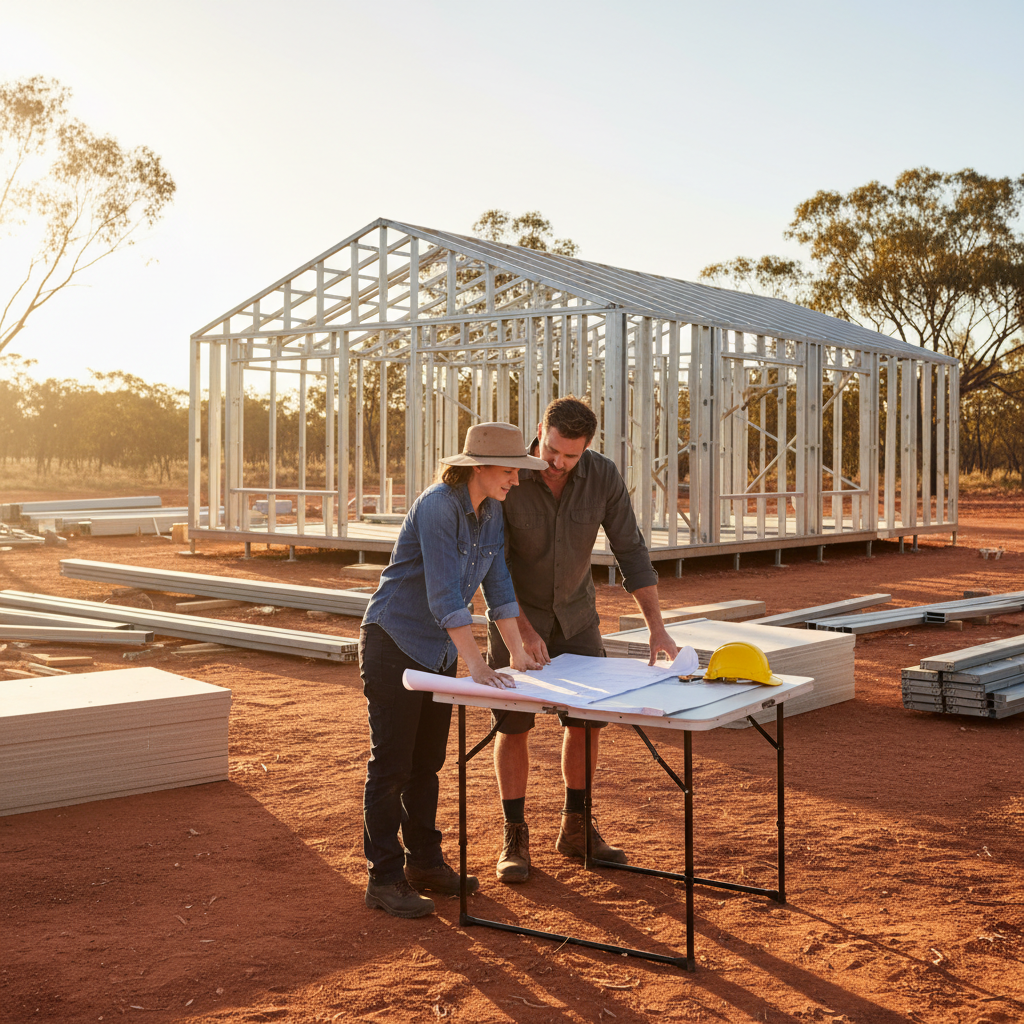
When it comes to building techniques for high wind areas, steel framing offers several distinct advantages. Using high-strength BlueScope TRUECORE steel ensures that the skeleton of your kit home is both lightweight and incredibly strong. Unlike traditional materials that can warp or shrink over time, steel remains perfectly straight and true.
One of the biggest benefits for owner-builders is the precision of the fasteners. In a steel kit home, the frames are engineered with pre-punched holes and specific brackets designed to handle the exact wind load of your site. Because steel is a ductile material, it has a level of flexibility that allows it to absorb energy during high-pressure events without snapping or crumbling. This is why you will often see steel kits favored in exposed coastal locations and cyclonic regions.
Practical Tips for Owner Builders
As you manage your project, keep these practical tips in mind to ensure your build goes smoothly:
- Order your site report early: Do not guess your wind rating. Hire a local engineer or surveyor early on. This report is essential for your kit manufacturer to provide an accurate quote and compliant engineering drawings.
- Check your window ratings: It is not just the frames that need to be strong. Your windows and glass doors must also meet the specific wind rating of your site. High wind areas often require thicker glass or reinforced frames.
- Focus on the footings: The wind rating dictates how your home is anchored to the ground. Ensure your concreter follows the engineering plans to the letter, as the depth and reinforcement of your slab or piers are what keep the house from moving.
- Understand the 'Pressure' factor: Remember that wind doesn't just push on your walls. It creates suction on the leeward side of the house and uplift on the roof. Proper tie-down sequences are the most critical part of a high-wind build.
Conclusion
Building a kit home in Australia is an empowering way to create your own space, but it comes with the responsibility of ensuring that space is safe. By understanding the difference between N1 and C4 ratings, you can communicate more effectively with your suppliers, trades, and local council. Whether you are building a quiet retreat in a sheltered valley or a coastal home facing the Southern Ocean, the right combination of engineering and high-quality materials, like BlueScope steel frames, will ensure your home stands strong for decades to come. Take the time to get your wind rating right from the start, and you will have the peace of mind that comes with a house built specifically for its environment.