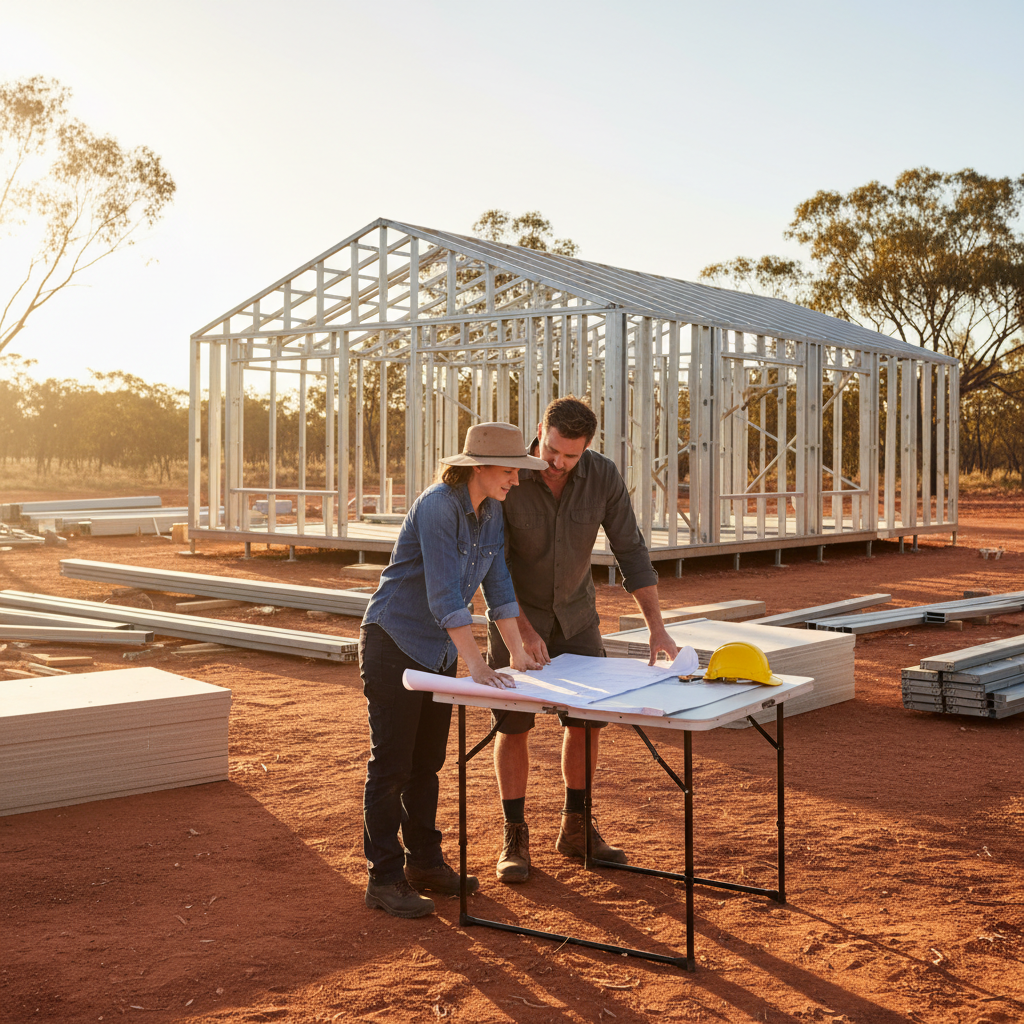
Mastering the Blueprint of Your New Australian Home
So, you have decided to take the plunge into the world of kit homes. It is an exciting journey that offers a unique sense of pride and a hands-on connection to your future residence. However, before you pick up a hammer or book a tradesperson, you are faced with a stack of documents that can look a bit like a foreign language: the plans and specifications. For many Australian owner builders, this is where the real work begins.
Understanding these documents is not just about knowing where the walls go. It is about ensuring your vision aligns with what will actually be delivered to your site. Misinterpreting a line on a drawing or a line item in a specification sheet can lead to unexpected surprises during the build. In this guide, we will break down how to read kit home plans like a pro, ensuring your project stays on track from the moment the steel frames arrive.
The Anatomy of Kit Home Plans
When you receive your kit home package, you will typically find several different types of drawings. Each serves a specific purpose in the construction process. Let's look at the core components you will encounter.
The Floor Plan
This is the bird's eye view of your home. It shows the layout of rooms, the location of windows and doors, and the overall dimensions. Look closely at the scale, often 1:100 or 1:50. This means every centimetre on the paper represents a certain number of centimetres in real life. Pay attention to door swings, they indicate which way a door opens, which is vital for planning your furniture layout and electrical switch placement.
Elevations
Elevations are flat views of the exterior of the house from the North, South, East, and West. These drawings give you a sense of the home's height, roof pitch, and how the windows sit within the walls. They are essential for understanding the aesthetic of the home and are the primary documents used by local councils to assess how your home fits into the neighborhood.
Sectional Drawings
Imagine slicing your house down the middle and looking at it from the side. That is a section. These drawings are technical gold for owner builders. They show the internal structure, including the height of the ceilings, the thickness of the insulation, and the relationship between the floor level and the ground. For kit homes using Aussie made steel frames, the sections will highlight how those frames connect to the slab and the roof trusses.
Understanding the Specification Sheet
If the plans are the map, the specifications (or 'specs') are the list of ingredients. The spec sheet tells you exactly what materials are included in your kit and, perhaps more importantly, what isn't. In the Australian kit home industry, clarity here is your best friend.
A standard high quality kit usually includes the structural components. You should see details regarding:
- The Framing System: Usually high strength BlueScope TRUECORE steel.
- Roofing and Cladding: The specific profiles and finishes of the exterior skins.
- External Openings: Details on the windows and glass doors, including glazing types.
- Internal Components: This may include internal stud walls and insulation batts.
As an owner builder, you need to cross reference the plans with the specs. If the plan shows a beautiful sliding stacker door but the spec sheet lists a standard sliding door, you need to clarify that before signing off. This prevents 'on site' headaches later on.
The Importance of Site Plans and Orientations
In Australia, our climate varies wildly. A kit home designed for the humid tropics of Queensland will have different requirements than one destined for the chilly hills of Tasmania. While your kit provider supplies the building plans, you (or your surveyor) are responsible for the site plan.
Your site plan shows where the house sits on your specific block of land. When reviewing this, consider the sun's path. Ideally, you want your main living areas and large windows facing North to take advantage of passive solar heating in winter. Check your plans to see if the window placements match your site's orientation. Sometimes, a simple 'flip' of the plan during the design phase can make a massive difference in your home's energy efficiency and comfort levels.
Technical Symbols and Notations
You will see a lot of shorthand on kit home drawings. Learning these common notations will save you a lot of googling:
- RL (Relative Level): Refers to the height of a point relative to a fixed datum point.
- DP (Downpipe): Shows where rainwater will exit your gutters.
- WC: Toilet.
- HWS: Hot Water System location.
- Finished Floor Level (FFL): Crucial for your concreter when pouring the slab.
If you see a symbol you don't recognize, don't guess. Ask your kit provider for a legend or an explanation. In the world of construction, a small symbol can represent a significant structural requirement.
Managing the Gap: What You Need to Arrange
One of the most important aspects of reading Australian kit home specifications is identifying the 'gaps'. Kit homes are a fantastic way to save on construction costs, but they are not a 'turnkey' solution. As the owner builder, the plans and specs are your guide for what you need to source independently.
Typically, your kit will arrive as a package of components, but the plans will also show elements that you are responsible for, such as:
- Foundation and Site Works: The slab or subfloor system.
- Services: Rough-in for plumbing and electrical.
- Internal Fit-out: Gyprock, flooring, cabinetry, and painting.
- Specialist Trades: You will need to use the plans to get quotes from licensed plumbers and electricians.
When you provide your plans to these trades, ensure you have the 'For Construction' set, not just the 'Preliminary' set. This ensures they are quoting on the final, approved dimensions.
Practical Tips for Reviewing Your Documents
1. Print Them Out: While digital files are convenient, there is nothing like spreading a full A3 or A1 set of plans on a table. It allows you to see the 'big picture' in a way a screen cannot.
2. Trace the Flow: Imagine walking through the front door. Is there enough room for a hallway table? Is the light switch in a logical place? Visualizing your daily routine while looking at the floor plan helps identify design tweaks before they become permanent.
3. Verify the Scale: Use a scale ruler to check room sizes. Sometimes a room looks huge on paper but feels small once you measure it out in your current living space. Mark out the room dimensions on your lawn with some stakes and string to get a real sense of the scale.
4. Check the Wind Rating: In Australia, homes are rated for wind speed (e.g., N2, N3, C1). Ensure the specifications of your kit match the wind rating required for your specific block. This is a critical safety and compliance requirement.
The Power of Steel Frames in Your Plans
When you are looking at the technical sections of your plans, you might notice the precision of the framing. Using steel frames like those made from BlueScope steel offers a level of accuracy that is hard to beat. Because steel is manufactured to millimetre-perfect specs, what you see on the plan is exactly what arrives on the truck. This makes the assembly process much smoother for owner builders, as you aren't dealing with bows, twists, or knots often found in traditional materials.
Conclusion: Knowledge is Your Best Tool
Taking the time to truly understand your kit home plans and specifications is the best investment you can make in your project. It empowers you to speak confidently with trades, manage your timeline effectively, and ensure that the finished product is exactly what you dreamed of. Remember, these documents are live tools, keep them clean, keep them handy, and never be afraid to ask for clarification. Happy building!