Taking the Mystery Out of Your Kit Home Plans
So, you have decided to join the growing ranks of Australian owner builders. You have been browsing designs, imagining your new life on a quiet block of land, and now you are staring at a stack of technical drawings and specification sheets. For many, this is the moment where excitement meets a bit of nerves. How do you actually read these things? What do all those symbols mean, and how do they translate to a physical building?
Understanding your kit home plans is the single most important skill you can develop before the first truck arrives on site. These documents are the ultimate source of truth for your project. They tell the council what you are building, they tell your trades where to install the plumbing, and they ensure that your steel frame fits together perfectly. In this guide, we will break down the language of kit home plans so you can approach your build with total confidence.
The Anatomy of a Kit Home Plan Set
When you receive your documentation, it is usually not just one page. It is a comprehensive set of drawings that view the house from different angles. To get a full picture, you need to understand what each specific drawing is trying to tell you.
The Floor Plan: The Bird's Eye View
The floor plan is your primary map. It shows a top-down view of the layout as if the roof has been lifted off. This is where you will see the flow of the home, the size of the rooms, and the placement of doors and windows. Look closely at the dimensions. In Australia, building plans are almost always in millimetres (mm). If you see '3000', that is exactly three metres.
Elevations: The Side Profile
Elevations are 2D drawings of the exterior of the house from the North, South, East, and West. These are vital for understanding the height of your roof, the pitch of the gables, and how the windows sit within the walls. Elevations also help you visualise the finished aesthetic, including where the cladding and roofing materials meet.
Sectional Drawings: The X-Ray View
Imagine slicing your house down the middle with a giant knife. A sectional drawing shows you the internal structure, including the ceiling heights, the thickness of the concrete slab, and how the roof trusses are supported. This is where the technical details of the steel frame become clearer.
Mastering common Architectural Symbols
Plans are a shorthand language. Instead of writing 'sliding glass door' everywhere, architects use symbols. Here are a few common ones you will encounter in an Australian kit home plan:
- Dashed Lines: Usually indicate something above head height, like a bulkhead or the edge of a roof overhang (eave).
- Arcs: These show the swing of a door. It is crucial to check these to ensure your furniture won't block a door from opening.
- RL (Relative Level): This refers to the height of a specific point relative to a fixed benchmark on your land.
- W and D Codes: You might see 'W01' or 'D02'. These refer to a window and door schedule, which is a separate list detailing the exact sizes and types for each opening.
The Importance of the Specification Sheet
If the plans are the 'where', the specifications (specs) are the 'what'. The spec sheet is a written document that lists every component included in your kit. For an Australian owner builder, this is your checklist. A premium kit usually includes the structural components like the steel frames and trusses, roofing, cladding, external doors, windows, and insulation.
When reading the specs, look for quality brands. For example, knowing your kit uses BlueScope TRUECORE steel for the framing gives you peace of mind regarding termite resistance and structural integrity in the harsh Australian climate. Pay attention to the 'inclusions' versus 'exclusions'. Typically, kit homes do not include the concrete slab, internal fit-out items like kitchens and tiles, or the labour for trades. Knowing exactly what is coming on the delivery truck prevents mid-build surprises.
Understanding the Steel Frame Advantage
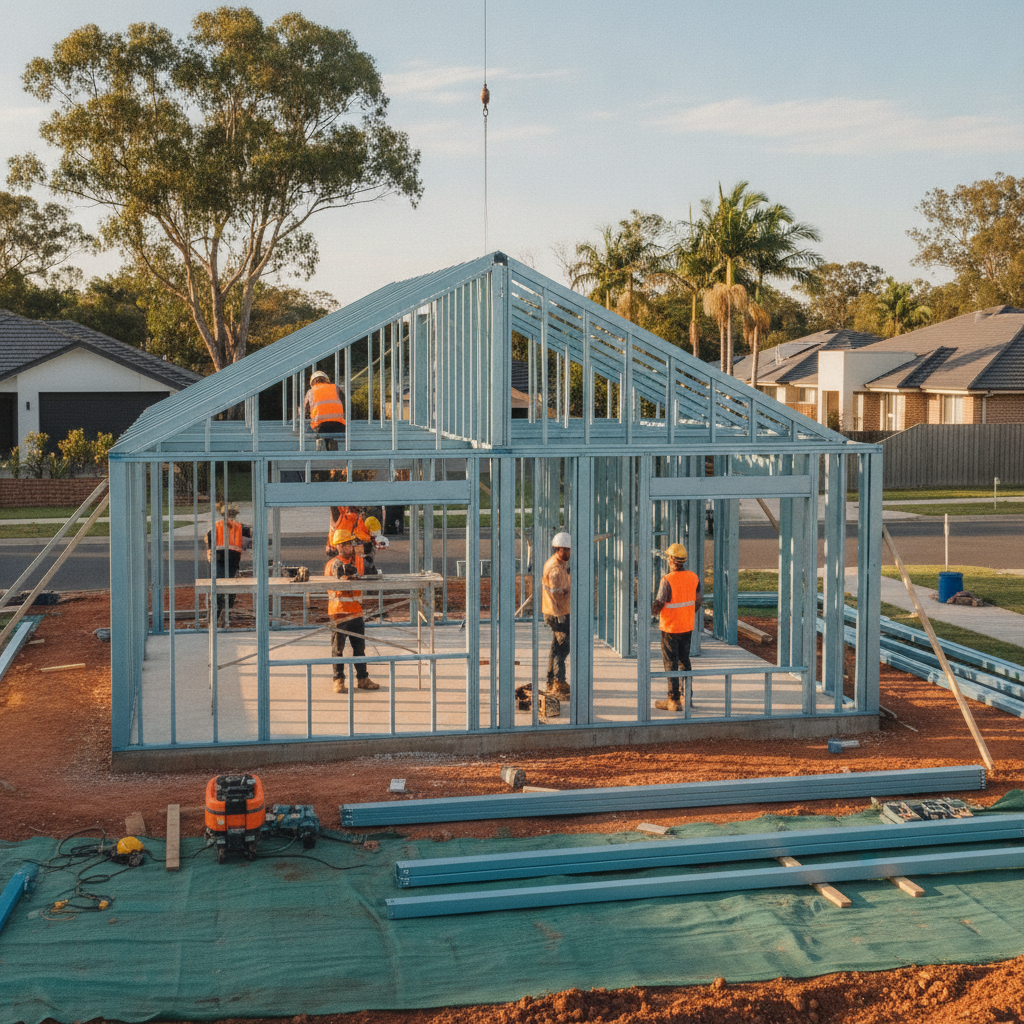
As you look through your structural plans, you might notice that steel frame layouts look slightly different from traditional timber plans. Steel frames are engineered to incredible precision. Because steel is manufactured to millimetre accuracy, the plans must be followed strictly.
One of the practical tips for reading steel frame plans is to look for the 'frame layout'. This shows how each pre-assembled wall panel connects. The benefit here is that the holes for electrical wiring and plumbing are often pre-punched into the steel studs. Understanding these locations on the plan allows you to coordinate your plumber and sparky much more effectively. They will appreciate the ease of running their lines through a straight, uniform steel channel rather than drilling through timber studs.
Practical Tips for Reviewing Your Plans
Before you sign off on your plans and head to the council for approval, take these practical steps:
1. The Furniture Test
Get a tape measure and go to your current living room. Measure your sofa, your dining table, and your bed. Now, look at the dimensions on your floor plan. Does that 'generous' master bedroom actually fit your king-sized bed and two bedside tables? Drawing your furniture to scale on a copy of your plan is a great way to ensure the space works for your lifestyle.
2. Check the Solar Orientation
In Australia, we want to catch the winter sun and hide from the summer heat. Look at the 'North' point on your site plan. Ideally, your main living areas and large windows should face North. If your plans show your main alfresco area facing West, you might want to consider extra shading or window tinting to handle the afternoon sun.
3. Verify the Opening Directions
Look at the way your windows and doors open. Do you have a sliding door that opens towards a light switch? Does a bathroom door swing in and hit the vanity? These small details are easy to change on paper but expensive to fix once the steel frames are standing.
The Role of the Engineering Report
Included with your kit home plans will be an engineering report. While it looks like a lot of complex math (because it is), it is a vital document. It confirms that your home is designed to withstand the specific wind speeds and soil conditions of your block. If you live in a cyclone-prone area or a high-wind zone on a hill, your plans will show specific tie-down points and heavy-duty steel connections. Always ensure your builder or your own DIY team follows these engineering specs to the letter.
Why Steel Makes It Easier for Owner Builders
One of the reasons many Australians choose steel frame kit homes is the 'Lego-like' nature of the assembly. When you read a steel frame plan, you are looking at a system designed for accuracy. Unlike timber, steel won't warp, twist, or shrink. If the plan says a wall is 2400mm high, it will be 2400mm high from the day it arrives until decades into the future. This makes reading and following the plans much more straightforward for someone who might be managing a building project for the first time.
Final Thoughts: Knowledge is Power
Reading kit home plans is a skill that improves with time. Don't be afraid to ask questions. If a symbol or a technical term in the specifications doesn't make sense, reach out to your kit provider. They are there to help you succeed. By taking the time to truly understand your drawings, you move from being a spectator to being the informed lead of your home building journey.
Your kit home is more than just a set of numbers and lines on a page. It is the blueprint for your future. When you can read that blueprint, you are well on your way to turning that dream into a reality, one steel stud at a time.