Taking the Mystery Out of Kit Home Plans
So, you have decided to take the plunge into the world of owner building. It is an exciting journey that offers a level of creative control and personal satisfaction that you simply do not get when buying an existing house. However, the first time you open a full set of kit home plans, it can feel like you are trying to read a foreign language. Between the abbreviations, the technical symbols, and the detailed specifications, there is a lot to take in.
Understanding these documents is not just about knowing where the walls go. It is about visualizing your lifestyle in the space and ensuring you are prepared for the construction phase. In this guide, we will break down how to read and interpret kit home plans and specifications, specifically focusing on the precision of steel frame construction, so you can move forward with your Australian owner builder project with total confidence.
The Importance of the Specification List
Before you even look at the floor plan, you need to understand your specifications. In the world of kit homes, the 'specs' are your shopping list and your rulebook. They define exactly what is included in your delivery and, more importantly, what isn't.
When you choose a steel frame kit home, your specs will usually detail high quality components like TRUECORE steel by BlueScope. This is a critical detail because steel frames are manufactured to millimetre precision. Unlike timber, which can warp or bow, the specifications for a steel frame ensure that your walls will be perfectly straight and your windows will fit exactly as intended. Your spec list should also detail your roofing material, external cladding options, windows, doors, and insulation. Take the time to go through this list line by line. If a specific component is not on that list, you will need to source it locally via your own trades or suppliers.
Mastering the Floor Plan
The floor plan is the heart of your kit home project. It is a 2D overhead view of your future home, but it contains 3D information. Here is what you should be looking for:
1. The Scale and Dimensions
Every plan will have a scale, often 1:100 or 1:50. This means every centimetre on the paper represents a certain distance in real life. Keep a scale ruler handy, but always rely on the written dimensions rather than measuring the paper itself. Written dimensions are the final word for your slab contractor and your frame installers.
2. Wall Thickness and Framing
This is where steel frame benefits really shine. On your plans, you will notice wall thicknesses are clearly defined. Steel frames allow for incredibly strong walls without the bulk, often providing a bit more internal floor space compared to traditional masonry. Look for the difference between load bearing internal walls and non load bearing partitions. This matters if you ever plan on making small layout changes during the design phase.
3. Door and Window Swings
It sounds simple, but pay close attention to which way the doors and windows open. Does the bedroom door swing into a wardrobe? Does the kitchen window slide or awning out over a walkway? Visualizing these movements helps you plan your furniture layout and ensures the flow of the home feels natural.
Understanding Elevations and Sections
While the floor plan shows you the 'where', the elevations and sections show you the 'how high' and 'what's inside'.
Elevations are flat views of the exterior of the house from each side (North, South, East, and West). These are vital for understanding the aesthetic of your home, including the pitch of the roof and the placement of cladding. Because steel frames offer great strength to weight ratios, you might notice larger window openings or interesting roof lines that are easier to achieve with steel than with other materials.
Sectional drawings are like taking a vertical slice through the house. These are perhaps the most important for an owner builder to understand. They show the 'sandwich' of the build: the slab, the steel floor joists (if applicable), the wall studs, the insulation layer, and the roof trusses. Understanding these layers helps you talk to your trades about how the various components of the kit will come together on site.
The Role of Engineering Drawings
For an Australian owner builder, the engineering drawings are your best friend. These plans are specifically designed to ensure the home is structurally sound for your specific site conditions, including wind ratings and soil types.
When working with steel frames, the engineering is often integrated into the frame design. You will see specific 'node' points and bracing requirements. Steel is termite proof and non combustible, which are great benefits, but it also requires specific fasteners and joining techniques detailed in the engineering plans. Don't gloss over these, they are the key to a council approved, high quality build.
Practical Tips for Reviewing Your Plans
To make the most of your kit home experience, follow these practical steps when reviewing your documentation:
- The Furniture Test: Get some graph paper or use a digital tool to draw your existing furniture to scale. Place it on your floor plan. This is the quickest way to realize if a room is too small or if a window is in an awkward spot for your bed head.
- The 'Service' Walkthrough: Look at where your plumbing and electrical 'wet areas' are located. In a kit home, your frames will often come with pre punched holes for electrical wiring and plumbing. Visualizing where the sinks, toilets, and power points go now will save you a lot of headache during the rough in stage.
- Check the Sun: Look at your site plan in conjunction with your elevations. Where will the afternoon sun hit? Steel frames work beautifully with high quality insulation and sarking, but you still want to ensure your windows are positioned to take advantage of natural light without overheating the home.
- The Delivery List: Once you understand the plans, cross reference them with the delivery schedule. Understanding the components of your steel frame kit means you will know exactly what to look for when the truck arrives at your site.
Why Accuracy Matters
The beauty of a kit home, especially one using BlueScope steel, is the accuracy. When a kit is designed, it is done so with the final result in mind. Unlike traditional 'stick build' construction where mistakes are often fixed with a saw on site, kit homes rely on the 'measure twice, cut once' philosophy during the manufacturing stage.
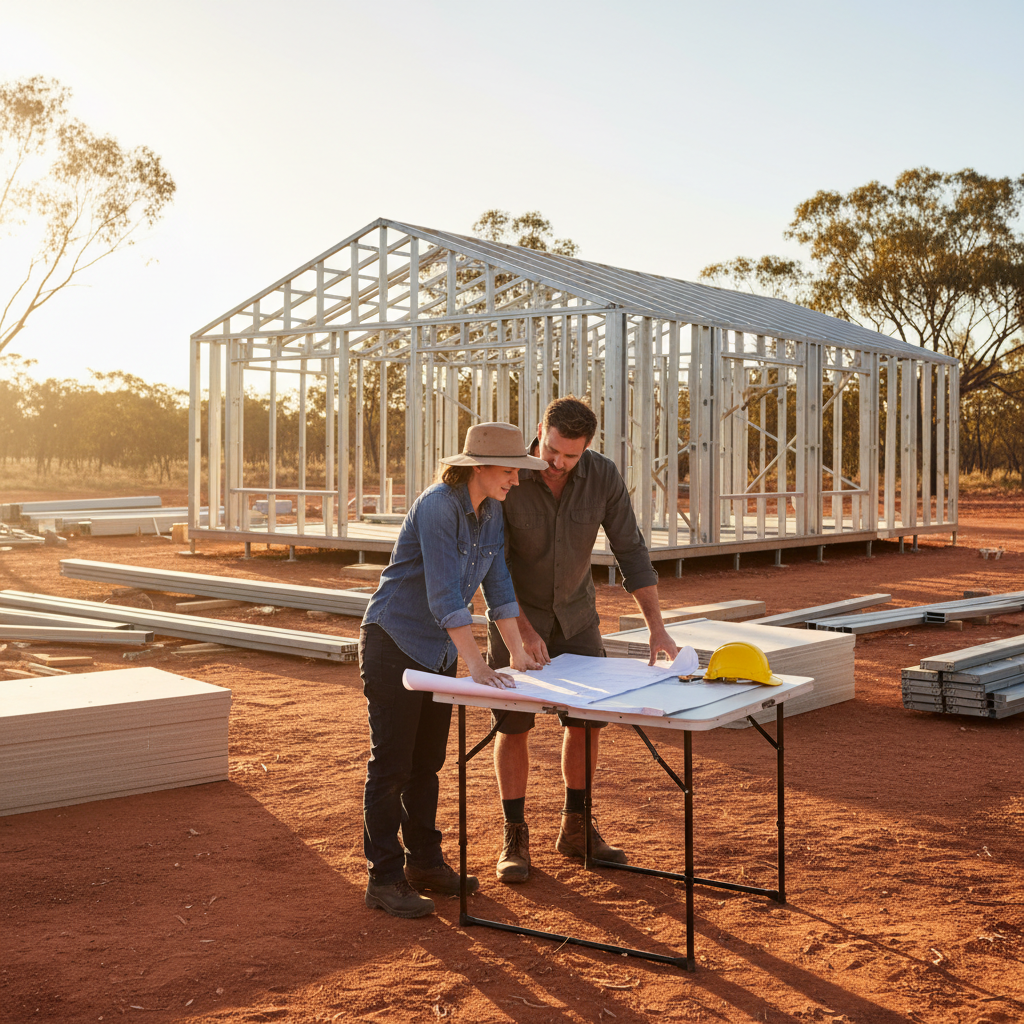
As the owner builder, your job is to ensure that the site works, particularly the concrete slab or sub floor, match the plans exactly. Even a small discrepancy in the slab dimensions can cause issues when the precision engineered steel frames arrive. Your plans are the bridge between the factory and your building site, so treat them with the respect they deserve.
Conclusion
Reading kit home plans does not require an architecture degree, but it does require patience and attention to detail. By taking the time to understand the specifications, floor plans, and engineering requirements, you are setting yourself up for a much smoother construction process.
Remember, your kit home is a system. The steel frames, the cladding, the windows, and the roof all work together to create a durable, modern Australian home. When you can read the 'map' of that system, you are no longer just a spectator in the building process, you are the project manager. Embrace the learning curve, ask questions when you are unsure, and enjoy the process of seeing your paper plans turn into a real, steel framed reality.