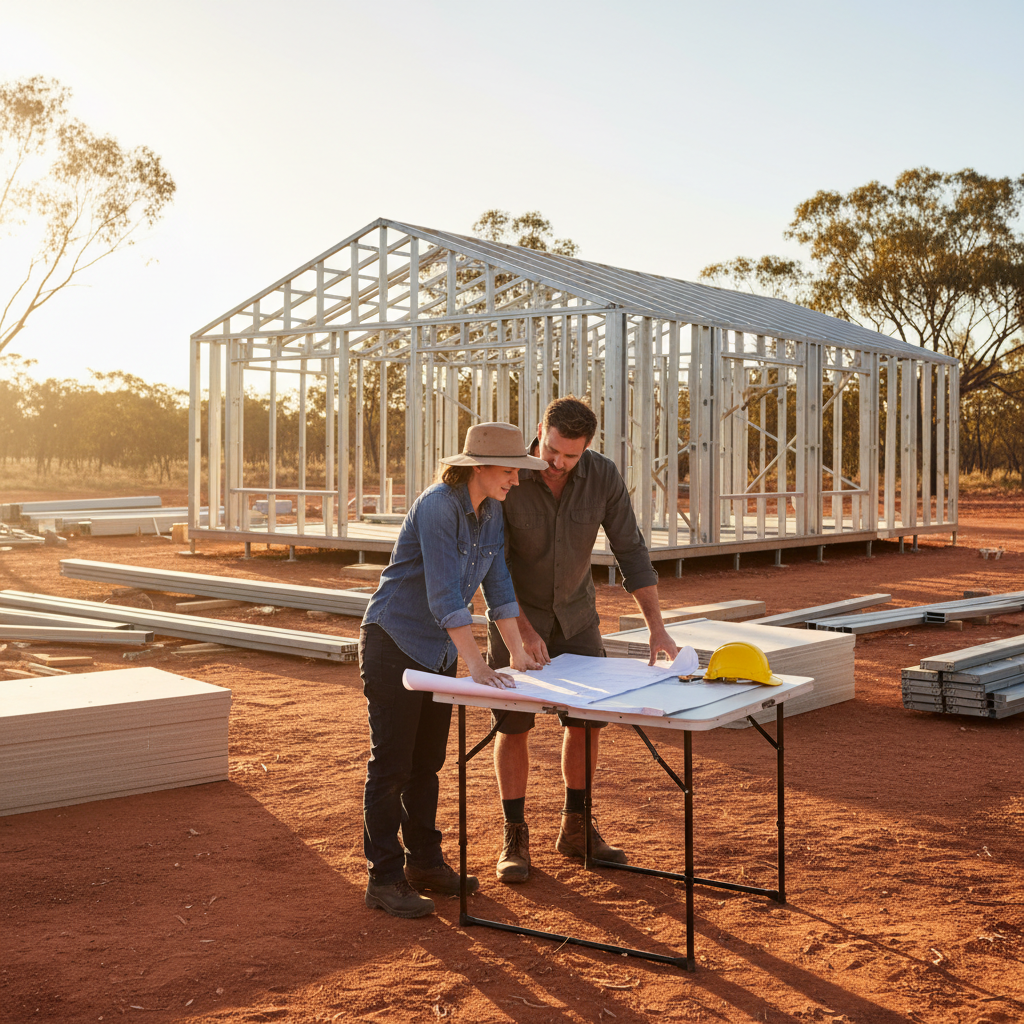
Standing on a bare patch of dirt in rural Victoria with a delivery driver asking where you want three tonnes of TRUECORE steel frames dropped is a wake-up call. If you haven't thought about your site layout before that truck rolls down the driveway, you're already behind the eight ball. Being an owner builder isn't really about swinging a hammer. It is about logistics. It is about making sure the plumber doesn't show up the same day the windows arrive because there won't be room for both utes, let alone the glass racks.
The Myth of the 'Rough' Site
Most blokes think a construction site is meant to look like a bomb hit it. They're wrong. A messy site is a dangerous one, and more importantly, it's a slow one. When you're building a kit home, you're managing hundreds of individual components. We're talking roof trusses, wall frames, bags of fasteners, rolls of sisalation, and stacks of cladding. If you chuck those frames in a heap, you'll spend three hours digging for the one wall section you actually need for 'Bedroom 2'. That is three hours of daylight wasted. Stop. Breathe. Clear a dedicated flat zone for your steel. Use dunnage or pallets to keep it off the wet dirt. Cover it with a tarp if the weather looks hairy, although the BlueScope steel can handle a bit of rain better than timber ever will. It won't warp or twist while you're waiting for the sun to come back out.
Mastering the Paperwork Trail
You need a physical folder. I know everyone wants to use their iPad these days, but when your hands are covered in grease or dust, you don't want to be swiping through PDFs. Get a heavy-duty ring binder. Inside, you need your stamped council plans, your engineering specs, and your kit delivery manifest. When the kit arrives, check it off piece by piece. If the manifest says sixty-two ceiling battens and you only count sixty, you need to know that minute, not three weeks later when you're halfway through the interior fit-out. Keeping receipts is another one. Stick them in plastic sleeves sorted by month. Your accountant will thank you, and it makes tracking your actual spend against your initial guess a lot easier.
Communicating With Trades
As an owner builder, you are the project manager. That means you've got to speak the language. Don't call a sparky and say, "I need some lights put in." Tell him, "I've got a three-bedroom kit with steel frames, and I need a rough-in for twenty-four points and a new board." Because you're working with steel frames, remind him to bring his grommets. If he tries to pull wire through those pre-punched holes without protection, the inspector will knock it back faster than a cold beer on a Friday. It's the little details like this that keep a project moving. It's also why you should have your electrical and plumbing layouts finalized before the frames even arrive. Chasing your tail trying to move a tap landing once the cladding is on is a nightmare you don't want.
The Steel Frame Advantage in Organization
One of the best things about using TRUECORE steel is how clean the process is. Unlike a timber site, you aren't dealing with a mountain of offcuts and sawdust. Every piece in your kit is engineered to fit. It's like a giant Meccano set for grown-ups. But, it requires a different mindset. You can't just 'adjust' a steel frame with a chainsaw if you measured your slab wrong. Double check your footings and your slab dimensions. Use a laser level. If your slab is out by 20mm, your steel frames will show it immediately because they are manufactured to such tight tolerances. Accuracy at the start saves you ten-fold on the finish.
You also need to think about your fasteners. A kit home comes with specific screws for a reason. Don't go using whatever you found in the bottom of your toolbox. Use the hex-head screws provided for the frame-to-frame connections and the specific cladding screws for the exterior. Set up a central 'parts station' on site. A couple of saw horses and a sheet of ply makes a great temporary bench where all your drills, batteries, and boxes of screws live. If you're constantly looking for your impact driver, you aren't building a house, you're just walking around the yard.
Scheduling Without Losing Your Mind
Don't book your trades back-to-back with no breathing room. If the roofer gets delayed by wind, and the plumber is booked for the next day, you're in trouble. Give yourself a 'buffer week' between major stages. Use that time to clean the site, move materials closer to where they're needed, and do a thorough check of the work completed. Did the frame tie-downs get installed to the engineering spec? Are the window flashings tucked in properly? Being an owner builder isn't about rushing to the finish line. It's about being the person who ensures the bones of the house are solid. Because once that plasterboard goes on, you're stuck with whatever is behind it for the next fifty years.
Keep a site diary too. A simple notebook where you write down the weather, who showed up, and what was achieved. If there is a dispute later about when a certain pipe was laid or why a delivery was delayed, that diary is evidence. Plus, it's a great way to look back and realize you're actually making progress, even on those days when it feels like you've spent the whole time just picking up rubbish and talking to council inspectors.
Final Thoughts for the Owner Builder
Last Tuesday, I talked to a guy in Dubbo who was mid-build. He was stressed because he couldn't find his window hardware. Turns out, he'd buried the box under a pile of insulation batts. That is exactly what happens when you don't have a plan for your materials. Label everything. Use a thick permanent marker and write on the plastic wrapping. If a pallet contains 'Eastern Wall Components', write it in big letters on all four sides. It seems like overkill until it's 4:30pm, the light is fading, and you're trying to find one specific bracket. Stay organized, keep your site clear, and respect the precision of your steel frames. You'll find the process becomes a lot more enjoyable and a whole lot less like a second job you're failing at.