The Anatomy of an Australian Kit Home Assembly
There is a unique sense of pride that comes with building your own home. In Australia, the kit home movement has evolved from basic timber shacks into sophisticated, high performance dwellings that leverage modern engineering. For the owner-builder, understanding the technical sequence of assembly is the key to a stress-free project. While you aren't manufacturing the components yourself, you are the project manager and, often, the lead hand on site.
This guide dives deep into the technical assembly process of a modern kit home, focusing on the precision of steel frame construction and the logical flow of building to lock-up stage. Whether you are swinging the hammer or supervising trades, here is how the pieces of the puzzle fit together.
Phase 1: Site Prep and the Foundation
Before the first truck arrives with your steel frames, the site must be ready. In the Australian context, this usually involves a concrete slab or a raised floor system. Because kit homes are engineered to precise millimetres, your foundation must be perfectly level.
If you are opting for a concrete slab on ground, ensure your plumber has accurately positioned all termite protection and under-slab drainage. Steel frame kits, particularly those using BlueScope TRUECORE steel, rely on an accurate footprint. If the slab is out of square by even a small margin, it can create headaches when it comes time to install the roof trusses and external cladding.
Phase 2: The Arrival and Inventory
A kit home arrives as a sophisticated set of components. You will receive the wall frames, roof trusses, roofing iron, external cladding, windows, and doors. The first technical task for an owner-builder is the inventory check. Everything is labeled according to a layout plan. Organizing your site at this stage saves hours of labor later. Group your wall panels in the order they will be raised and ensure your steel finishes are protected from ground moisture and scuffing.
Phase 3: Standing the Steel Frames
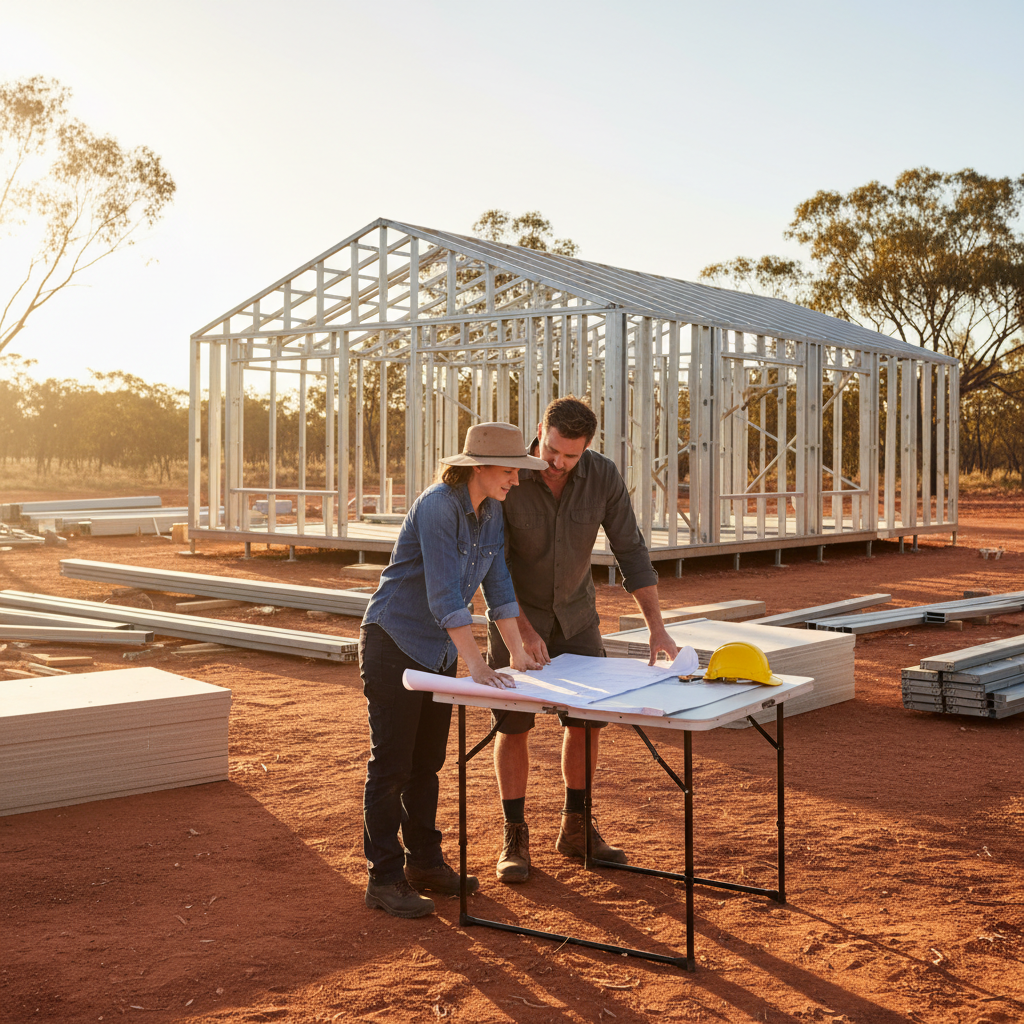
This is where the project truly takes shape. One of the primary benefits of steel frame construction is the weight to strength ratio. Steel frames are significantly lighter than traditional timber, making them much easier for two or three people to handle without heavy lifting equipment.
Technical Tip: Squaring and Bracing
Start at a corner. Once the first two walls are joined, they become self-supporting. Use a spirit level and a plumb bob to ensure every section is perfectly vertical. Steel frames come with pre-punched holes for electrical and plumbing services, which is a massive time-saver for your sub-contractors later. As you work your way around the perimeter, use temporary bracing to hold everything in position until the internal walls are fixed and the roof trusses are tied down.
Phase 4: The Roof Structure
Once the walls are braced and bolted to the foundation, it is time for the roof trusses. In Australian kit homes, steel trusses are engineered to withstand local wind speeds, whether you are building in a sheltered valley or a coastal high-wind zone. Trusses are lifted into place and secured to the top plate of the wall frames using specialized connectors.
After the trusses are secured, you will install the roof battens (the thin strips of steel that the roof sheets screw into). This creates a rigid skeleton that is incredibly strong. Because steel does not warp, twist, or shrink like timber, your roofline will remain straight and true for the life of the building.
Phase 5: Achieving Lock-Up
Lock-up stage is a major milestone for any Australian owner-builder. This involves making the home weather-tight so that internal work can begin regardless of the rain. This phase includes several critical steps:
- Vapour Barriers and Insulation: Before the cladding goes on, the frame is wrapped in a breathable membrane. This is vital for managing condensation and improving the thermal performance of your home.
- Windows and External Doors: These are fitted into the pre-punched openings in the steel frames. Ensure you use high quality flashing to prevent water ingress.
- Roof Cladding: Installing the metal roof sheets. In Australia, this is often corrugated steel which provides excellent durability against the sun and storms.
- External Wall Cladding: Whether you choose traditional weatherboards or modern architectural panels, the cladding is fixed directly to the steel studs.
The Steel Frame Advantage in Building
From a technical building perspective, steel offers several advantages that simplify the assembly process for the DIY enthusiast. Firstly, steel is straight. When you are installing skirting boards or cabinetry later on, you won't be fighting against bowed studs or crowned joists. Secondly, steel is termite proof. In many parts of Australia, this provides immense peace of mind without the need for heavy chemical treatments.
Furthermore, the precision of steel manufacturing means that every component is cut to the exact millimetre. This reduces on-site waste significantly. You aren't cutting down lengths of timber and throwing the off-cuts into a skip bin. You are simply assembling a high-performance kit designed for a perfect fit.
Important Tips for Owner-Builders
While the assembly process is logical, it requires attention to detail. Here are some practical tips for those managing their own kit home build:
Invest in the right tools
Working with steel requires specific tools. A high quality cordless drill with a range of hex-head drivers and metal-piercing screws is your best friend. You will also need tin snips for trimming flashing and a good set of clamps to hold frames while you fasten them.
Safety First
Always wear gloves when handling steel frames and cladding, as the edges can be sharp. Because you are often working at height during the truss and roofing phase, ensure you have appropriate scaffolding or fall protection in place. Australian site safety regulations apply to owner-builders just as much as they do to commercial contractors.
Follow the Sequence
The engineering plans provided with your kit are your bible. Never skip a fastening or a brace. The structural integrity of the home relies on every component being installed exactly as specified. If the plan calls for a specific number of screws in a bracket, use them.
Conclusion: The Reward of Technical Mastery
Assembling a kit home is a journey of technical discovery. It takes the mystery out of construction and allows the Australian homeowner to be intimately involved in the creation of their sanctuary. By choosing a steel frame system, you are working with a material that is durable, precise, and perfectly suited to our harsh environment.
While the process requires hard work and coordination, the result is a high quality, modern home built to the highest standards. Once the shell is complete and the home is at lock-up stage, you have a blank canvas to finish the interior to reflect your personal style and local lifestyle. The transition from a pile of steel components to a standing home is one of the most rewarding experiences a DIY builder can have.