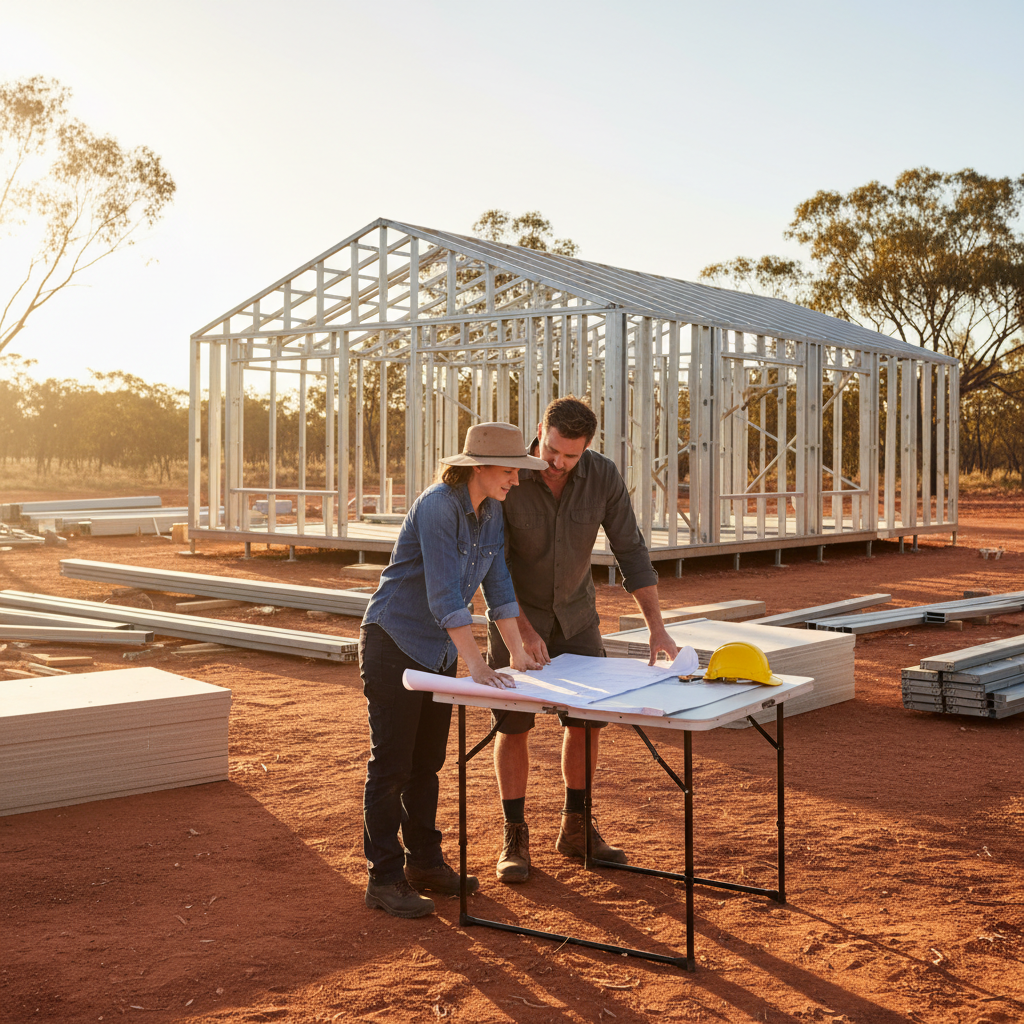
The concrete truck just pulled out of the driveway, the slab is curing, and the steel frames have finally arrived on site. It's an exciting moment for any owner builder in Australia. But before you start thinking about paint colours or that fancy stone benchtop, we need to talk about the guts of the house. I'm talking about the rough-in. This is the stage where your sparky and plumber come in to run their lines before the internal linings go on. If you screw this up, you'll be cutting holes in your brand new plasterboard later on, and that is a headache nobody needs.
The Reality of Steel Frames and Services
Most of the kits we send out use BlueScope TRUECORE steel. It's straight, true, and termites won't touch it. But for a sparky who's spent twenty years drilling holes in pine studs, steel frames require a different approach. You can't just rock up with a spade bit and start chewing through the wall. Modern steel frames come with factory-punched service holes. These are pre-cut flared holes designed for cables and pipes to pass through without snagging. But here is the thing. They aren't always exactly where your specific trade wants them to be. You need to make sure your trades are using plastic grommets. If a sparky pulls a cable through a steel hole without a grommet, the vibrations of the house over time can lead to the steel edge slicing through the insulation. It’s a massive fire risk and a guaranteed way to fail an inspection. Most good sparkies know this, but you’d be surprised how many 'forget' them on a Friday afternoon.
Plumbing Logic in a Kit Environment
Plumbing rough-in is a bit more invasive than electrical. You've got waste pipes, hot and cold lines, and gas if you're going that way. Because you're managing the trades yourself as an owner builder, you have to be the gatekeeper of the frame's integrity. Don't let a plumber cut a massive chunk out of a load-bearing stud just because they didn't bring the right hole saw. In a steel frame kit, the strength is in the C-section. If they need to go through a stud and there isn't a factory hole, they should be using a proper hole saw and then reinforcing it if the hole is over a certain size. AS 3500 is the plumbing code they should be sticking to, but you should also keep an eye on the engineering specs provided with your kit. If they compromise a structural member, the council inspector will knock you back faster than a cold beer on a 40-degree day in Mildura.
The Kitchen Island Trap
I see this all the time. An owner builder wants a massive island bench with a sink and a dishwasher, but they forget the plumbing needs to come up through the slab or the floor frame before anything else happens. If you’re on a slab, those pipes need to be dead accurate. There is no 'nudging' a 100mm PVC waste pipe once the concrete is hard. You’ve got maybe a 50mm margin for error before you’re into jackhammer territory. When you’re laying out your kitchen, don't just guess. Get the actual spec sheet for your sink and dishwasher. Know exactly where that waste needs to pop up. Use a string line. Check it four times.
Electrical Planning for the Real World
Australia is getting hotter, and our houses are getting smarter. When you’re doing your electrical rough-in, think about more than just light switches. Think about data. Even with great Wi-Fi, nothing beats a hardwired Cat6 cable for the home office or the TV. Run them now. It costs peanuts when the walls are open but a fortune once the gyprock is up. Plus, consider your outdoor areas. Most kit home buyers love a good verandah. Make sure your sparky runs the cables for outdoor fans and sensor lights during the initial rough-in. Trying to fish a cable through an insulated wall later is a recipe for high blood pressure.
And then there's the switchboard. Position it somewhere sensible. Don't just stick it on the front of the house because it’s easy for the sparky. Put it on a side wall where it won't ruin the street appeal. If you're planning on solar panels later, tell your sparky now. They can run a conduit from the roof space down to the board area so the solar installers won't have to run ugly conduit all over your nice new cladding.
Interfacing with Insulation
You’ll likely be using some form of glasswool batts or earthwool between your studs. This happens after the rough-in but before the cladding and internal lining. The mistake people make is squashing the insulation around pipes and cables. If you compress insulation, it loses its R-value. It’s like wearing a puffer jacket that’s been vacuum-sealed. It doesn't work. Your trades should fix their lines to the center of the wall cavity. This allows the insulation to sit snugly behind and in front of the services without being bunched up. For electrical cables, make sure they aren't completely buried in thick insulation if they are carrying heavy loads, like for an oven or a large split system AC. Heat needs to dissipate. Talk to your sparky about 'derating' cables if the house is heavily insulated. It’s a technical detail that separates the pros from the hacks.
Managing Your Trades on Site
Being an owner builder means you're the boss. You aren't there to be their mate, you're there to get the job done right. When the plumber shows up, give them a copy of the floor plan that you've marked up. Don't rely on a verbal 'yeah, I want the shower there'. Draw it on the slab with a permanent marker. Write 'SHOWER' in big letters. Write 'TOILET' where the pan goes. It’s much harder for someone to move a pipe if they’ve literally walked over the word 'TOILET' all morning.
Also, watch the clock. Most tradies charge by the hour or by the job, but if they hit a snag because they didn't read the kit instructions, that shouldn't be your cost. We provide detailed layouts for a reason. Often, the easiest path for a pipe isn't the best path for the structure. You need to be firm about this. If the plans show the plumbing going through a specific service duct, make sure they use it.
The Gap Between Rough-in and Fit-out
Once the rough-in is done, take photos of every single wall in the house. Every one. Hold a tape measure against the studs so you can see exactly how far that water pipe is from the corner of the room. Two months from now, when you're trying to screw a towel rail into the wall, you’ll be glad you have a photo showing that you aren't about to drill straight into the main water line. It happens more than you’d think. A single screw through a pex pipe can stay hidden for weeks, slowly dripping behind the wall until your floorboards start to warp and you’ve got a mould problem.
So, get your grommets in, watch your slab penetrations like a hawk, and don't let anyone cut your steel frames without a very good reason. The rough-in isn't just a box to tick. It’s the nervous system of your home. Treat it with a bit of respect, and the rest of your build will go a hell of a lot smoother.