Twelve years ago I watched a bloke in the Hunter Valley try to convince a council inspector that his site drainage was fine while standing ankle-deep in a mud puddle that looked like a Lindt chocolate fountain. He'd bought a stunning kit home but forgot that the land actually has to hold the thing up. That is the reality of the game. People see the shiny floor plans and the clean lines of BlueScope steel frames and they forget that building is a gritty, loud, often frustrating process that requires more than just a bit of enthusiasm. It takes a thick skin and a heap of planning.
The Slab is Not the Start
Most first-timers reckon the build begins when the concrete truck rolls up. Wrong. It begins months before that at your local council desk. I have seen too many people buy a kit, get it delivered to their backyard, and then realize they are in a high Bushfire Attack Level (BAL) zone. If you are in a BAL-29 or BAL-FZ area, your requirements for windows, doors, and even the gaps in your eaves change completely. You can't just slap up a standard kit and hope for the best. You need to know your site classifications before you even look at a catalog. Talk to a private certifier early. They are worth their weight in gold because they know the local loopholes and the genuine deal-breakers that the council won't tell you until it is too late.
The Myth of the 'Complete' Kit
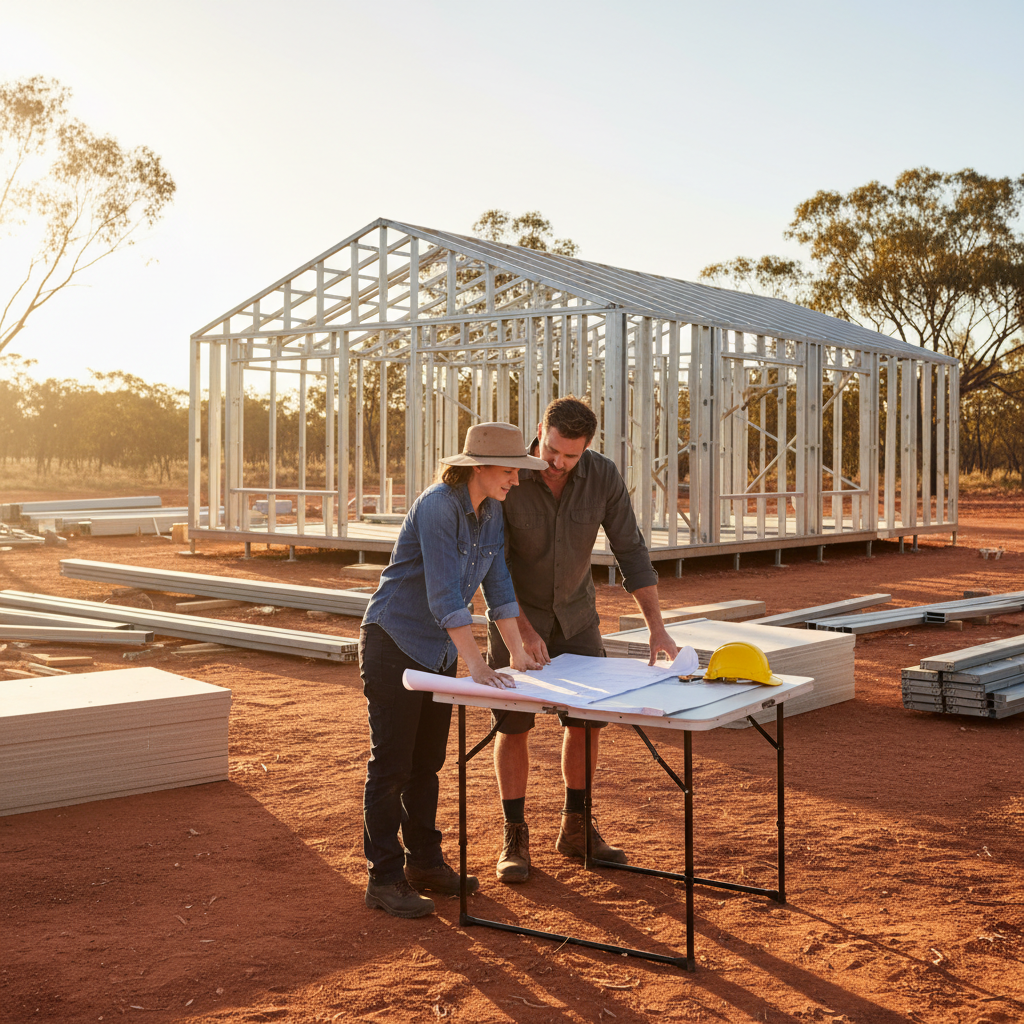
Kits are great. They give you the bones, the TRUECORE steel frames, the cladding, and the roof. But they aren't a Lego set that comes with every single nut and bolt for the entire house. You are the owner-builder. That means you are the project manager. You need to source your own local sparky, your own plumber, and your own tiler. A common mistake is not having these trades lined up before the steel arrives on the truck. If your frames are up and you're waiting three weeks for a plumber to rough-in the pipes, you're losing money and momentum. The weather doesn't care about your schedule. If those frames sit exposed because you didn't book the roofers in time, you'll be kicking yourself when the sky opens up over Gippsland or wherever you're building.
Owner-Builder Permits are Not Optional
I get it. Paperwork is a pain. But in most Australian states, if the value of your work exceeds a certain amount (usually around $10,000 to $20,000 depending on where you live), you need an owner-builder permit. This isn't just about being legal. It is about insurance. If a contractor trips on your site and you don't have the right paperwork and site insurance, you are cooked. You'll be paying out of pocket for the rest of your life. Get your white card, do the owner-builder course, and understand that you are the boss. The buck stops with you. Not the kit provider. Not the guy delivering the sand. You.
Access Problems Will Kill Your Budget
I remember a project near the Glass House Mountains where the owner forgot to check if a semi-trailer could actually turn into his driveway. The delivery truck arrived, saw the narrow, winding dirt track, and told the owner it was a no-go. They had to double-handle the entire kit onto a smaller flatbed at a massive extra cost. When you are looking at your site, don't just look at where the house goes. Look at the road. Are there low-hanging power lines? Is the ground soft? Can a crane get close enough to lift the trusses? If the answer is no, you need a plan. And a plan usually costs money, so it’s better to know now than when the driver is staring at you with his engine idling.
The Insulation Oversight
Australia is a land of extremes. One day you're melting in 42-degree heat in Dubbo, the next you're freezing. Because we use steel frames, which are incredible for straight lines and termite resistance, you have to be smart about thermal breaks. Don't skimp on the insulation. NCC Volume 2 outlines the energy efficiency requirements for a reason. You want a high R-value in those walls and the ceiling. Use a high-quality building wrap. It keeps the moisture out and the comfort in. Some people try to save a few hundred bucks here, but they end up paying thousands over the years in electricity bills because their house has the thermal properties of a tin shed. Don't be that person.
Managing Your Trades
Here is a tip from someone who has been on tools: pay your trades on time. If you want a subbie to do a good job on your kit home, treat them with respect. They are used to working for big builders who pay on 30-day terms. If you pay them the Friday they finish, they'll move mountains for you. But also, be firm. Check their work against the plans. If the window openings are five millimetres out, tell them to fix it then and there. Once the cladding is on, it's too late. It’s your house. You’re the one who has to live in it and look at that slightly crooked wall for the next twenty years.
Storage on Site
When your kit arrives, you'll have a mountain of steel and timber and boxes. Don't just let the driver dump it in a pile. Organize your site. Put your frames near where they'll be stood up. Keep your windows under cover and off the ground. I’ve seen expensive glass smashed because a dog ran through the site or some bloke knocked a ladder over. A messy site is a dangerous site and an expensive site. Keep it tidy.
The Bottom Line
Building a kit home is one of the most rewarding things you can do. There is nothing like sitting on your deck with a cold drink knowing you managed the whole thing. But it’s a marathon, not a sprint. Take your time with the slab prep. Triple-check your council requirements. Don't be afraid to ask questions. Most of the blokes in the office at the kit company have seen every mistake under the sun. Use that knowledge. If you're organized, realistic about your skills, and ready to get your hands dirty, you'll end up with a cracking home that'll last a lifetime. Just make sure the truck can actually get up your driveway first.