The Myth of the 'Straight' Timber Stud
Walk onto any residential build site in Australia where they're using green timber and you'll see it. A chippie standing there with a plane, shaving down a bowed stud so the plasterboard doesn't look like a mountain range once the sun hits it at 4pm. It's a waste of time. I’ve spent 15 years watching blokes struggle with timber that twists the second a bit of moisture hits the air in North Queensland or dries out too fast in the Perth heat. Steel doesn't do that. When we talk about precision engineering in kit homes, we aren't just using fancy words. We're talking about the fact that a 2400mm wall stud made from BlueScope TRUECORE steel is exactly 2400mm today, tomorrow, and in twenty years when your grandkids are crashing into the walls.
Precision starts in the software. Before a single piece of steel is rolled, the entire house is modeled in 3D. Every service hole for the sparky and the plumber is pre-punched. Every connection point is marked. Because we use computer-controlled roll-forming machines, the margin for error is basically zero. You try getting that kind of accuracy with a hand-saw and a blunt pencil on a windy Tuesday in Gippsland. It just won't happen. Most owner-builders think they're saving money by going with whatever is cheapest at the local yard, but they forget the 'frustration tax'. That's the tax you pay when your kitchen cabinets won't sit flush because your corner isn't a true 90 degrees. Steel fixes that before you even pick up a drill.
Termites Don't Eat Steel. Period.
It's a blunt truth. If you live anywhere north of Hobart, termites are a constant, nagging threat that'll keep you up at night if you let 'em. I've seen termite damage in the Riverina that would make a grown man cry, structural beams turned to lace in a matter of months. Sure, you can pump your soil full of chemicals and hope the barrier holds, or you can build with a material that isn't on the menu. Steel is 100 percent termite proof. It’s also borer proof. You don't need to spray the frames with toxic stuff. It’s a peace of mind thing. Plus, if you're building in a Bushfire Attack Level (BAL) rated zone, steel is your best mate. It's non-combustible. It won't add fuel to a fire, and it won't help a blaze spread through your roof cavity. In an Australian summer, that's not just a benefit, it's a necessity.
The Engineering Behind the Strength
People worry that steel is flimsy because it's light. Wrong. It’s the strength-to-weight ratio that matters. We use cold-formed steel sections that are incredibly rigid once they're screwed together. Think about it like an aircraft wing. It's light so it can fly, but strong enough to hold up under massive pressure. Your kit home frames are designed to meet Australian Standard AS 4100 or AS/NZS 4600 for cold-formed steel structures. This isn't guesswork. Every truss and every wall plate is engineered to handle wind loads specific to your block. Whether you're building on a windswept cliff in Tassie or a flat paddock in the Wheatbelt, the engineering is dialed in for your specific GPS coordinates.
What's Actually in the Delivery Truck?
When the truck rolls up to your site, you aren't just getting a pile of metal. You're getting a giant Meccano set for adults. Here is what usually comes in a standard kit:
- Wall frames and roof trusses made from TRUECORE steel.
- External wall cladding (often Colorbond or weatherboards).
- Roofing iron, gutters, and downpipes.
- Aluminium windows and external doors with locks.
- All the hardware, screws, and brackets to get the shell up.
- Quality insulation to keep the heat out and the cool in.
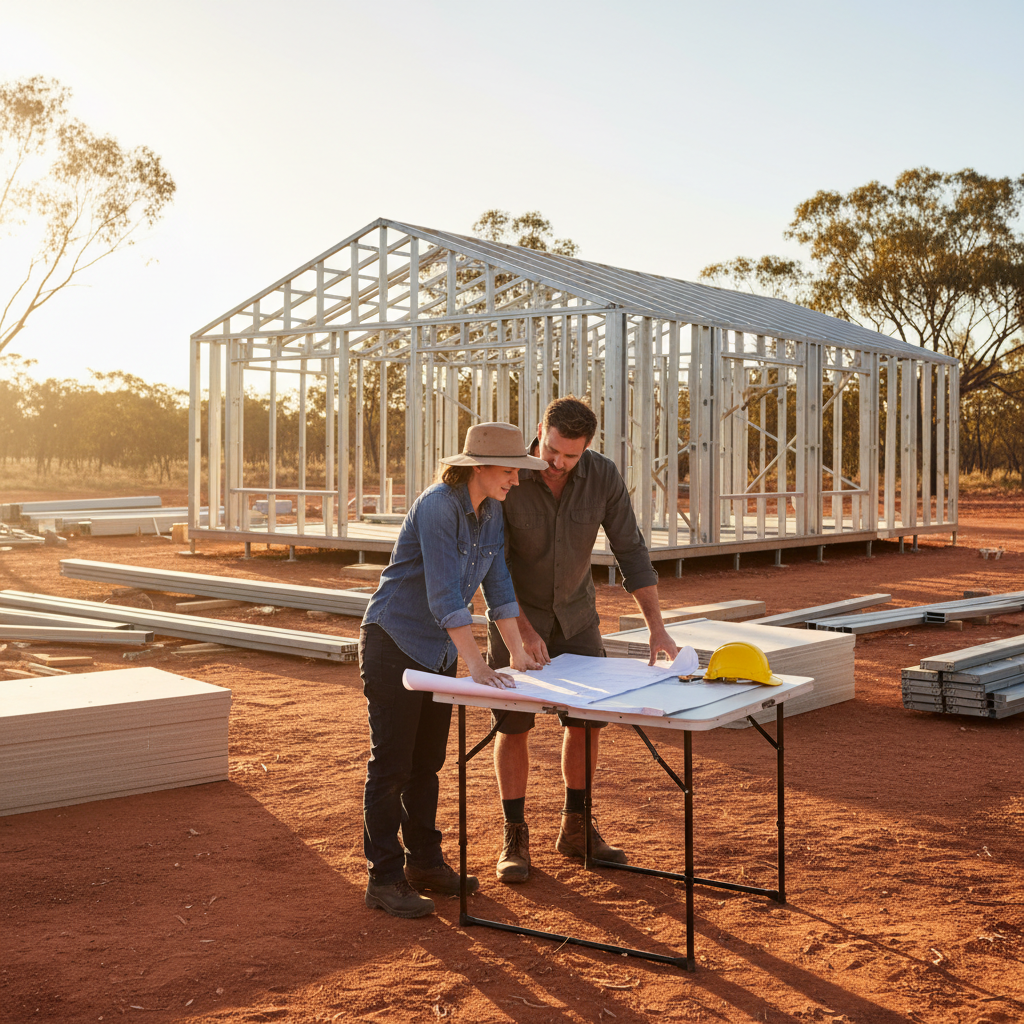
As an owner-builder, you're responsible for the heavy lifting before and after. You'll need to sort your slab or sub-floor, get the plumber to run the stacks and drains, and hire a sparky for the rough-in. But because the steel frames come pre-assembled or in easy-to-manage panels, the 'standing the frames' part of the job goes incredibly fast. I've seen two mates and a couple of battery drills have the walls up on a small three-bedroom floor plan in a weekend. Try doing that with stick-built timber and a nail gun without a trip to the emergency room.
The Accuracy Benefit No One Mentions
Here is a trade secret. If your frames are dead straight, every other trade saves time. Your plasterer won't complain about 'bellies' in the wall. Your tiler won't have to use half a ton of extra glue to level out a wonky shower recess. Your skirting boards will actually sit flat against the wall without huge gaps you have to fill with Caulk. This precision makes the finish of the house look a million bucks, even if you did most of the work yourself. It hides the fact that it's your first time building. Because the steel provides the perfect skeleton, the 'skin' of the house looks flawless.
But lets be real for a second. Steel can be a bit loud when you're working with it. Every time you drop a stud on the slab, it rings. And yeah, it can expand and contract a tiny bit with major temperature swings, but modern engineering accounts for that with clever clip systems and thermal breaks. It's a small price to pay for a house that won't warp, rot, or get eaten by bugs. Plus, steel is 100 percent recyclable. If the house ever gets knocked down in 100 years, that steel can be melted down and turned into a new bridge or a fridge. Can't say that for treated timber soaked in chemicals.
Owner-Builder Realities
I always tell people: don't be a hero. Just because the frames are easy to put up doesn't mean you should ignore the paperwork. You still need your Owner-Builder permit from the QBCC or whatever your state authority is. You still need to manage your site safety. And for the love of everything holy, wear gloves when handling steel. The edges can be sharp, and a slice from a steel flange is a quick way to end your Saturday arvo early.
One trick I've learned is to use the pre-punched holes for what they're actually for. Don't go drilling new holes through your structural members just because it's easier to run a pipe that way. The engineering depends on the integrity of the steel. Use the service holes provided. If you have to put a hole somewhere else, check the manual or call us. We’ve seen it all before. Usually, there's a specific way to reinforce a web if you’ve had to cut it, but it’s better to just stick to the plan. Precision only works if you respect the design.
Wrapping It Up
At the end of the day, you're building a home, not a garden shed. You're putting your hard-earned cash into a slab and some walls. It’s gotta last. Steel frame kit homes give you a level of accuracy that old-school building methods just can't touch. It’s like comparing a high-res digital photo to a blurry Polaroid. Both show you the picture, but one is clearly better. If you’re keen to get your hands dirty and manage your own build, steel is the smartest way to ensure you don't end up with a crooked house and a massive headache. Get the foundations right, trust the engineering, and you'll be having a cold one on your new deck before you know it.