The Problem with Moving Parts
Walk into a twenty year old timber frame house and you'll usually see the signs. There's a hairline crack running from the corner of the lounge room window, or maybe the bathroom door sticks every time there's a humid week in February. Most people think it's just the house settling. It isn't. It's the skeleton of the home physically changing shape as the wood breathes, sucks up moisture, and dries back out. When you're an owner-builder taking on the massive task of putting together your own place, you don't want to fight the materials from day one. You want things square, and you want them to stay that way.
Timber is a natural product. It's got cells that expand and contract. Even kiln-dried stuff has a mind of its own once it hits the humid air on a site in coastal Queensland or the dry heat of a Victorian summer. Steel doesn't do that. It's inert. A steel wall frame made from BlueScope TRUECORE is the same length at 6 AM in the frost as it is at 3 PM in the sun. This is what we call dimensional stability. It sounds like a fancy engineering term, but for a kit home builder, it's the difference between a house that fits together like Lego and one that requires a plane, a chisel, and a lot of swearing.
Precision Matters When You're the One Swinging the Hammer
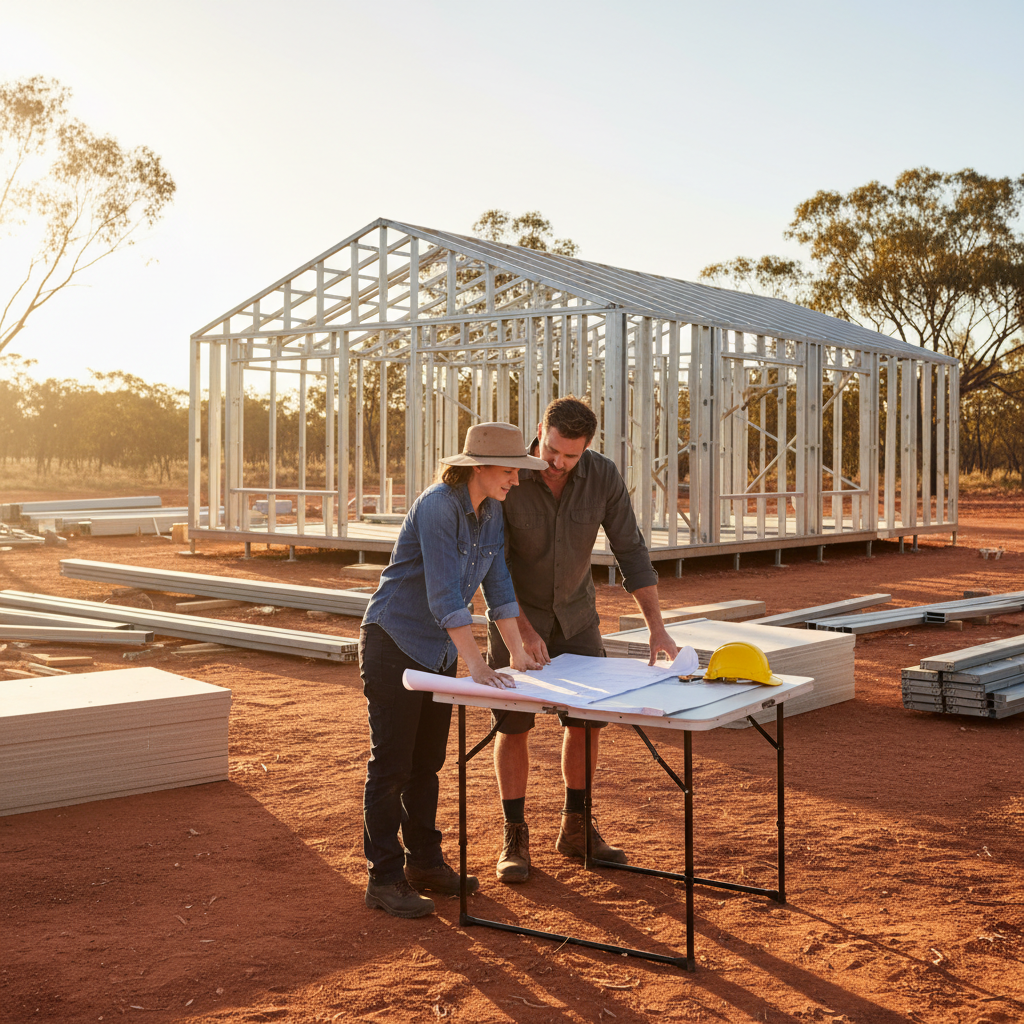
Most kit homes come out to site as a big puzzle. If you're using steel, those pieces are roll-formed to the millimetre. Because steel frames don't warp or twist while they're sitting in a pack on your slab, the holes for your electrical runs and plumbing always line up. I've seen blokes spend half a day redrilling timber studs because the wood bowed three degrees after a rain shower. That's a waste of time you don't have when you're managing trades or doing the heavy lifting yourself on the weekends.
Think about your kitchen cabinets. You spend ten grand on stone tops and high-end joinery, and you expect those cupboards to sit flush against the wall. If your studs have bowed out 5mm because the timber dried out unevenly, your cabinet maker is going to have a nightmare of a time scribing panels to hide the gaps. Steel gives you a perfectly flat substrate. Everything follows. Your plasterboard goes on flatter, your skirting boards don't have those ugly gaps at the top, and your windows don't bind in their tracks three years down the road.
The Science of the Sag
Under AS 4100 or the residential framing code AS 4600, we look at how materials handle loads. Timber has a habit of 'creep'. It's a slow, permanent deformation under a constant load. Think of a heavy tile roof sitting on wooden rafters for thirty years. Eventually, you get that slight sag in the ridgeline. Steel won't creep. It has a high strength-to-weight ratio that stays consistent. Plus, it's non-combustible. If you're building in a Bushfire Attack Level (BAL) rated zone, steel is almost a no-brainer. It doesn't add fuel to the fire, and it won't twist out of shape under moderate heat like some people assume.
So, why isn't everyone using it? Some old-school chippies reckon it's harder to work with. They're used to a nail gun and a circular saw. But for a kit home, that's irrelevant. The engineering is done. The trusses are pre-calculated. You aren't out there with a hacksaw trying to fabricate a hip-and-valley roof on the fly. You're assembling a system that's been designed on a computer and cut by a robot. It's a different way of thinking about building. It's more about assembly and less about 'making it fit'.
Real World Headaches You Can Avoid
I remember a project out near Dubbo. A mate was doing a timber kit, and a big storm rolled in right after he'd got the frames up but before the roof was on. That timber sat in the wet for four days, then the sun came out and baked it at 38 degrees. By the time he went to put the internal linings on, half the studs looked like bananas. He had to spend two days 'sistering' studs—nailing straight bits of wood to the bent ones—just so the plaster wouldn't crack. If that had been steel, he could've just hosed the mud off and kept going. Moisture doesn't change the shape of steel. No rot, no fungi, and crucially for most of Australia, no termites. Those little white ants can't eat BlueScope steel. You still need your termite barriers for your finishes and cupboards, obviously, but the structural integrity of your house isn't on the menu.
Tips for Handling Steel on Site
Even though it's tough, you've got to treat it right. Here's a few things I've learned over the years:
- Keep your packs off the ground. Not because of rot, but to keep them clean and stop them getting scratched up before they're buried behind the walls.
- Use the right screws. Don't try and use timber fasteners. You want self-drilling wafer head screws for your frame-to-frame connections. They bite in and pull the steel tight.
- Wear gloves. Freshly cut steel edges are like razor blades. I've seen many a tough bloke humbled by a tiny sliver of steel swarf in the finger.
- Don't forget the noggins. If you're planning on hanging a massive 75-inch TV or a heavy dryer in the laundry, tell your kit provider early. We can add extra steel noggins so you've got something solid to screw into. You can't just throw a screw anywhere like you can with a 90x45 pine stud.
The Trade-Off: Acoustic Performance
Let's be honest, because every material has a downside. Steel is a great conductor of sound. If you don't insulate properly, a steel frame house can feel a bit like a tin drum when the wind really picks up or the kids are hollering in the next room. But we've sussed this out. You use acoustic batts. You use thermal breaks (which are actually required by the NCC now anyway). Once you've got your insulation in and your cladding on, the sound difference is negligible. The trade-off is that you get a house that's straighter than a die and will stay that way for fifty years.
Buying a kit home means you're taking control of the process. You're the one hiring the plumber, the sparky, and the tiler. If you give those trades a perfectly plumb and square frame to work with, they get their job done faster. A tiler will love you if your bathroom walls are actually 90 degrees. It means he doesn't have to use two inches of bed to level out a wonky corner. That saves you money on materials and labor, even if the steel kit costs a touch more upfront than a budget timber pack.
Finishing Touches
When you're looking at floor plans, think about the long game. You're not just building for the move-in date. You're building for ten years' time when you don't want to be patching plasterboard cracks every spring. The dimensional stability of a steel kit house is like an insurance policy for your finishes. It keeps everything tight. No popping nails in the ceiling, no jamming doors, and no creaks when the temp drops at night. It's a calculated decision. If you want a house that stays exactly where you put it, go with steel. Simple as that.