I remember standing on a slab out near Dubbo back in the early 2000s, watching a bloke try to straighten a pack of timber studs that had been sitting in the sun for three days. They looked like boomerangs. He was sweating, swearing, and wasting hours trying to plane back bows so the plasterboard wouldn't look like a mountain range once it went up. That's the moment the lightbulb went on for me. Timber is okay for some, but if you want accuracy, you go with steel. Specifically, cold-rolled BlueScope TRUECORE steel. It's not just about strength. It's about sleep. The kind of sleep you get when you know your house isn't going to twist, shrink, or get eaten from the inside out by local termites.
The Myth of the 'Soft' Home
People often reckon steel feels cold or clinical. They're wrong. Once the cladding is on and the insulation is tucked in tight, you can't tell the difference by looking at it. But you sure can tell the difference when you try to close a bedroom door in five years' time. Because steel doesn't have moisture content, it doesn't move. It doesn't care if it's a humid 40-degree day in Rockhampton or a freezing morning in the Blue Mountains. The frame stays exactly where the CAD software told the roll-former to put it. We're talking millimetre precision here. If the plan says a wall is 4350mm, it's 4350mm. Period.
This matters more than you think for the DIY crowd. When you're an owner builder, you're usually balancing a day job and family life while trying to play project manager on the weekends. You don't have time to be a master carpenter. You need a system that fits together like a giant Meccano set. Every hole is pre-punched. Every service duct for your sparky is already there. You aren't standing there with a drill and a prayer, hoping you aren't compromising the structural integrity of a load-bearing member just to run some 2.5mm twin and earth cable.
Engineering that Does the Hard Work for You
The precision engineering behind modern kit homes is actually pretty staggering. When we talk about engineering, we aren't just saying it sounds fancy. We mean the Australian Standards like AS 4100 (Steel Structures) and AS/NZS 4600 (Cold-formed steel structures). These designs are pushed through software that calculates wind loads for specific regions. If you're building in a Cyclonic Region C area, your kit isn't just a generic box. It's beefed up where it counts. The screws, the brackets, the gauge of the steel - it's all calculated to ensure the roof stays on when the weather turns nasty.
And let's chat about termites for a second. They're a nightmare in almost every part of Australia. You can spray chemicals into the ground and hope for the best, or you can build with a material that literally offers them zero nutritional value. Steel is 100% termite proof. It won't ignite in a bushfire either. While no house is completely fireproof, having a non-combustible frame gives you a massive head start in meeting your BAL (Bushfire Attack Level) requirements. It's one less thing to stress about when the RFS starts making noise on the evening news.
The Reality of the Build Site
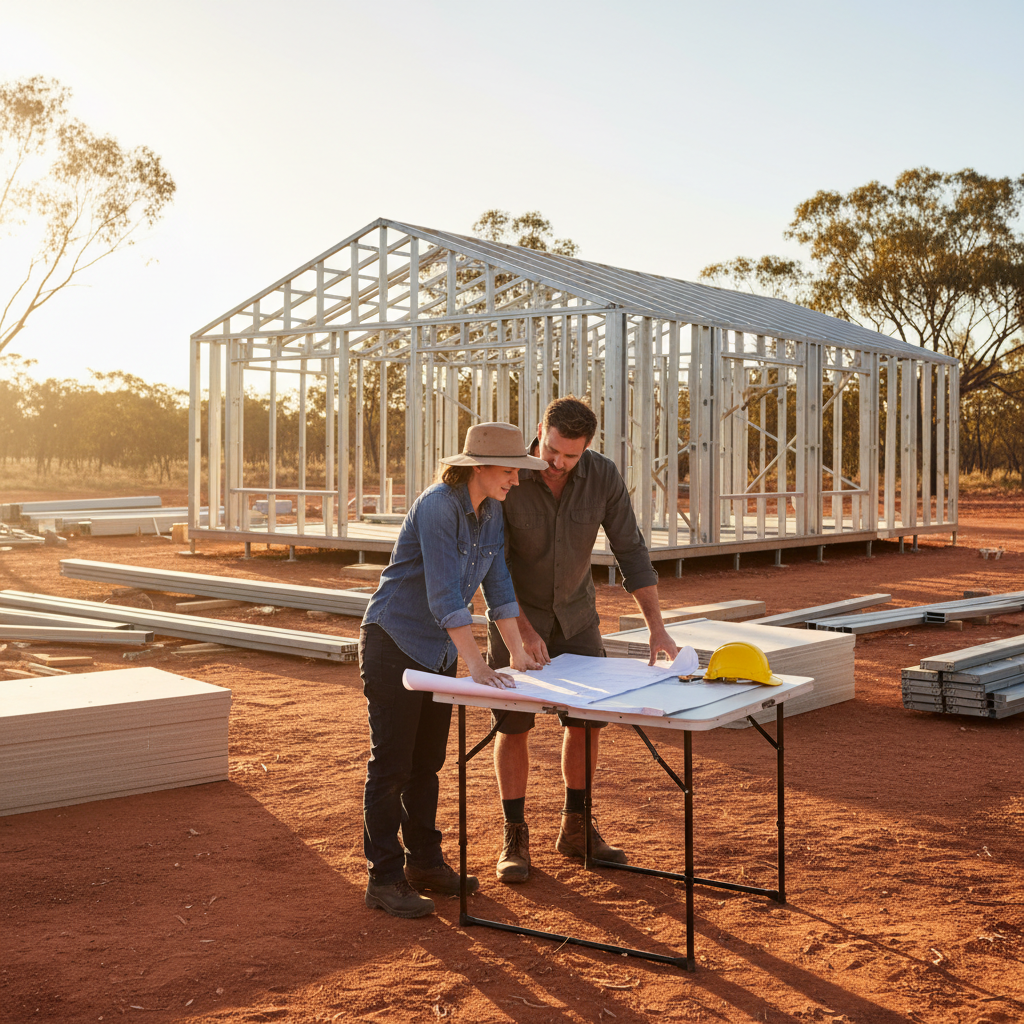
When your kit arrives on the back of a truck, it's a pile of components ready to go. No off-cuts. No waste. No giant skip bin filled with hundreds of dollars of wasted timber because someone measured twice and cut once but still got it wrong. Because the steel is cut to length in the factory, the site stays clean. This is a huge win if you're building on a tight suburban block or a sensitive rural patch where you don't want rubbish blowing into the back paddock. Plus, steel frames are lighter than timber. You aren't going to throw your back out quite as easily, though I'd still recommend a good pair of gloves because those edges can be sharp if you're move too fast.
Beyond the Frame: The Shell Components
A kit home isn't just the skeleton. It's the whole shell. You get the roofing, the cladding, the windows, and the doors. But the frame is the boss. It dictates how everything else sits. If your frame is out by 10mm, your windows won't fit right. You'll be there with shims and expanding foam trying to hide the gaps. With steel, the window openings are square. Every time. It makes the lock-up stage so much faster. I've seen guys get their frames up and cladded in a fraction of the time it takes for a traditional stick-build. It's about momentum. As an owner builder, momentum is your best friend. Once the roof is on and the windows are in, you feel like you're winning. The pressure drops.
One thing people ask about is 'oil canning' or those ticking noises in the heat. Modern engineering has mostly sorted this. Using the right thermal breaks and ensuring the cladding is fixed correctly allows for the minor expansion and contraction that happens with all materials. It's not a ghost in the walls; it's just physics. And honestly, I'd take a tiny click in the roof over a slab-dropping crack in a crooked timber stud any day of the week.
Practical Tips for the Steel Frame Novice
- Buy a high-quality impact driver. Don't go cheap here. You'll be driving thousands of Tek screws through steel. Your wrist will thank you for getting a tool with good ergonomics.
- Keep your magnets handy. It sounds silly, but finding studs behind cladding or linings is a breeze when you can just slide a magnet along the wall.
- Plan your noggins. If you know you're hanging a heavy 75-inch telly or a row of heavy kitchen cabinets, talk to the designer early. Adding extra support in a steel frame is easy during the design phase, but a bit more fiddly once the frame is stood up.
- Organize your site. When the truck arrives, don't just let them dump the packs anywhere. Sort them by wall sequence. It saves you walking five kilometres a day just fetching the next bit of track.
The Environmental Angle
A lot of people don't realize steel is one of the most recycled materials on the planet. If, in a hundred years, someone decides to pull your house down, that steel can be melted back down and turned into something else. It doesn't end up in landfill like treated timber, which is full of chemicals. Plus, because every piece is precise, there's virtually zero scrap produced during the manufacturing process. It's efficient. Australians like efficiency. We're a practical bunch. We don't want fluff; we want a house that stands up to the sun and the bugs and the wind.
Building your own home is a massive undertaking. It's probably the biggest thing you'll ever do. Choosing to go with a steel-framed kit isn't just a technical decision. It's a choice to simplify the hardest parts of construction. You're buying the results of millions of dollars of R&D and thousands of hours of engineering expertise. You're buying a straight line in a world that's often crooked. When you're standing there on your porch on a Saturday afternoon with a cold drink, looking at a wall that's perfectly plumb, you'll know you made the right call.