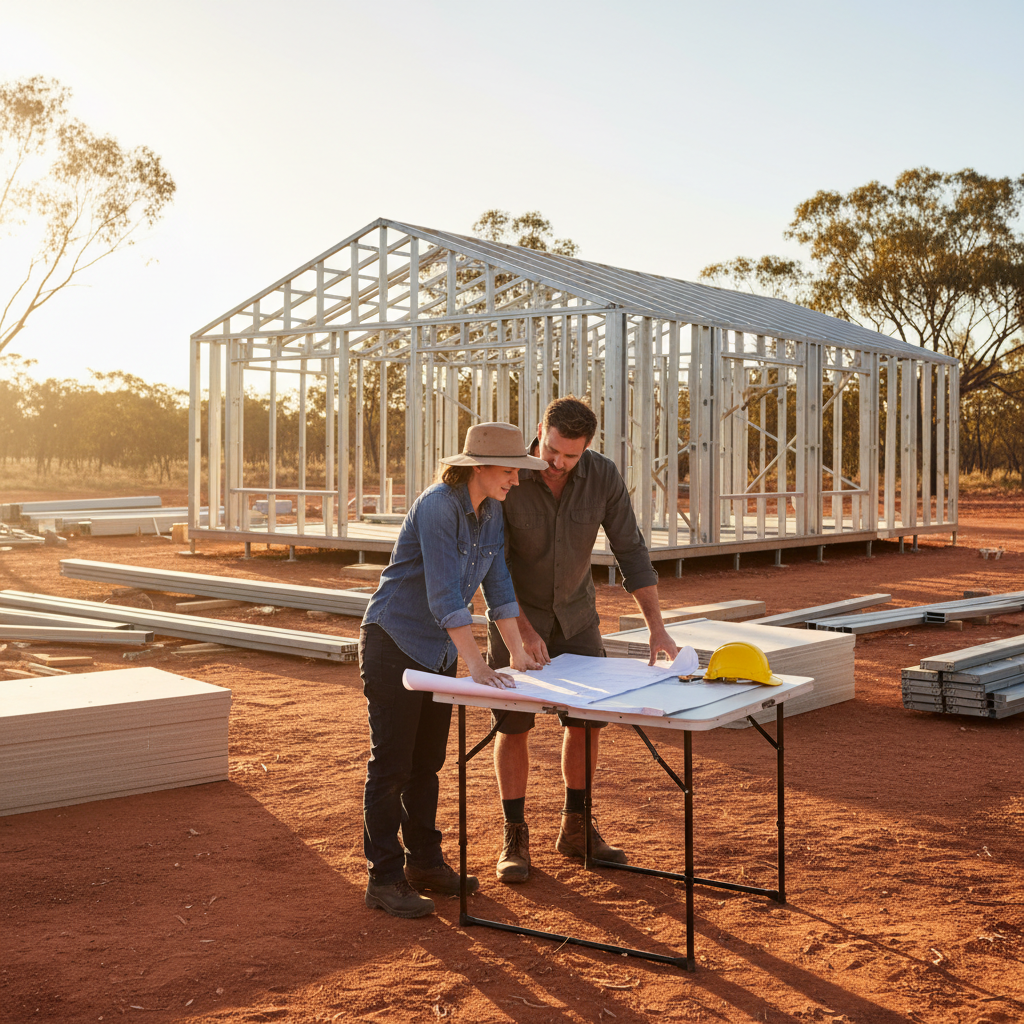
I was standing on a site out past Ipswich last summer, mid-January, heat coming off the ground in waves. The owner-builder there had just finished his slab and was about to start standing frames. He'd gone with a steel frame kit because he was sick of seeing wavy walls in his mates' places. Smart move. See, when you're building a kit home in Australia, your biggest enemy isn't the council or the plumber. It's the climate. Timber sits on a pallet for three weeks in the rain, then gets baked in 40-degree heat, and suddenly your 90mm studs look like boomerangs. That's where the precision engineering of steel changes the whole job for a DIYer.
The Myth of the 'Close Enough' Measurement
In the trade, there's always a guy who says 'near enough is good enough'. But when you're the one hanging the internal doors 6 months later, you'll realize it bloody well isn't. If your frame is out by 5mm at the base, it's out by 15mm at the top. Suddenly your plaster cracks and the door won't latch. Steel frames, specifically the stuff rolled from TRUECORE steel, are engineered to a fraction of a millimeter. Every piece is cut and punched in a factory using CAD software. It means when you pull a piece out of the pack, it's exactly what the plan says it is. No more using the circular saw to shave bits off or shimming out low spots because the wood's twisted in the sun.
The engineering behind this isn't just about being straight. It's about how the house handles the Australian environment. We deal with reactive soils here. One month it's a drought and the ground shrinks, the next we get a week of tropical rain and the slab wants to heave. Steel has a strength-to-weight ratio that timber can't touch. It stays stable. It's also 100 percent termite proof. You don't need to spray nasty chemicals every couple of years just to make sure the white ants aren't eating your investment. Plus, steel doesn't burn. In a country where BAL (Bushfire Attack Level) ratings are getting stricter every year, having a non-combustible frame is basically a mandatory insurance policy for your peace of mind.
Why Australian Standards Matter to You
If you're digging into the technical side, you'll want to know about AS 4100 (Steel Structures) and AS/NZS 4600 (Cold-formed Steel Structures). These aren't just boring documents for engineers to argue over. They go into how your kit home is actually designed to hold up against wind loads. If you're building in a Cyclone Region C or D up North, or even just a windy ridge in the Blue Mountains, the engineering behind those steel connections is what stops your roof from ending up in the neighbor's paddock. Because the frames are engineered as a system, every screw hole is pre-drilled. You aren't guessing where the bracing goes. The software has already calculated the stress points.
Working with TRUECORE Steel
We use BlueScope's TRUECORE because it was developed specifically for the Aussie residential market. It's got a blue resin coating that makes it easy to mark and easy to handle. When you're an owner-builder, you're usually working with a small crew, maybe just yourself and a couple of mates. Steel is light. You aren't breaking your back lifting a 6-meter lintel like you would with heavy LVL or hardwood. You can literally carry most of the wall frames into place without a crane.
But here's a tip from someone who's seen a few of these go up. You've got to use the right fasteners. Don't go buying cheap screws from a clearance bin. Use the specific tek screws recommended for steel framing. And since the frames are so precise, you need to make sure your slab is dead level. If your concrete contractor messed up the levels by 20mm, the steel won't 'bend' to fit like timber might. You'll need to shim it properly. Steel doesn't hide mistakes, it highlights them, which is actually a good thing because it forces you to build a better house from the ground up.
The Reality of On-Site Assembly
A lot of people think they need to be a boilermaker to work with steel. Wrong. Modern kit homes are designed for assembly, not fabrication. You aren't welding anything. It's all high-strength screws and bolts. It feels more like a giant Meccano set than a traditional building site. One of the best parts? The holes for your electrical and plumbing are already punched. No more spending three days with a spade bit drilling holes through studs for the sparky. They just pull their cables through the plastic grommets and they're done. It saves you a heap of money on trade labor because they aren't fighting the house to get their job done.
So, what about the downsides? People worry about noise. 'Doesn't it creak?' they ask. If a steel frame is installed correctly with the right thermal breaks and insulation, it's as quiet as any other house. The creaking you hear in old steel sheds is usually because of poor expansion management. Modern engineering takes care of that. And yeah, hanging a heavy TV or a kitchen cabinet takes a bit more thought. You can't just slap a nail anywhere. You need to use a stud finder and the right toggles or screws. But honestly, once you've done it twice, you won't even think about it again.
Practical Tips for Your Build
- Check your delivery. When the truck arrives with your kit, have a clear, flat spot ready. Don't just dump the pallets on uneven ground or in a boggy patch.
- Get yourself a decent impact driver. A cheap drill won't cut it when you're driving hundreds of screws into 1.2mm steel.
- Keep your plans dry. It sounds basic, but I've seen guys lose their engineering drawings to a spilled coffee or a rainstorm on day one. Laminate the main framing layout.
- Wear gloves. Steel edges can be sharp, especially the offcuts.
Building your own place is a massive undertaking. You're going to have days where it feels like nothing is going right, usually because the weather turned or a subcontractor didn't show up. But when you stand back at the end of the day and see those silver frames shining in the sun, perfectly straight and laser-accurate, you'll know you've got a solid foundation. You aren't just building a kit, you're using high-strength technology to bypass the flaws of old-school building methods. It's about doing it right the first time so you don't have to fix it for the next thirty years. Plus, there is a distinct satisfaction in knowing your house won't be saggy in the middle by the time the kids finish school.