Building a home in a Region C or D wind zone isn't about picking out pretty tiles or deciding where the kitchen island goes. Not at first, anyway. If you're standing on a block in places like Exmouth, Port Hedland, or anywhere north of Bundaberg, your first priority is making sure the house is still there after a February blow. I've seen timber rafters snapped like kindling after a Category 4 system moved through, and it isn't a sight you forget quickly.
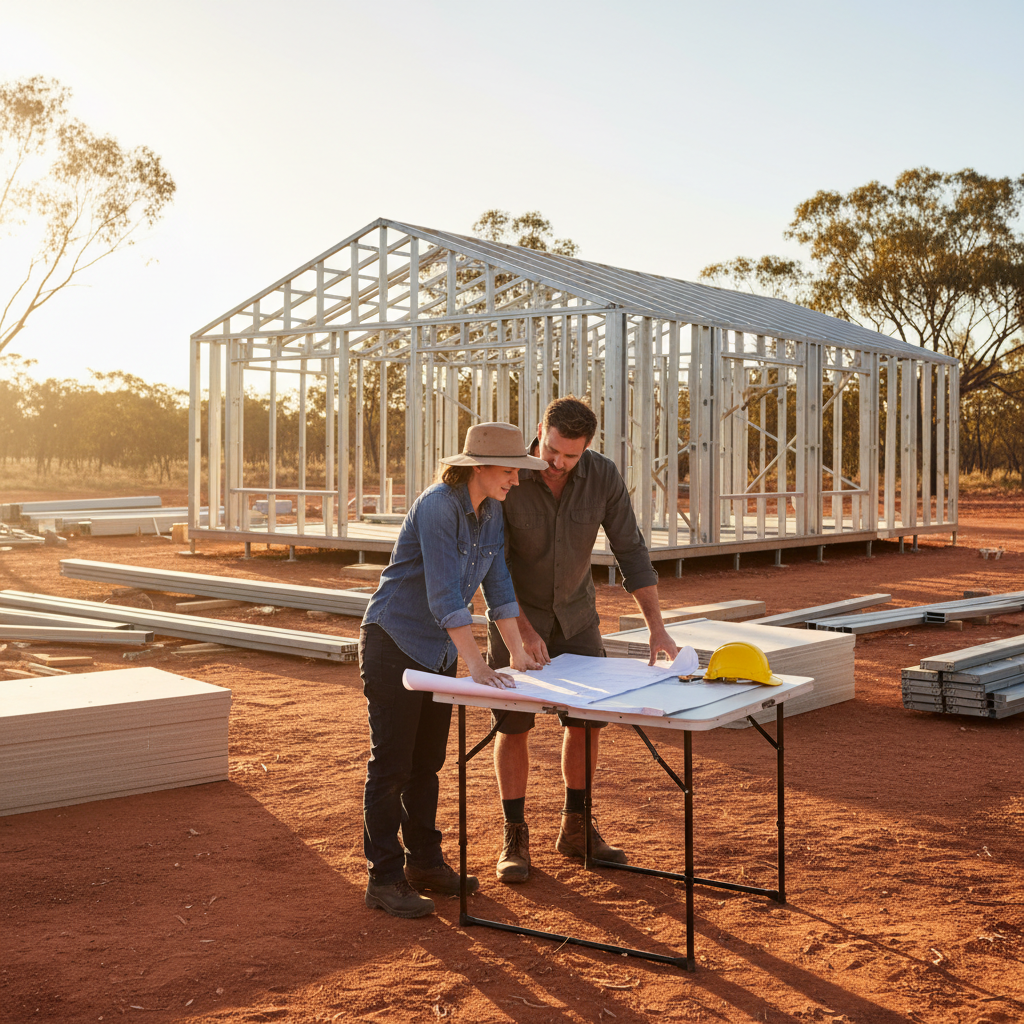
When you're an owner builder taking on a kit home project in these high-wind areas, the structural skeleton is your most vital decision. We use BlueScope TRUECORE steel for our frames because, frankly, I wouldn't trust my own family under anything else when the barometer starts dropping. Steel has a strength-to-weight ratio that timber just can't touch, and in a cyclone, that connection integrity is what keeps your roof from becoming a missile.
Understanding Wind Ratings and Your Block
Before you even look at a floor plan, you need to know your wind classification. It's not just a suggestion. It's dictated by AS 4055 and it changes everything from your screw spacing to the thickness of your steel sections. Most kit homes are designed for N1 or N2 - standard suburban stuff. But once you hit the coast or high ridges, you're looking at N3, C1, C2, or even C3.
C-ratings are for tropical cyclone areas. The engineering requirements here are brutal. You aren't just worried about the wind pushing the house over. You're worried about uplift. Intense low pressure during a storm literally tries to suck the roof off the walls. Steel frames allow for integrated tie-down systems that run from the roof truss right through the wall frames and into the slab. It becomes one continuous metal loop. Try doing that with a bunch of nails in a pine stud and see how you go when 200km/h gusts hit. You won't like the result.
The Precision Factor of TRUECORE Steel
I like steel because it's predictable. Every piece of TRUECORE steel that arrives on your site is manufactured to millimetre perfection. This matters immensely for owner builders. If a timber plate is warped or has a massive knot in it, it's a weak point. In a cyclone, that weak point is exactly where the failure starts. Steel is isotropic, which is a fancy way of saying it has the same strength properties in all directions. No grains, no knots, no surprises.
Plus, because the frames are roll-formed based on CAD designs, the holes for your electrical and plumbing are already there. You aren't hacking into the structural integrity of a stud with a hole saw just to run a cable. Every bit of metal stays exactly where the engineer intended it to be. When yours is the person signing off on the Form 15 or Form 16 for council, that peace of mind is worth its weight in gold.
Corrosion and the Salt Air Reality
If you're building in a cyclone zone, you're almost certainly near the drink. Salt spray is the enemy of metal, but people get confused about how modern steel works. The galvanised coating on our frames, specifically that aluminum/zinc/magnesium alloy coating, performs a sacrificial role. It protects the structural core. Even so, if you're within 200 metres of the breaking surf, you need to be talking to us about high-corrosion configurations.
Don't just assume standard spec is enough if you can smell the salt from your front porch. I always tell blokes building up in the Pilbara or the Whitsundays to be religious about washing down their external claddings. Even the best steel likes a bit of maintenance. And use the right fasteners. Using cheap, non-rated screws in a steel frame kit is the fastest way to ruin a high-quality build. Match the screw coating to the frame coating or you'll get galvanic corrosion, and that's a nightmare nobody wants to deal with ten years down the track.
Owner Builder Tips for Frame Assembly
Putting these kits together is basically a giant Meccano set for grown-ups. But don't get cocky. Here's a few things I've learned from being on the tools:
- Check your slab levels twice. Three times. Steel doesn't have "give". If your slab is out by 15mm, your frames won't sit flush, and you'll be swearing at the sky when the roof sheets don't line up.
- Invest in a high-quality impact driver. Do not try to build a whole steel house with a cheap 12V drill you bought on sale. Your wrists will thank me later.
- The weather strips and seals are just as important as the steel. In a cyclone, water gets driven horizontally. If your window flashings aren't spot on, the steel frame will survive, but your plasterboard and carpet will be ruined.
- Keep your site clean. Steel offcuts are sharp. Very sharp. They'll go through a pair of work boots like butter if you're messy.
The Myth of the 'Loud' Steel House
I hear this all the time. People reckon steel frames creak and pop like a bowl of Rice Bubbles every time the sun goes down. That's bush talk from thirty years ago. If the house is engineered correctly and you use the thermal breaks required by the NCC (National Construction Code), it's dead quiet. The insulation we include in our kits does more than just keep you cool in the Darwin heat. It acts as an acoustic damper.
And let's be real. If a cyclone is hitting, you're going to hear the wind howling regardless of what the house is made of. I'd rather hear a few thermal expansion ticks in the afternoon than hear my roof trusses splitting at 2am during a storm surge.
Termites Don't Eat Steel
It's an obvious point, but it's massive in Northern Australia. In places like Townsville, the termites are big enough to carry away your car keys. While a steel frame home still has timber in the fit-out (skirting boards, cabinets, etc.), the structural integrity of the house isn't at risk. If the white ants get in, they might ruin a cupboard, but they won't make the roof collapse. It's a layer of insurance you don't have to pay a premium for every year. Because it's just physics. They can't chew through BlueScope.
When you're looking at the total value of your build, you have to factor in that long-term durability. A lot of owner builders get caught up in the initial kit cost. But think about the 30-year horizon. No rot, no warping, no chemical termite treatments for the frame itself. It's a smarter way to build in the tropics, simple as that.
If you're planning a build in a high-wind area, don't cut corners. Get the engineering right. Make sure your kit is rated for your specific block, not just your general town. It's a big job, but doing it yourself with a solid steel kit is the best way to know that when the clouds turn black and the wind starts picking up, you've built a fortress, not just a house. Just make sure you've got a decent ladder and a bit of patience when those frames arrive on the truck. You'll be right.