The Sound of Half Your House Being Eaten at Night
I stood on a site in Gympie about eight years ago, staring at a wall stud that looked perfectly normal from the outside. The owner builder tapped it with the back of a screwdriver and the whole thing just... imploded. It sounded like dry leaves crunching. Termites had chewed the guts out of that timber house before the poor bloke even got his occupancy certificate. He'd done everything right with barriers, but a small gap in the concrete slab was all those little bastards needed to get in and start feasting. That's why I'm a steel man. Always have been. When you're putting your life savings into a kit home, you don't want to be wondering if the local wildlife is viewing your structural support as a four-course buffet.
In Australia, we've got some of the most aggressive subterranean termites on the planet. Most of the country is a high-risk zone. If you're building in places like Darwin, North Queensland, or even just the bushy bits of the Perth hills, a timber frame is basically a ticking clock. Steel is different. It's inorganic. You can leave a pile of TRUECORE steel frames in a damp paddock for a month and the termites will just crawl right over them looking for something tasty. They can't eat it. They won't touch it. It's the most straightforward insurance policy you'll ever buy for your home.
Physics Doesn't Lie: The TRUECORE Advantage
We use BlueScope TRUECORE steel for a reason. It's not just about the termite resistance, though that's the big one. It's about precision. Wood moves. It warps, it bows, and it develops knots that make your plasterer swear when he's trying to get a flush finish. Steel is straight. It stays straight. When you're an owner builder standing on a ladder in the wind trying to bolt a roof truss into place, you want that sucker to line up first time. Because these frames are engineered to the millimetre, they actually fit. No site-cutting, no shaving down studs because they twisted in the sun, and no dodgy shims. Plus, it's lightweight. You won't throw your back out nearly as fast as you would manhandling heavy treated pine.
The Australian Standard AS 3660.1 covers termite management in new buildings. If you go with timber, you're looking at chemical barriers, physical mesh, and ongoing inspections that cost a fortune over twenty years. With a steel frame, the frame itself is termite resistant. You still need to protect your door frames and skirting boards if they're wood, but the structural integrity of the house? That's safe. It's a massive weight off your shoulders, especially when you're managing the build yourself and already have a million other things to worry about like council inspections and getting the plumber to actually show up on time.
Wait, Isn't Steel Harder for Owner Builders?
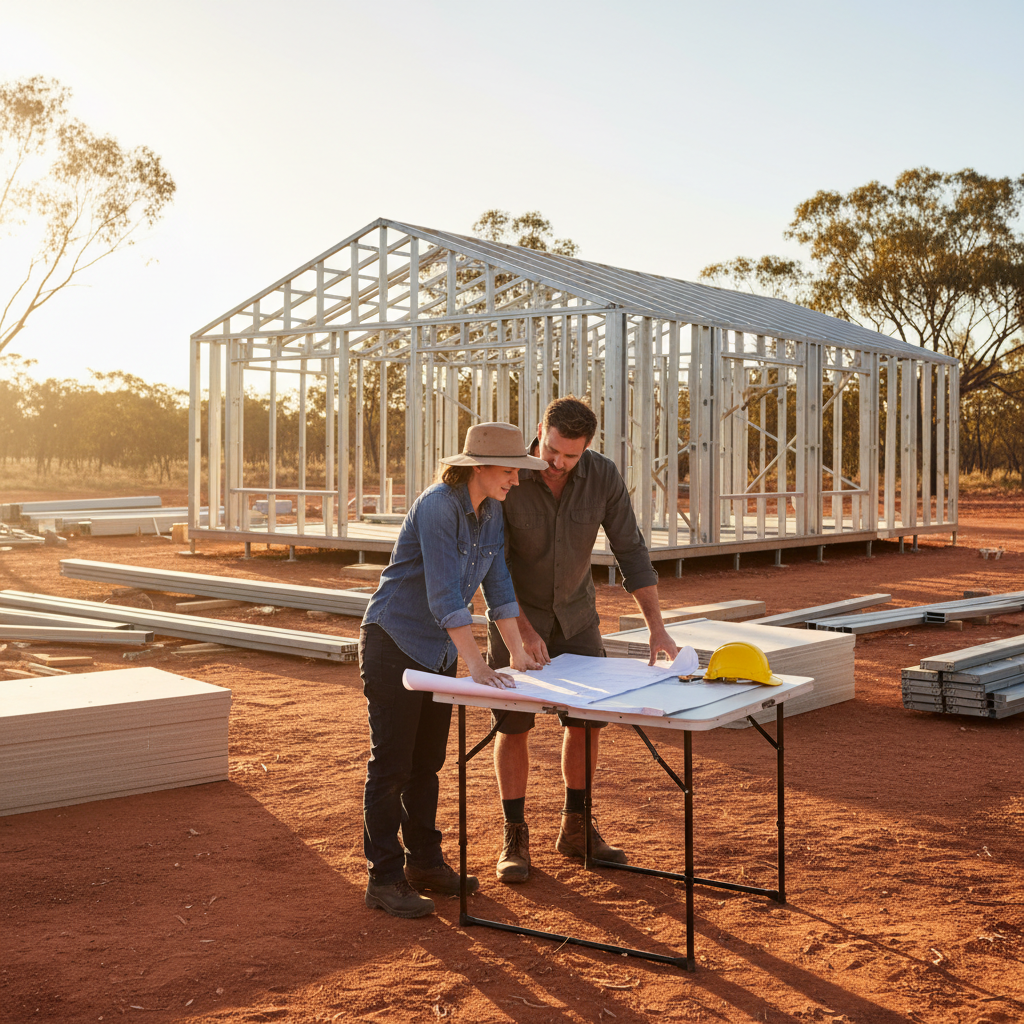
I hear this a lot. People reckon they need to be a welder or a boilermaker to put together a steel kit home. That's rubbish. We send these kits out with pre-punched holes for your electrical and plumbing. Your sparky will love you because he doesn't have to spend three days drilling through studs. Most of the assembly is done with a high-torque drill and tek screws. It's actually more like a giant Meccano set than traditional carpentry. You'll need a good pair of gloves because those edges can be sharp, and a decent impact driver will become your best friend. But the learning curve isn't nearly as steep as people think. If you can read a plan and hold a level, you're halfway there.
One thing you do need to keep in mind is thermal bridging. Since steel conducts heat faster than wood, we include high-quality insulation and thermal breaks in our kits. This satisfies the NCC Volume 2 requirements for energy efficiency. Don't skip the foam strips or the wrap. They stop the heat from the afternoon sun transferring through the frame and into your living room. It's a small extra step during the build that makes a massive difference to your power bill once you move in.
The Real Cost of "Cheap" Materials
You might find a timber frame kit slightly cheaper on paper. But have a look at the long-term reality. Every year, you've got to crawl under the house or check the perimeter for mud tunnels. You're paying for annual termite inspections. Then there's the shrinkage. Timber dries out over the first two years, which is why you see those ugly cracks in the cornices or doors that suddenly won't latch in February. Steel doesn't shrink. It doesn't expand with the humidity. Your walls stay flat, your windows don't jam, and you're not out there with a plane trying to fix a door that's sticking for the third time this summer.
I remember a project out near Dubbo. Hot as anything during the day, freezing at night. The owner was worried the steel would "ping" and make noise as it expanded. We talked about how modern engineering handles those tolerances. He went ahead with the steel kit. Two years later, he called me up just to say he was the only one on his street whose plaster hadn't cracked after a particularly nasty drought cycle. The precision of the steel saved him thousands in maintenance. That's the stuff they don't tell you in the brochures.
Building for the Future (and the Bushfire Zone)
If you're building in a bushfire-prone area, which is about 80% of the good spots in Australia these days, steel is a no-brainer. It's non-combustible. While it won't make your house "fireproof" on its own, it won't add fuel to the fire like a timber frame does. When you're dealing with BAL (Bushfire Attack Level) ratings, having a steel frame makes meeting those strict construction standards a lot easier. We provide the cladding, the roofing, and the insulation to suit, but the steel skeleton is your first line of defence against the structure collapsing during a fire event.
Let's talk about the eco side of things too. Steel is 100% recyclable. If someone knocks your house down in a hundred years, that steel can be melted down and turned into a new bridge or another house. You aren't losing 20% of your material to offcuts and waste like you do with a stick-built timber frame either. Everything in our kits is pre-cut to size. You aren't paying for a skip bin full of wasted wood that you can't even burn because it's full of copper chrome arsenic treatment chemicals.
At the end of the day, building a kit home is a huge undertaking. It's stressful, it's tiring, and it'll probably take you longer than you planned. Why add "termite anxiety" to that list? Using a steel frame means one less thing that can go wrong. No sagging lintels, no rot, and definitely no tiny insects eating your lounge room while you sleep. Just a solid, straight, reliable house that'll still be standing straight when your grandkids are old enough to complain about the weather.