Steel Doesn't Snap When the Wind Reels Back
I was standing on a site up near Port Douglas about five years ago, right after a decent blow had come through. Most of the old stick-builds in the street had lost bits of their verandas or had tiles scattered like confetti. But the bloke down the road with a steel kit home? Not a scratch. He was sitting on his porch having a brew while his neighbours were chasing their gutters down the road. That's the difference between building to a standard and building for survival.
When you're building in Region C or D (those high-wind zones for the uninitiated), you aren't just looking for something that stays up on a sunny Tuesday. You're looking for something that can handle a Category 4 or 5 cyclone without folding like a wet cardboard box. Most people think a house is just a house, but in the kit home world, the skeleton is everything. We use TRUECORE steel from BlueScope because it's specifically engineered to take those lateral loads that would make timber frames groan and eventually give up the ghost. It's about the shear strength. If the wind is pushing at 250 clicks an hour, you want a frame that's bolted into the slab with precision, not held together with a few nails and a prayer.
The Engineering Behind the Badge
Designing for the tropics isn't about guessing. It's about AS 1170.2. That's the Australian Standard for wind actions, and it's a dry, boring read unless you actually care about your roof staying attached to your walls. In a kit home context, every single member of that frame is calculated. The thickness of the steel, the placement of the bracing, the gauge of the screws. It all matters. You can't just go to the local hardware store and buy some off-the-shelf trusses and expect them to survive a Darwin summer. Because steel is manufactured to such tight tolerances, we know exactly how it will behave under stress. No knots. No twists. No warped bits of wood that happened to be sitting at the bottom of the stack on a rainy day.
But it's not just about the big gusts. It's about the rain. Driving, horizontal rain that finds every tiny gap in a building envelope. Steel frames don't rot. They don't soak up moisture like a sponge and then start growing mould inside your walls. When you get those three-week wet seasons in Far North Queensland, you don't want to be worrying about your wall studs rotting from the inside out because a bit of moisture got behind the cladding. Steel just sits there. Doing its job. Plus, being 100% termite proof helps. Down south, termites are a nuisance. Up north, they're like a professional demolition crew. They'll eat a timber frame out from under you before you've even finished the landscaping.
Direct Fix vs. Battening
One thing most owner-builders overlook is how they're actually going to finish the guts of the house. With a steel kit, you get straight lines. Every time. If you've ever tried to hang plasterboard on a timber frame that's been sitting out in the sun for six weeks, you'll know the pain of wavy walls. You end up spending a fortune on top-coat to try and hide the humps and bumps. With BlueScope steel, the frame is true. It stays straight. This makes your plasterer happy, and a happy plasterer usually does a better job. Just remember to use the right screws. You can't just bang a nail into this stuff. You need a decent impact driver and a bit of patience, but the result is a finish that looks like a million bucks.
The Kit Home Advantage for Remote Builds
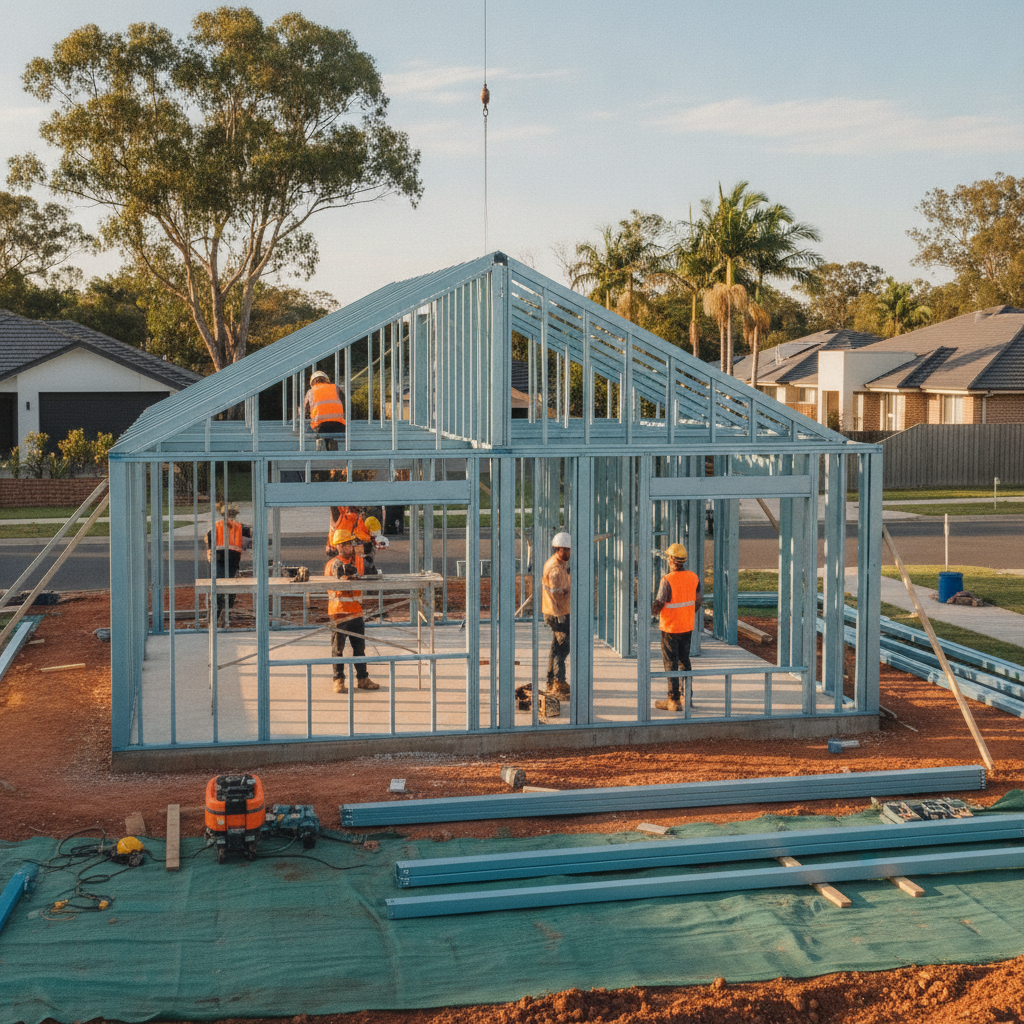
If you're building out in the sticks, logistically everything becomes a nightmare. Getting a chippy to stay on site for three months while he cuts every stick of timber by hand is expensive. He'll want a travel allowance, a place to stay, and probably a beer every arvo. A steel frame kit turns up on the back of a truck, pre-punched and ready to bolt together. It's like a giant Meccano set. For an owner-builder, this is gold. You aren't standing there with a tape measure and a circular saw trying to figure out if your rafters are level. The holes are already there. If the bolt goes through, it's right. Because the kits include the frames, roofing, and windows, you don't have to deal with twelve different suppliers who will all blame each other when something doesn't fit.
I've seen guys manage their own site works and have the frame up in a week or two. That's a massive win when you're racing against the clock before the wet season kicks in. You want that roof on fast. Once the roofing and insulation are in, you've got a dry shell to work in. It doesn't matter if it pours for the next month, you can be inside doing the fit-out or getting the sparky in to run his cables through the pre-punched service holes. No drilling. No mess. Just pull the wire through and move on to the next one.
Thermal Performance and the Heat Factor
People reckon steel homes are hot. That's an old wives' tale from back when grandpa lived in a tin shed with no insulation. Modern kit homes come with proper insulation blankets and wall wraps. When you combine that with reflective foil and the right design, a steel frame home is actually easier to keep cool. Steel has a low thermal mass, which sounds like fancy talk, but it basically means it doesn't hold onto the heat once the sun goes down. A brick house will radiate heat into your bedroom at 10pm like a slow-cooker. Steel cools down fast. Throw in some high ceilings and cross-ventilation, and you've got a house that's actually comfortable to live in without running the air-con 24/7.
One tip for the owner-builders out there: don't skimp on the wall wrap. It's tempting to buy the cheap stuff, but when you're in a high-humidity zone, that moisture barrier is your best friend. It keeps the condensation off the frame and stops the interior of your walls from becoming a sauna. Pay the extra couple of hundred bucks for the high-spec stuff. Your future self will thank you when it's February and 90% humidity outside.
Practical Realities of Life on Site
Building your own place isn't all glossy brochures and smooth sailing. It's hard work. You'll be covered in dust, you'll probably lose a few kilos, and you'll definitely have a few moments where you wonder why you didn't just buy an existing house. But there's a specific kind of pride in seeing that steel skeleton go up. I remember a customer in Broome who was worried about the sea spray. We made sure he had the right coating on the steel, and three years later, that frame still looks brand new. No rust. No sagging. Total peace of mind.
You've got to be organised, though. You can't just wing it when you're acting as the owner-builder. You need your slab poured and cured, your trades lined up, and your site access sorted before the truck arrives. If the driver can't get into your block because it's a boggy mess, that's on you. But if you get your ducks in a row, building a kit home is the most rewarding thing you'll ever do. It gives you a house that's engineered for the worst Australian weather, without the overheads of a traditional builder who's taking a massive cut on every nail and screw. Just stick to the plans, follow the engineering, and don't try to get clever with the structural stuff. The engineers have already done the hard work for you.
At the end of the day, building with steel in a cyclone zone is common sense. It's predictable, it's strong, and it won't get eaten by bugs. Whether you're building a little weekend getaway or a full-sized family home, giving yourself that structural edge is the smartest move you can make. The weather isn't getting any calmer, so you might as well build something that's ready for the fight.