I remember standing on a job site in Gympie about eight years back. The owner had pulled off a piece of skirting board in his old timber cottage and honest to god, the wood just turned to dust between his fingers. It looked like someone had filled a bag with grey flour. That's the reality of living in Australia. If it's made of cellulose, something is trying to eat it. Termites are a literal silent plague in this country, and they don't care if you've got a nice view or a well-kept lawn. They want your structural integrity for lunch.
The Real Cost of the Australian Termite Problem
Most people don't realize that standard home insurance in Australia usually doesn't cover termite damage. You can check your PDS tonight, but I'd bet my best impact driver that there's an exclusion clause in there. One in four Australian homes will be attacked by termites at some point. That's a staggering stat. When you're an owner-builder putting your life savings into a kit home, you can't afford that kind of risk. You're the one on the hook for the repairs. And those repairs? They often involve stripping back plasterboard just to see how far the little buggers have traveled up the wall studs.
Using steel frames, specifically stuff like BlueScope TRUECORE steel, changes the math entirely. It's not just about strength. It's about biology. Termites physically cannot eat steel. They can't chew through it, they can't nest in it, and they don't find it particularly appetizing. While your neighbor might be sweating over his annual pest inspection and drilling holes in his concrete slab to pump in chemicals, you're sitting pretty. Plus, steel doesn't require those heavy chemical treatments every few years that make your house smell like a refinery.
Why Steel Stands Up Where Timber Fails
It’s not just about the termites, though they're the headline act. In many parts of Queensland and the NT, the humidity is brutal. Timber moves. It twists, it warps, and it bows because it’s a natural material that reacts to moisture in the air. When timber bows, it creates gaps. Small gaps. Perfect little entrance ramps for pests. Steel stays straight. It’s precision engineered. When we send out a house kit, those frames are millimetre-perfect. That means your windows sit flush, your doors don't stick in Feb when the humidity hits 90 percent, and you don't get those mystery cracks in the cornice three years down the track.
Every piece of our kit homes is punched and pressed from high-tensile steel. It’s light enough to carry around the site without blowing your back out, but it doesn't offer a single calorie of nutrition to a subterranean termite. They'll walk right past a steel stud looking for a timber coffee table or a pile of cardboard boxes in the garage instead. It forces the bastards out into the open where you can actually see their mud tunnels and deal with them before they reach your furniture.
Building Tight and Right
Because steel frames are dead straight, the whole building process for an owner-builder becomes a lot more predictable. If you've ever tried to hang plaster on a wonky timber stud, you know the nightmare I'm talking about. You end up shimmying and shaving just to get a flat finish. With steel, the flat surface is a given. You start with a straight line and you end with a straight line. It makes the internal fit-out, which is usually where the DIYers take over, a whole lot less stressful. But it's the long-term game where the steel frame really pays for itself. No rot. No fungal decay. No structural sagging because a colony of Coptotermes decided your king stud was a five-star buffet.
The Kit Home Process for Owner Builders
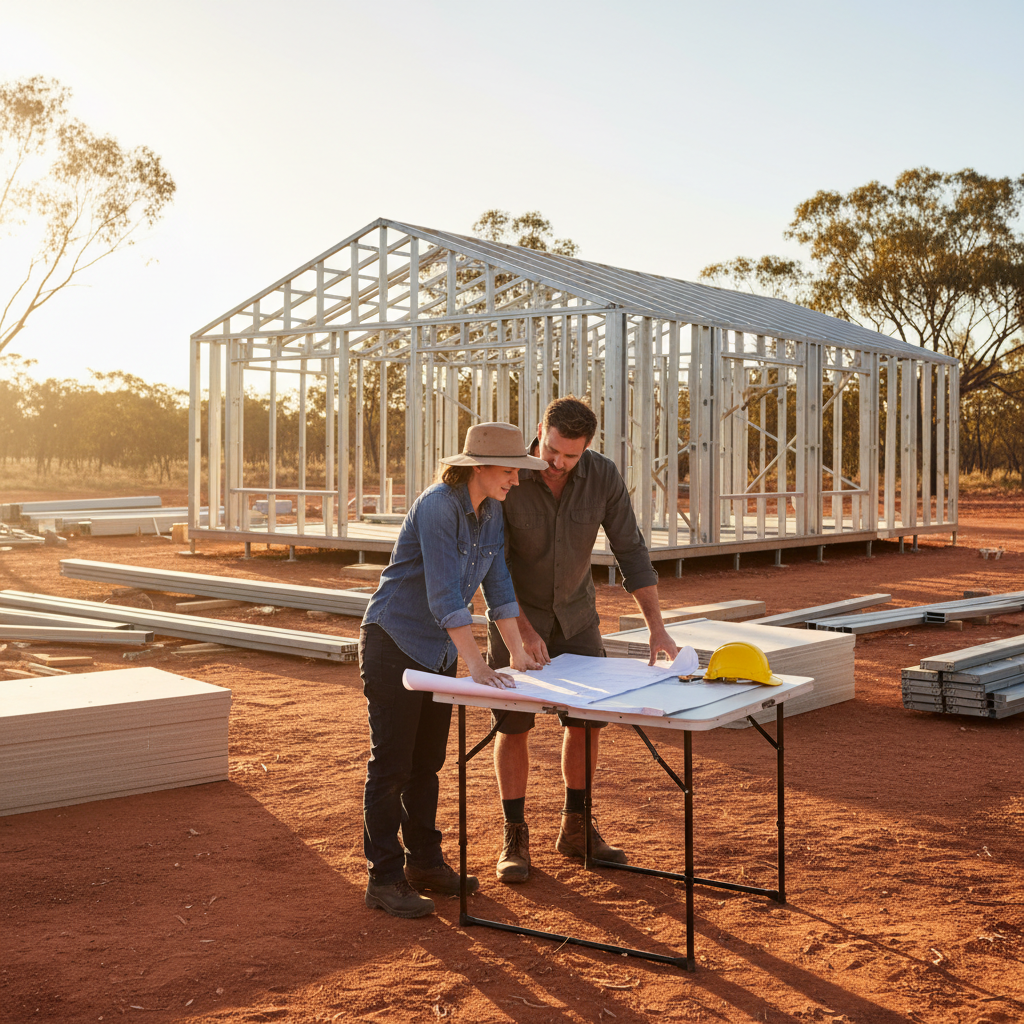
We supply the skeleton and the skin. The frames, the trusses, the Colorbond roofing, and the cladding. But the real magic is in the assembly. You're not out there with a hand saw trying to figure out compound mitres. The kits are designed to bolt together. It’s a bit like a giant Meccano set for grown-ups. But even with a steel frame, you still need to be smart about your site works. Don't go piling garden mulch up against your weep holes. That’s just asking for trouble, giving those pests a bridge over your physical barriers.
One thing I always tell people is to focus on the slab edge. A clear, exposed slab edge is your best friend. It doesn't matter if your house is made of steel, brick, or glass, termites will still try to get inside to find your stuff. But with a steel frame kit, they can't hide inside the walls and eat the house from the inside out. They have to build mud tunnels up the outside of the steel where you can spot them during a Sunday arvo BBQ.
Steel and Fire: The Other Big Benefit
While we're talking about the frame, we have to talk about fire. Especially if you're building in the bush or on the outskirts of the city. Steel is non-combustible. It won't spark up if a stray ember gets into your roof cavity. In a bushfire scenario, timber frames can actually help fuel the fire once it gets inside the wall cavity. Steel doesn't do that. It doesn't add fuel to the burn. For many Australians building in BAL (Bushfire Attack Level) rated zones, steel isn't just a preference, it's a massive advantage for meeting council requirements without spending a fortune on extra fire-rated cladding.
Practical Tips for Your Steel Kit Build
If you're jumping into a kit home project, here are a few things I've learned over the years on the tools:
- Invest in a good quality cordless impact driver and a couple of 5.0Ah batteries. You'll be driving a lot of screws, and the cheap stuff won't last the week.
- Keep your steel off the ground. Even though it's galvanized or coated, you don't want it sitting in a puddle of muddy water for three months while you're waiting for the plumber.
- Check your local council’s termite barrier requirements. Even with a steel frame, you still need physical barriers like termimesh around your pipe penetrations in the slab.
- When you're doing your internal fit-out, remember that you need fine-thread screws for steel studs, not the coarse ones you use for timber.
- Don't be afraid to ask for help with the trusses. They're light, but they can be awkward to handle if the wind picks up.
I’ve seen blokes try to save a few bucks by sourcing cheap timber locally, only to regret it when the wood starts to twist before they've even got the roof on. Or worse, they find out two years later that the "treated" wood wasn't treated quite well enough for the local termite population. Steel removes that variable. It gives you a constant you can rely on. It’s predictable, it’s clean, and it’s tough as nails. Building your own home is an enormous task, and you’ve got enough to worry about with tradies, council, and weather without adding "is my house being eaten" to the list.
At the end of the day, a home is the biggest investment you'll ever make. Why build it out of something a bug can destroy? Steel framing gives you a level of security that timber just can't match in the Australian environment. It's about building something that'll still be standing, straight and true, when your grandkids are looking for a place of their own. So if you're planning that build, do yourself a favor and look at the steel option. Your future self, and your bank balance, will thank you when the termites come knocking and find the door barred.