I have spent years watching owner builders stare at a pile of steel and timber like it is a thousand piece puzzle without the picture on the box. It happens every time. The truck pulls up, the driver drops the packs exactly where you do not want them, and suddenly the reality of building your own home hits you right in the chest. But here is the secret. A kit home is not a mystery, it is just a sequence. If you mess up the sequence, you are chasing your tail for six months. If you get it right, you will have a dried-in shell before the neighbors have even figured out what you are building.
The Slab and the Critical Set Out
Everything starts with the concrete. You cannot bolt a precision-engineered steel frame to a slab that is shaped like a dog's hind leg. I always tell people to spend the extra bit of money on a decent concreter who knows how to read a plan. If your slab is out by 20mm, your TRUECORE steel frames will hang off the edge or sit too far in, and then your cladding will look rubbish. It is that simple. Before the pour, make sure your plumber has their p-traps and waste pipes exactly where the internal walls are going to land. There is nothing worse than jackhammering a brand new slab because the toilet waste is 100mm inside a bedroom.
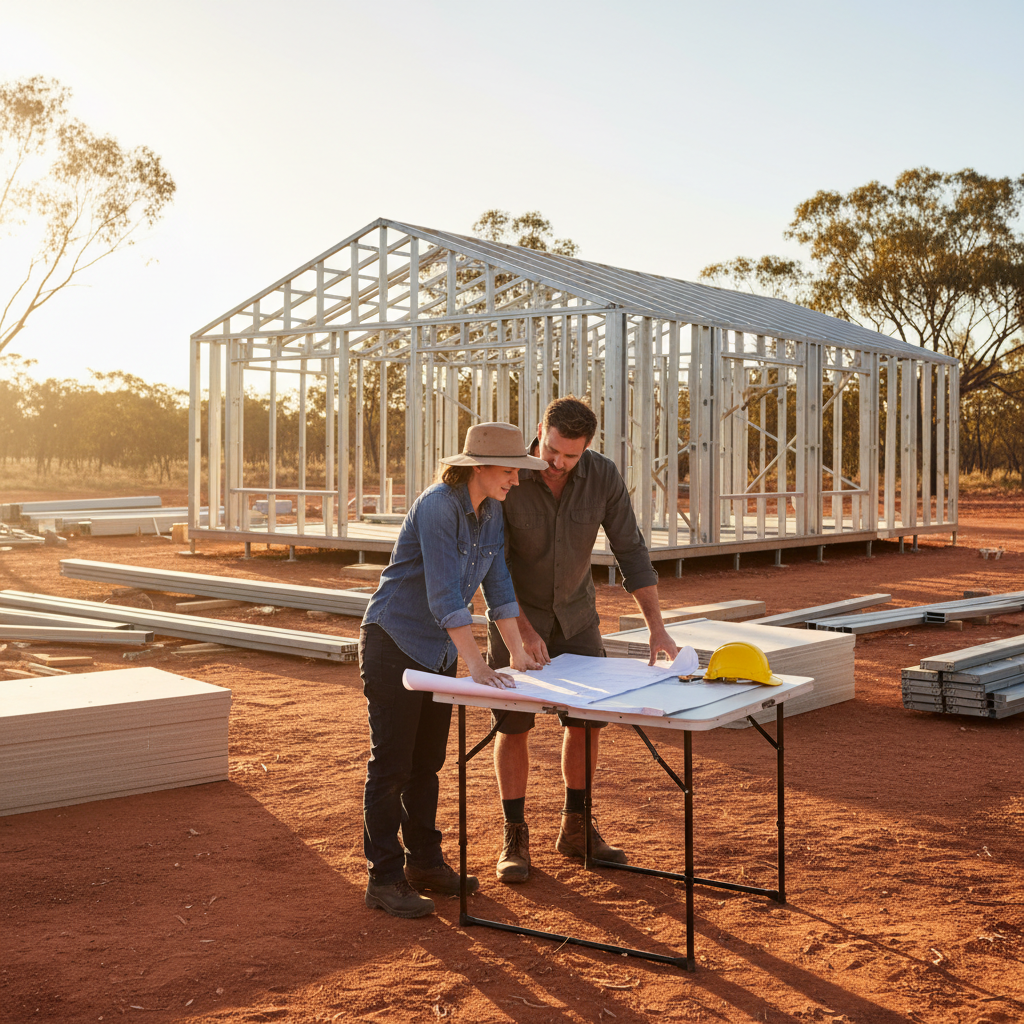
Once the concrete is cured and you have stripped the formwork, you need to snap your chalk lines. This is the moment of truth. You are marking out exactly where the bottom plates of your walls will sit. Use a big 3-4-5 triangle to make sure your corners are dead square. If you do not know the 3-4-5 rule, look it up, because it is the only way to ensure your house is not a trapezoid. Because steel frames are manufactured to the millimeter in a factory, they do not have the 'give' that old-school timber framing has. They are honest. If your slab is wrong, the steel will tell you immediately.
Standing the Walls Without Losing Your Mind
The frames arrive flat-packed. They are numbered, usually following a layout plan provided by the supplier. Do not just rip the plastic off everything at once. Find the corner start point. Usually, you will want a couple of mates for this part, a cordless impact driver, and a decent level. You start at a corner, brace it back to the slab with some scrap timber or temporary steel bracing, and then work your way along. It is fast. So fast that you might get cocky. Don't.
Check every single wall for plumb. Just because the bottom is on the line doesn't mean the top isn't leaning out toward the fence. Use a long level, or better yet, a plumb bob if it is a windy day. We once had a guy in Toowoomba who stood all his external walls in a single Saturday, but he forgot to check plumb on the cross-walls. He spent the next three days unscrewing everything because his roof trusses wouldn't sit flat. It was a mess. Slow down. Bolt the bottom plates down using the recommended mechanical anchors or chemical bolts specified in your engineering. Don't skimp here. This is what keeps your house attached to the earth when a storm rolls through.
Trusses and the Roof Line
Once the walls are up and braced, you are looking at the skeleton. It looks like a house now. Now comes the heavy lifting. Roof trusses. Depending on the size of your kit, you might need a crane or a telehandler for a few hours. If it is a small granny flat, you and three strong blokes might manage, but my back hurts just thinking about that. Cranes are worth every cent of the five hundred bucks they cost for a morning.
The trusses sit on the top plates of your walls. They need to be spaced exactly as per the layout. You will be using Tekscrews and triple-grips to humiliate them into place. One tip from the trenches: make sure you install your fascia and gutters before you start throwing roofing iron up. It is much easier to hang a gutter when you aren't leaning over the edge of a slippery sheet of BlueScope steel. Plus, once the gutters are on, you have a clear line to work to. Plus, the site stays a lot drier if the rain has somewhere to go besides straight into your fresh door tracks.
The Importance of the Vapor Barrier
Before the cladding goes on, you have to wrap the house. We call it 'blue skin' or wall wrap. This is not just a suggestion. It is your secondary line of defense against moisture. AS 4200.2 covers the installation of underlays, and you want to pay attention to the overlaps. Wrap it tight. Tape the joins. If you leave gaps, you are asking for draughts and condensation issues later on. In places like coastal Queensland or the humid parts of NSW, managing that dew point inside the wall cavity is the difference between a healthy home and a moldy nightmare. Use the proper foil tape, not the cheap stuff that peels off the moment the sun hits it.
Getting the Windows and Doors In
You want to get the house 'lock-up' ready as fast as possible. This means windows and external doors. Kit homes usually come with aluminum units. They are fairly light, but they are awkward. Make sure you use a good quality flashing tape around the openings before the window goes in. This directs any water that gets behind the cladding back out to the street where it belongs. Settle the window into the opening, pack it so it is perfectly level (even if the wall plate is a tiny bit off), and screw it through the reveals. If the window isn't level, the sash will never slide right. You will be fighting that window for the next twenty years. Get it right now.
Cladding and the Final Shell
The cladding is the face of your home. Whether you are using Colorbond steel sheets, fiber cement planks, or fancy architectural panels, the rule is the same: start level and check often. If you start 5mm out at the bottom, by the time you get to the eaves, you will be 50mm out and it will look like a funhouse at the Ekka. Use a story pole. This is just a piece of scrap wood where you mark exactly where each row of cladding should sit. It keeps you honest.
The kit will include all your corners and flashings. These are not optional extras. They are what stops the horizontal rain from driving into your wall cavity. Screw placements should be uniform. If you are using steel cladding, use a proper nibbler or shears to cut it. Don't use a grinder. A grinder burns the protective coating on the steel and you will see rust spots within twelve months. It is the hallmark of a lazy builder. Use the right tools. It takes longer but it is worth it.
A Few Hard Truths for the Owner Builder
- The kit is a shell. You still need to manage your electrical rough-in and plumbing before the insulation and internal linings go on. Don't forget the NBN conuit.
- The NCC (National Construction Code) Volume 2 is your bible. If you do not own a copy, get one. It outlines everything from ceiling heights to window flashings.
- Buy more drill bits than you think you need. Steel frames eat them for breakfast.
- Organize your site. A messy site is where accidents happen and parts get lost. If the window screws are buried under a pile of damp cardboard, you are losing money every hour.
Building a kit home is a massive undertaking, but it is not magic. It is just one task after another. You bolt the steel together, you keep it square, and you keep the water out. If you can handle a drill and you have got enough patience to read a technical drawing twice before you cut once, you are ahead of half the blokes I see on site. Just remember to take it one wall at a time. Before you know it, you will be standing in the kitchen area, holding a cold drink, wondering why you ever worried about it in the first place.