Stop looking at the furniture and start looking at the bones
Most people open a set of kit home plans and immediately start imagining where the TV goes. That's a mistake that'll cost you three weeks and twenty grand in variations if you aren't careful. When your kit arrives on the back of a semi-trailer in a stack of BlueScope steel, the floor plan isn't a suggestion anymore. It's a rigid reality. I spent fifteen years on sites across New South Wales and Queensland, and the blokes who succeeded were the ones who treated their plans like a legal contract, not a coloring book.
A kit home isn't like a traditional build where the chippy can just 'work it out' on the fly. These frames are precision engineered. If the plan says a window is 1210mm wide, that steel opening is exactly 1210mm. If you bought a bargain window from a garage sale that's 1250mm? You're in for a world of pain. Understanding the technical specifications is about knowing exactly where the kit supplier's job ends and yours begins. Plus, if you don't know your floor joist spacing from your rafters, you'll be standing there scratching your head when the crane is costing you two hundred bucks an hour.
The Floor Plan is Only the Beginning
You'll usually get a set of architectural drawings first. These show the layout, the elevations (what it looks like from the street), and basic sections. But for an owner-builder, the real meat is in the engineering drawings. This is where you see the TRUECORE steel frame layouts. You need to look for the bracing schedule. It's usually a series of symbols like 'KB' for knee braces or 'X' patterns for strap bracing. If you miss a brace during the frame stand, the building inspector will knock you back before you can even think about cladding. Because the NCC (National Construction Code) Volume 2 is pretty clear about structural integrity, you can't just skip a bolt because it's hard to reach.
Look at the slab plan too. Most kit suppliers expect you to handle the concrete. The plans will specify the rebate depth for your external cladding. If your concretor pours a flat slab without a 20mm or 30mm rebate, water is going to find its way under your bottom track the first time a southerly buster hits. It happens more often than you'd think. A quick chat with the concretor while looking at the 'Slab Details' page prevents a lifetime of soggy carpets.
Reading the Specification List
This is where the 'he said, she said' happens. The spec list tells you what's in the box. Our kits generally include the steel wall frames, roof trusses, Colorbond roofing, external cladding, windows, and insulation. But wait. Does it include the internal doors? The skirting boards? The kitchen sink? Usually, the answer is no. Kit homes are designed to give you the shell and the structural integrity, while the fit-out is where you get to choose your own adventure. You need to be methodical here. Go through the list with a highlighter. If 'Tiling' or 'Plumbing Fixtures' isn't highlighted, it's coming out of your pocket later at the local hardware store.
Wait, what about those 'other' home types?
I get asked all the time about those homes that arrive on a truck completely finished. Let's be clear: a kit home is a different beast entirely. We don't do the factory-built cubes that you just plug in like a toaster. A kit home is for someone who wants to be involved. You're building a real house on a permanent foundation. It's built to last using Australian steel, not some lightweight transportable frame. Because you're assembling it on-site, you have way more control over the quality. You can see every screw and every bracket. There's no hiding dodgy wiring behind a factory-finished wall. It's honest work, and it results in a more substantial home that actually feels like a home, not a shipping container.
The Hidden Details: Wind Ratings and BAL
If you live in the hills or near the coast, your plans will have a wind rating like N2, N3, or even C1 if you're up north. This isn't just jargon. It dictates how many screws go into your roof sheets and how thick the steel plate is on your connectors. If you're building in a bushfire-prone area, your specs will mention a BAL (Bushfire Attack Level) rating. This might mean your windows need to be toughened glass or your eaves need specific fire-rated lining. I've seen owner-builders buy standard windows off the shelf only to have the certifier tell them to rip them out because they didn't meet the BAL-29 requirements on the paperwork. Read the 'Notes' column on the right-hand side of the page. It's boring, but that's where the gold is buried.
Top Tips for Plan Reading
- Check the scale bar. Never trust a ruler on a printed PDF because printers can shrink the image. Use the written dimensions only.
- Identify the load-bearing walls. Usually, these are your external walls and specific internal steel frames. Don't go hacking a hole for a trendy archway until you know what's holding up the roof.
- Look at the plumbing drops. The plans show where the pipes go. If you're on a slab, those pipes need to be in the ground before the concrete truck arrives.
- Confirm the roof pitch. A 15-degree pitch looks very different from 25 degrees on-site.
Managing the Site and the Trades
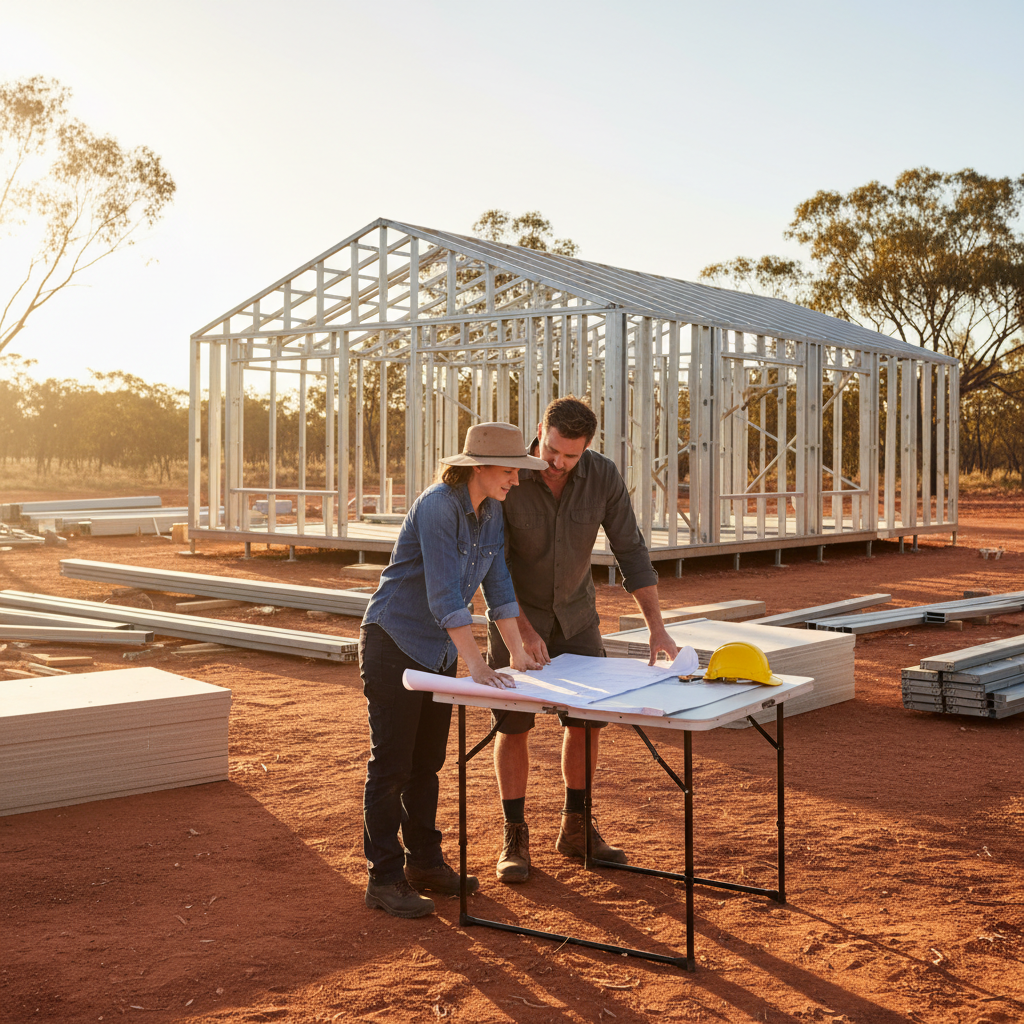
When you're the owner-builder, you're the site manager. You'll have the sparky asking you where the switchboard goes and the plumber asking about the fall for the sewer. Your plans should have a 'Services' layout or at least show the entry points. If you haven't sussed this out before the frames arrive, you'll be paying trades to stand around while you look at the paperwork. Keep a physical set of plans in a weather-proof sleeve on-site. Tablets are great until they run out of battery or you drop them in the mud. Old-school paper doesn't glitch.
Remember that the engineering is the law. If the plan specifies 12 gauge screws for a certain bracket, don't use 10 gauge. The council inspector isn't being a pain just for the sake of it – they're checking that your house won't walk away in a storm. Using BlueScope steel means the quality is consistent, but the assembly is down to you or your subbies. Get it right the first time and you'll sleep better when the wind starts howling.
So, are you ready to build?
Reading plans is a skill like anything else. It takes a bit of practice. Spend a few nights just staring at the lines until you can see the house in 3D in your head. Walk the site with a can of marking paint and spray out the rooms according to the measurements. It'll start to feel real once you see the footprint on the grass. Building a kit home isn't the easy way out, it's the smart way to get the house you actually want without the massive builder's margin. Just make sure you know exactly what's in that kit before you sign the bottom line. It saves a lot of swearing later on.