You're standing on your block of land in the middle of July and the wind is whipping across the ridge so hard it's whistling through your ute's door seals. It hits you right then. This isn't just a bit of a breeze. It's a structural load. If you're building a kit home in Australia, your wind rating isn't something you just tick off on a council form to get your DA approved. It dictates every single screw, bracket, and sheet of cladding you're going to touch for the next six months. Get it wrong and you're not just looking at a bit of a rattle. You're looking at catastrophic failure when a cyclone decides to pay a visit.
The Basics of AS 4055
In Australia, we rely on Australian Standard AS 4055, which covers wind loads for housing. It's the bible for small-scale residential stuff. This standard splits the country into wind regions, but it doesn't stop there. It looks at your specific patch of dirt. You could be in Region A (most of Australia) but if you're on top of a bald hill with no trees for three kilometres, your rating is going to be wildly different from a bloke tucked away in a suburban gully down the road. Wind behave like water. It speeds up as it goes over hills (topography) and slows down when it hits obstacles like houses or bushland (shielding).
Non-Cyclonic vs Cyclonic
We split ratings into two main camps: N and C. N stands for non-cyclonic. If you're building in Melbourne, Sydney, or out in the Aussie bush far from the coast, you're looking at N ratings. C stands for cyclonic. This is for the top end, the WA coast, and parts of Queensland. If you're building in Broome or Darwin, you aren't just worried about wind speed. You're worried about pressure changes and flying debris. This affects how we design the steel frames. A C3 rated kit home has significantly more tie-down points and heavier gauge steel than an N2 cottage. It's just simple physics. You need more meat in the bones to stop the roof from lifting off like a giant wing.
Breaking Down the N Ratings (N1 to N6)
Most kit home buyers find themselves in the N1 to N3 range. N1 is basically a sheltered suburban block. It's calm. N2 is the standard for most typical residential builds. It handles a maximum design gust of about 40 metres per second. Once you hit N3, things get serious. This is usually where you're on the coast or in a particularly exposed rural area. The jumps between these levels might seem small on paper, but the engineering requirements for your steel frames change fast. At N3, we start seeing heavier bracing and specialized screw patterns for your cladding. N4, N5, and N6 exist, but they're rare for standard homes. If your site is N4, you're basically building on a cliff face and you should probably wear a harness just to get the mail.
I remember a project out near the Glass House Mountains. The owner thought they were N2 because the neighbor down the hill was. But this block was on a ridgeline with a massive drop-off to the east. The wind speed increases as it's forced up that slope. The wind speed classification came back as N3. That meant extra internal bracing in the TRUECORE steel frames. It added a bit of work during the frame standing stage, but it meant the house didn't creak like an old wooden tall ship every time a storm rolled through from the coast.
When Things Get Windy: C1 to C4
If you're in a C zone, forget everything you know about standard backyard DIY. Every single component in your kit home has to be tested for cyclonic pressures. We're talking about C1 (low) all the way up to C4 (severe). A C4 rating is for places like Exmouth or Port Hedland where the wind can hit 300 clicks an hour. The engineering in these kits is incredible. The BlueScope steel frames are braced to within an inch of their lives. You'll find yourself installing heavy-duty cyclonic washers on every roof screw. These look like little metal mushrooms and they stop the wind from literally sucking the roof sheets right over the heads of the screws. It's tedious work, but you'll be glad for it when the sky turns green and the news starts reporting on a Cat 4 cyclone heading your way.
The Role of Steel Frames in High Wind Areas
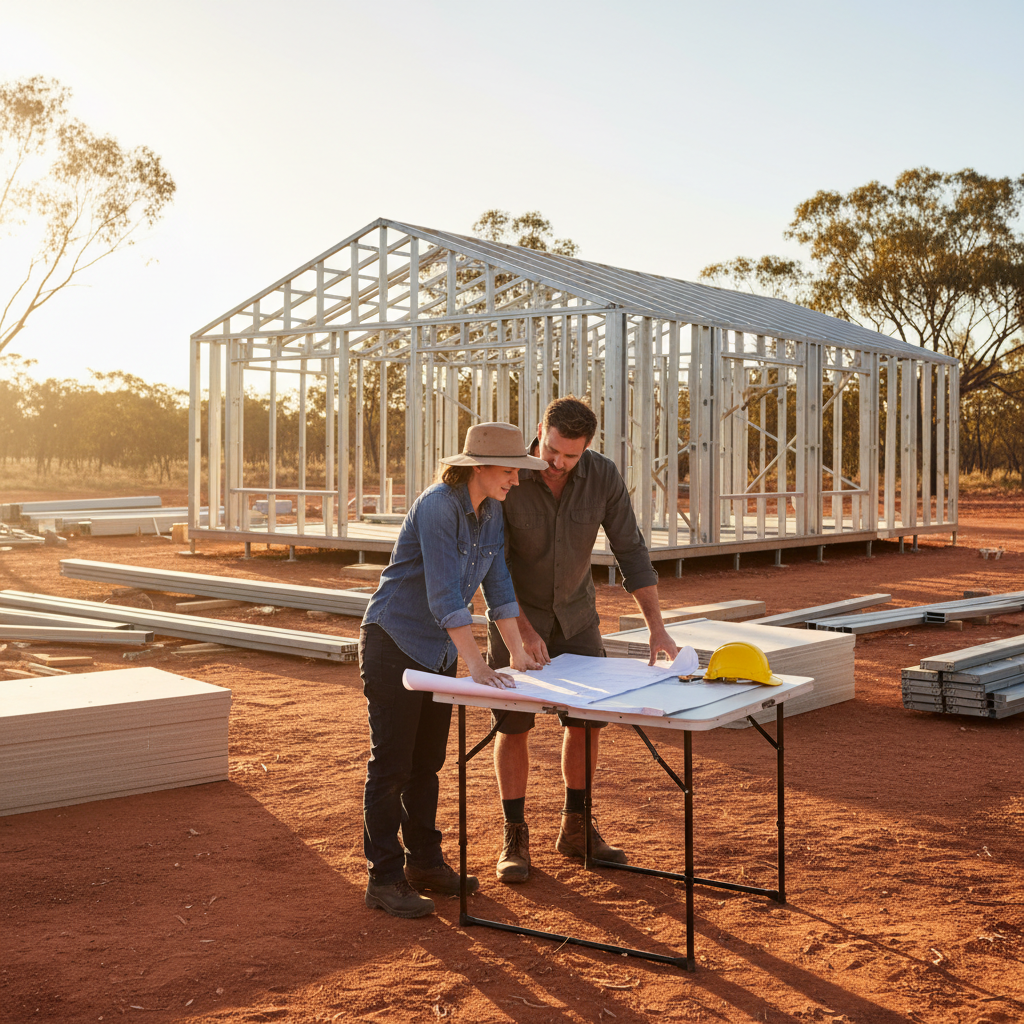
This is where steel really shows its worth. When you're dealing with N3 or C1 ratings, the precision of your frame matters. Wood can warp or have knots that create weak points. Cold-rolled steel frames are consistent. Every hole is pre-punched by a machine. Every truss is engineered to a specific millimetre. When you're an owner-builder standing there with a drill, knowing that the engineering has been calculated specifically for your wind zone's uplift forces gives you a bit of peace of mind. Plus, steel doesn't shrink or move over time. In high wind areas, houses flex. Steel can handle that repetitive loading without the joints loosening up like old timber and nails often do.
Tips for Owner Builders Planning Their Site
Don't guess your wind rating. Just don't. I've seen blokes try to save a few hundred bucks by telling the kit provider they're N2 when they're clearly N3. Here is how you handle it properly:
- Get a Site Classification Report early. A soil test usually comes with a wind rating assessment. This is done by a pro who looks at the topography and shielding.
- Talk to your local council. They often have mapped wind zones, especially in cyclone-prone areas. But remember, the council map is a general guide. Your specific block is what matters.
- Check your shielding. If you're building in a new estate where there are no other houses yet, you have 'full effects' of the wind. Even if there will be houses there in five years, you have to build for the conditions right now.
- Look at your openings. Big glass sliding doors look great for the view, but in high wind zones, they need to be rated too. We include windows and doors that match your site's rating, but you need to make sure you aren't swapping them out for cheap, unrated stuff you found on a marketplace site later.
The Importance of Tie-Downs
The biggest battle in a wind storm isn't the weight of the house pushing down. It's the uplift. Wind moving over a roof creates a vacuum. It wants to pull the house out of the ground. This is why the connection between your steel frames and your slab is the most important part of the whole build. For an N1 site, you might just have standard bolts. For a C2 site, you're looking at chemical anchors and heavy-duty brackets that tie the roof trusses all the way down to the footings. When you're doing the fit-out, don't skimp here. Follow the engineering plan to the letter. If it says 12mm bolts at 600mm centres, don't put them at 900mm because you ran out of bolts on a Sunday afternoon.
Building your own place is a massive undertaking. It's easy to get caught up in the kitchen taps and the color of the cladding. But the invisible stuff, the engineering that keeps the roof on during a tropical low, is what actually makes it a home. Take the time to understand your wind rating before you even pull the trigger on a floor plan. It affects your budget, your assembly time, and how well you sleep when the trees start bending over in a gale. So, go find your site's wind classification. It's the first real step in making sure your kit home isn't just a temporary fixture on the landscape.