The Groundwork of a Successful Build
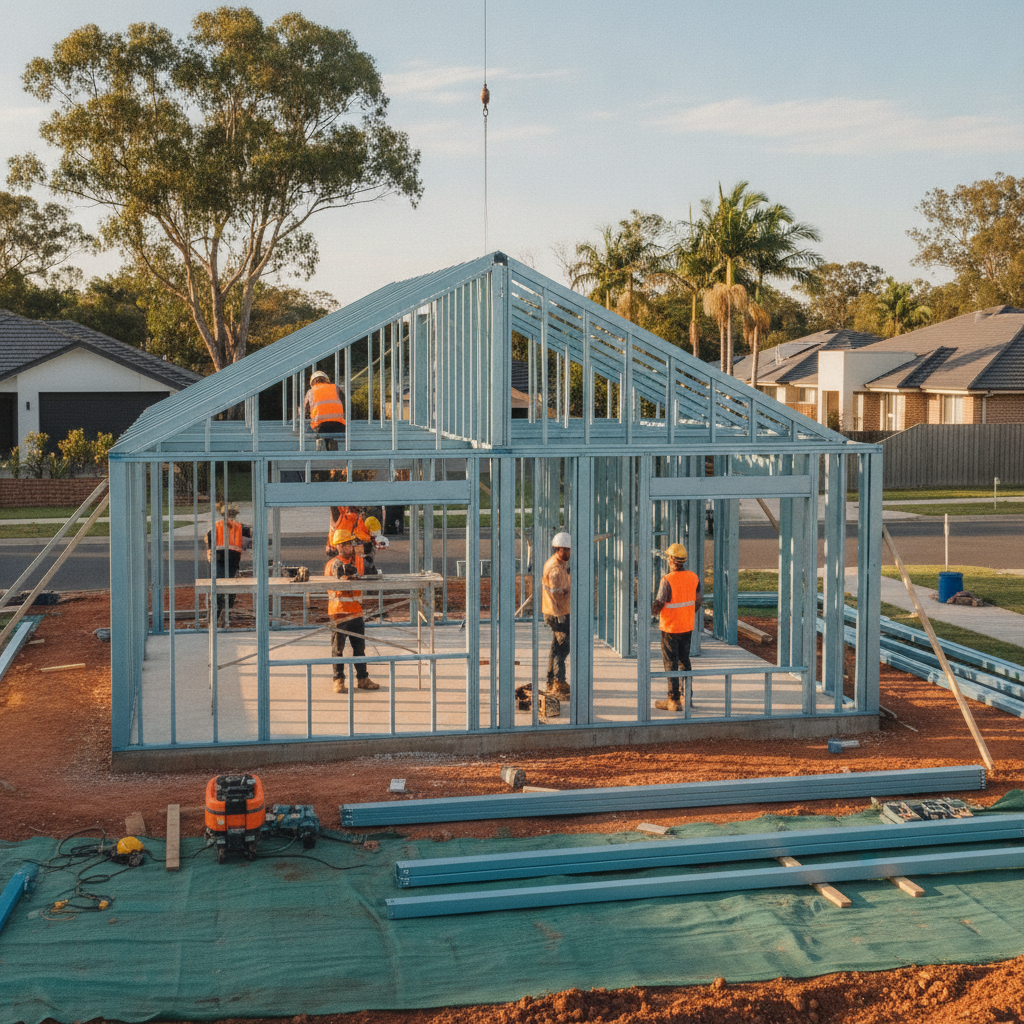
When you first receive your delivery of precision-engineered steel frames, it is tempting to want to start standing walls immediately. However, the longevity, thermal performance, and structural integrity of your Australian kit home depend entirely on what happens before the frames arrive. Choosing a foundation is not just a matter of cost or convenience, it is a technical decision influenced by your block of land, your soil type, and your lifestyle goals.
In Australia, we generally see three main contenders for kit home foundations: the traditional concrete slab on ground, timber or steel stumps, and deep-set piers. Each has a specific relationship with the steel frame kits commonly used by owner builders today. Because steel frames, such as those made from BlueScope TRUECORE steel, are incredibly dimensionally stable and lightweight, they offer great flexibility across all three foundation types. Let us explore which one might be right for your project.
The Concrete Slab: The Solid Standard
The concrete slab on ground is perhaps the most common sight in Australian suburban developments. For a kit home, a slab provides a solid, level, and permanent base that integrates seamlessly with modern floor finishes like polished concrete or large-format tiles.
Thermal Mass and Energy Efficiency
One of the primary benefits of a slab is thermal mass. In many Australian climates, a well-insulated slab can help regulate internal temperatures, keeping the home cooler in summer and retaining heat in winter. When you pair a concrete slab with a steel frame kit, you create a robust structure that feels grounded and permanent.
Technical Considerations for Owner Builders
If you are managing the build yourself, remember that a slab requires significant site preparation. You will need to coordinate excavation, drainage, plumbing rough-in, and vapor barriers before the concrete is even poured. Precision is everything here. Because steel frames are manufactured to the millimeter, your slab must be perfectly square and level. Any deviation in the slab will be magnified once you start erecting your wall frames.
Stumps and Bearers: Rising Above the Challenges
Often referred to as a raised floor system, using stumps (either timber or steel) is a classic Australian building technique. This method involves driving or concreting posts into the ground, which then support a sub-floor of bearers and joists.
Perfect for Sloping Blocks
Australia is famous for its rugged terrain. If your dream block has a significant slope, a slab might require massive amounts of cut-and-fill or expensive retaining walls. Stumps allow you to build out from the hillside with minimal site disturbance. This is often a more environmentally friendly approach as it preserves the natural flow of water across the site.
The Steel Frame Advantage
When using a raised floor system, steel floor joists are a natural partner for steel wall frames. Using steel throughout the sub-structure ensures that the entire skeleton of the home moves at the same rate during temperature fluctuations. Furthermore, steel stumps and joists are impervious to termites, which is a massive relief for owner builders in high-risk areas across Queensland, Western Australia, and New South Wales.
Piers and Screw Piles: Solving Soil Issues
Sometimes, the surface soil is simply not strong enough to support a standard slab or shallow stump. This is common in areas with reactive clay (which expands and contracts with moisture) or sandy coastal soil. In these cases, piers or screw piles are the technical solution.
Piers are deep concrete columns poured into holes drilled deep into the earth to reach more stable ground. Screw piles are large steel screws that are mechanically driven into the earth. For a kit home builder, using piers can provide the peace of mind that the house will not shift or crack over time, even if the topsoil moves significantly.
Comparing the Techniques: A Quick Reference
To help you decide, consider these practical factors:
- Site Access: Concrete trucks need clear access for a slab. If your site is remote or has narrow access, a stump and joist system might be easier to transport and install.
- Under-house Storage: A raised floor on stumps provides space for plumbing and electrical maintenance, or even extra storage, whereas a slab restricts access to services once they are cast in concrete.
- Termite Protection: While steel frames are termite-proof, your foundation shouldn't provide a hidden path for pests to reach your internal fit-out. Raised floors allow for easy visual inspection of termite shields.
- Construction Speed: For an owner builder, a slab can be faster to complete once the ground is ready, but it requires more specialized trade coordination (the concreter, the plumber, and the steel fixer).
Owner Builder Tip: The Soil Report is Your Best Friend
Before you commit to a foundation type, you must obtain a Geotechnical Soil Report. A soil engineer will take core samples from your block to determine the soil classification (Class A for stable, up to Class P for problem sites). This report dictates exactly how deep your stumps must go or how thick your slab needs to be. Do not skip this step! It is the most important piece of technical data you will collect during your planning phase.
The Impact of Steel Frame Construction
Regardless of the foundation you choose, the use of steel frames influence the load-bearing requirements. Steel is lighter than traditional timber framing, which can sometimes reduce the load on your foundations. This lightness, combined with the extreme strength of TRUECORE steel, allows for wider spans and open-plan designs that might be more difficult to achieve with heavier materials. When the frame is delivered, it is engineered to be straight and true, meaning your foundation is the only variable you need to manage closely to ensure a perfect fit.
Practical Advice for the DIY Hero
If you are planning to tackle some of the foundation work yourself, here is some hands-on guidance. First, always ensure your set-out is double-checked. Use a laser level or a professional surveyor to mark the corners of your house. Even a five-centimeter error at the ground level can cause massive headaches when you are trying to bolt down your steel wall plates.
Second, consider the future. If you might want to add a deck or an extension later, ensure your foundation plan accounts for those future loads now. It is much easier to pour extra piers or install additional stumps during the initial build than it is to retro-fit them later.
Conclusion
There is no one-size-fits-all answer for the perfect foundation. If you value thermal mass and a flat, easy-access entry, a slab is likely your winner. If you are building on a beautiful, sloping bush block or want to maximize airflow under the house, stumps and bearers are the way to go. For those dealing with tricky soil, piers offer the ultimate structural security.
The beauty of the Australian kit home is the ability to adapt high-quality materials, like steel frames and Colorbond cladding, to your specific environment. By understanding these building techniques and starting with a solid foundation, you set yourself up for a rewarding and successful owner builder journey. Take the time to get the ground right, and the rest of your home will stand tall for decades to come.