The Reality of the Owner Builder Grind
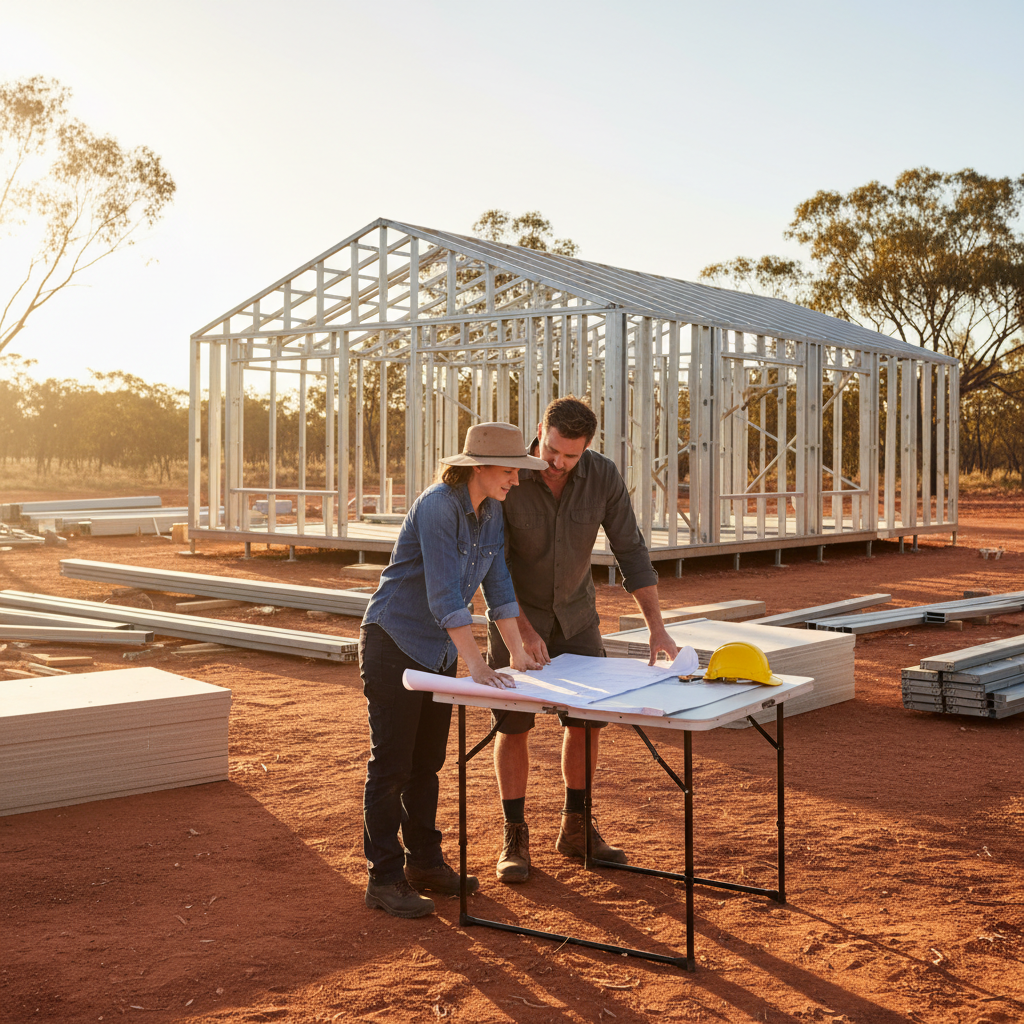
Most people think managing a kit home build is about looking at floor plans and picking out tapware. It isn't. It is about standing in a muddy paddock at 6:30am in your boots, waiting for a sparky who swore black and blue he would be there, while you wonder if the slab caterers actually read the engineering specs for the thickened edges. If you have gone the kit route with a steel frame, you have already made a smart call on the bones of the house. BlueScope TRUECORE steel does not warp and termites would rather eat a brick, so that part of the job is sorted. But the house does not build itself. You are the project manager now. That means you are the one responsible for the flow of subcontractors, and if you muck up the sequence, you're the one paying for a tradie to sit in his ute drinking a flat white while he waits for another guy to finish.
Setting the Groundwork with Your Concreter
Your slab is the most important part of the whole project, especially with steel frames. Because steel is manufactured to millimetre precision in a factory, your slab needs to be spot on. Wood is forgiving, you can plane it back or shim it up. Steel? Not so much. If your concreter pours a slab that is 20mm out of square or has a massive hump in the middle, your frames won't sit right and you'll be fighting the structure until the day you move in. Mention AS 2870 to your concreter and make sure he is across the site classification. Don't just take his word for it. Get out there with a string line and a laser level before the pour. Check the rebate for the sliding doors. Check the plumbing stack locations. Once that concrete is hard, it is a permanent mistake. I have seen guys spend three days with a concrete grinder because they didn't watch the level during the pour. Don't be that person.
The Steel Frame Advantage for Trades
One thing you'll notice when the kit arrives is the pre-punched holes in the TRUECORE studs. Your plumber and sparky will love this, or at least they should. They don't have to spend all day drilling through timber studs to run their pipes and cables. But here is the catch. You need to make sure they use the right plastic grommets. If a sparky runs 2.4mm twin and earth cable directly through a steel hole without a grommet, the vibratory movement of the house over time can chafe through the insulation. It is a massive fire risk and it is against the rules. I always keep a bag of grommets in my glove box just in case the sparky 'forgot' his. It shows them you're paying attention. It shows them you know the standards.
Sequencing Your Subs to Avoid the 'Trade Waltz'
Trade sequencing is where most owner builders fall over. You cannot have the plasterer starting while the roof plumber is still fiddling with the flashing. It sounds obvious, but when you are juggling a day job and a family, it is easy to get the wires crossed. Here is a rough guide on how it should go once your kit arrives:
- Wall and roof frames up (the skeleton).
- Roofing and gutters on (getting it watertight).
- Windows and external doors in (lockup stage).
- Rough-in for plumbing and electrical.
- Insulation and internal linings.
Communication and the Art of the 'Check-In'
Tradies are busy people. The good ones are booked out months in advance. If you want them to show up on your kit home site, you need to be professional and direct. Don't send vague texts. Give them a clear scope of work and ask for a fixed quote, not an hourly rate. And for heaven's sake, pay them on time. If word gets around the local hardware store that you're slow to pay, you won't get a quality sub to come near your block. I found that a Friday afternoon shout or just having a fridge with cold water and some Gatorade on site goes a long way. It creates a site culture where people actually want to do a good job for you. But don't be a pushover. If a job looks shonky, call it out. Use a straight edge. Check the tolerances in the NCC Volume 2 for residential construction. It is your house, and you're the one who has to live with the wonky walls if you don't speak up during the build.
Managing the Delivery and Site Access
When your kit arrives on a semi-trailer, you need to be ready. You can't have a pile of steel frames dumped in the middle of where the crane needs to sit. Plan your site layout. Where is the waste go? Where is the sand pile? If your cladding is sitting in the mud because you didn't have pallets ready, that is on you. Steel kits are tough, but they aren't indestructible. Treat the window frames like gold. Keep them upright and out of the way. If a sub dings a window frame because you left it in a high-traffic area, that is an argument you don't need. Keep the site clean. A messy site is a dangerous site and it tells your subcontractors that you don't care about quality. If the owner doesn't care, why should the plumber?
The Finish Line and Beyond
Managing your own build is a marathon. By the time you get to the fit-out, you'll be exhausted. Every weekend for six months has been spent on site. But this is the stage where the kit really becomes a home. The steel frames provide those perfectly straight lines for your cabinetry and skirting boards. No bowing, no twisting. It makes the finishing work so much easier for your carpies and tilers. Stay on top of the paperwork too. Keep every certificate of compliance your plumber and sparky give you. You'll need those for your final occupation certificate from the council or your private certifier. It is the boring stuff that catches people out at the very end. But when you finally sit on that deck with a cold drink, looking at a house you managed from a pile of steel into a finished home, it is a feeling you can't buy. It is hard work, but if you're organized and hold your subs to a high standard, it is the best way to build in Australia.