I have spent fifteen years watching people look at kit home floor plans with that glassy look in their eyes. They see a finished house. They see the Sunday morning coffee on the deck. What they don't see is the three months spent arguing with a private certifier over a bushfire attack level rating or the mud caked on their boots while they are dragging a heavy roll of sarking across a roof in a July drizzle. Building your own home is a massive undertaking. It is better than paying a volume builder to cut corners, but it takes grit. Actual grit.
The White Paperwork: More Than Just a DA
Before you even think about ordering a kit, you need to suss out your local council. Every shire has its own quirks. Some are relaxed. Others act like they are guarding the crown jewels. You will need a Development Application (DA) or a Complying Development Certificate (CDC). This is where the fun starts. You will be submitting site plans, soil reports, and maybe even an effluent report if you are out on a bush block with no town sewerage. Get a professional drafter or surveyor to do your site plan. Do not try to draw it yourself with a ruler and a grey lead pencil. Council will laugh you out of the office.
Once the DA is through, you need the Construction Certificate (CC). This is the green light for the physical work. You cannot pour a drop of concrete without it. Plus, as an owner builder in Australia, you typically need to do a short course to get your permit. It is a few hundred bucks and some study hours, but it covers the legal bits like site safety and insurance. Do not skip the insurance part. If a sparky trips over a bit of loose steel framing and breaks a wrist, you want to be covered.
Site Prep and the Slab
Your kit arrives on a truck, but it needs somewhere to sit. This is the hardest part for most DIY types to coordinate. You need a big, flat, clean area. If you are building on a slope, you are looking at cut and fill or maybe steel piers. Most kit homes sit on a concrete slab. You will hire a concreter for this. Don't try to screed a whole house slab yourself unless you want a floor that looks like the surface of the moon. This is also when your plumber comes in to lay the 'rough-in' pipes. If they are off by 100mm, your toilet will end up in the hallway. Get it right first time.
Timing the Delivery
Don't have the kit delivered while the site is still a swamp. You want the slab cured. You want a clear path for the crane truck. Most of our kits use BlueScope TRUECORE steel. It is tough as nails and won't rot or attract termites, but you still don't want it sitting in a foot of mud for six weeks because you timed the slab pour poorly. Check the weather. If La Niña is sticking around, wait for a dry window.
Standing the Frames
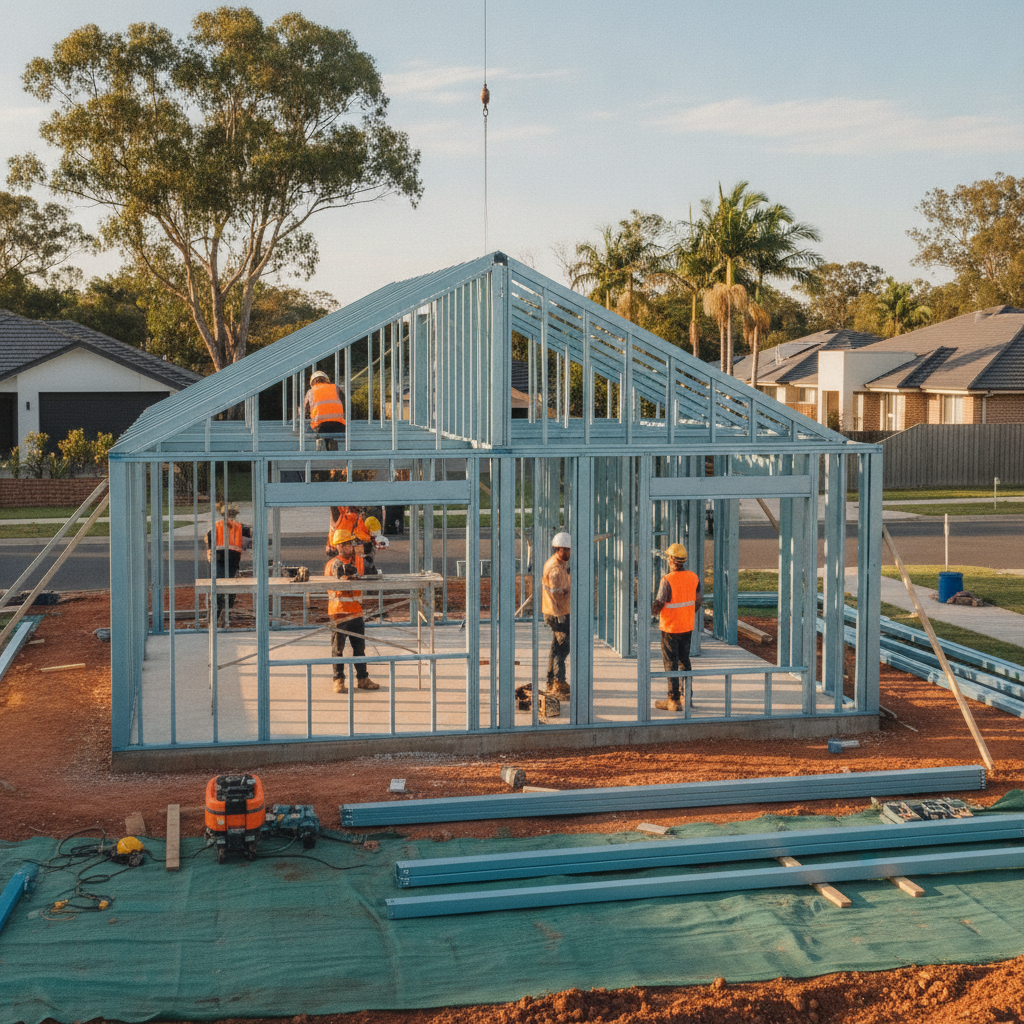
This is the part where it starts to look like a house. Steel frames are lighter than timber, which is a godsend for your lower back. Because they are manufactured to such tight tolerances, everything is straight. No bowed studs. No wonky corners. You follow the ticking plan, bolt the bottom plates down, and suddenly you have rooms. It's like a giant Meccano set for grown-ups. Use a good quality cordless impact driver. Your wrists will thank me. You'll spend a lot of time on a ladder here, so make sure your site is level and you've got some decent scaffolding if you're going high.
And then there is the roof. This is where you really see the benefit of a steel kit. The trusses go up, the battens follow, and then the roofing sheets. We include the roofing and cladding in the kit. It's usually Colorbond steel because that is the Aussie standard for a reason. It handles the sun. It handles the hail. Just make sure you get your insulation (Sarking and batts) in before the sheets go down. An uninsulated steel house in an Australian summer is basically an oven. Nobody wants that.
Managing the Trades
Even as an owner builder, you aren't doing everything. Unless you are a licensed sparky or plumber, you are legally required to hire professionals for the wet stuff and the wires. Finding good tradies is half the battle. Don't just pick the first name on a Google search. Go to the local pub or the hardware store in town. Ask who shows up on time. A bad plumber will hold up your whole project for weeks. You need to be a project manager as much as a builder. Have your windows and doors ready to go. Our kits come with them, which saves a massive headache, but you still need to be ready to fit them so the house is lock-up ready.
Internal Fit-out: The Slow Burn
Once the shell is up and the house is watertight, the pace feels like it slows down. This is the 'death by a thousand cuts' phase. Gyprock, skirting boards, painting, tiling. It feels like you are doing a lot of work for very little visual gain compared to when the frames went up in three days. Because steel frames are dead straight, your plastering should be a breeze. No shimmying out walls to get them flush.
A few tips for this stage:
- Seal your wet areas properly. Water leaks are the number one killer of Aussie homes. Don't skimp on the waterproofing membrane.
- Plan your kitchen early. If you want a massive island bench with a sink, that plumbing needs to be in the slab months ago.
- Think about your lighting. It is much easier to run extra wires before the ceiling goes up than it is to crawl through a roof space in 40-degree heat later.
The Final Stretch
When the kitchen is in and the toilets actually flush, you'll be tempted to just move in. Don't. You need your final inspection and the Occupation Certificate (OC). This is the piece of paper that says the house is legal to live in. The inspector will check things you didn't even think about. Balustrade heights. Smoke alarm locations. Termite barriers. Get your certificates from your sparky and plumber early. You'll need those to get the OC over the line.
Building a kit home as an owner builder isn't for everyone. It is stressful. You will get frustrated when a supplier sends the wrong flashings or when it rains for fourteen days straight. But when you stand in that living room and realise you managed the whole thing, from a pile of steel to a finished home, the feeling is pretty hard to beat. Just keep your site clean, keep your paperwork organized, and don't try to rush the slab. You'll get there.