The Hard Truth About Managing a Site
Most people think the hardest part of an owner-builder project is the physical labour. It's not. You can learn to swing a hammer or screw down some BlueScope TRUECORE steel frames if you've got the patience. The real nightmare starts when you pick up the phone. Dealing with trades and suppliers is where most kit home dreams go to die, usually because the communication breaks down before the first pier is even poured. I've spent 15 years in this game and the blokes who succeed aren't always the handiest with a drill. They're the ones who know how to talk to a sparky at 6:30am without sounding like a goose.
Tradies are busy. They're dodging calls from annoying clients, fighting with councils, and trying to get home before dark. If you come across as another 'pain in the neck' owner-builder who doesn't know their AS 1684 from their AS 3000, they'll quote you a 'go away' price or just never show up. You need to prove you're organized. Fast. Because if you don't, your site will sit empty for weeks while your windows sit in a warehouse gathering dust.
The Quote Is Your First Test
Don't just call up a plumber and say you're building a kit home in the Hunter Valley and need a price. That's a waste of everyone's time. You need a package ready to email the second you hang up. This means having your engineering drawings, your floor plan, and a specific scope of works. If you want a wall-hung vanity and a floor-to-ceiling tiled wet room, say it now. Don't wait until he's roughing in the pipes. I've seen too many owners get stung with variations because they weren't specific. A variation is just a polite word for a bill you didn't see coming.
When you're talking to suppliers for your cladding or roofing, ask about lead times immediately. We're seeing some crazy delays on certain profiles lately. It doesn't matter how fast you can bolt your steel frames together if your Colorbond is six weeks away. Get a firm date. Put it in your calendar. Then call them two weeks out to make sure it's actually happening. Squeaky wheels get the oil, and in the building game, the quiet ones get forgotten at the bottom of the pile.
Talking the Talk Without Pretense
You don't need to pretend you've been on a tools for twenty years. Tradies smell that a mile off. But you do need to understand the sequencing of a build. If you ask a tiler to come before the waterproofing is cured, he's going to think you're a clown. Plus, it's illegal. Read the NCC Volume 2. Know what a rebate is. Understand why your slab needs to be 100% level for those steel frames to sit right. When you speak the language, you get respect. And respect gets you guys who actually turn up on a Tuesday morning when they said they would.
Specific Details Matter
Stop using vague terms. Don't say 'the big window in the front.' Say 'Window W01 on the eastern elevation.' It's right there on the schedule. This removes any wiggle room for mistakes. I remember a bloke in Toowoomba who told his sparky to 'put a few extra outlets in the kitchen.' He ended up with four piddly double-poles in useless spots and a bill for five hundred bucks in labor. If he'd marked the studs with a thick Sharpie exactly where he wanted the boxes, he would've got exactly what he needed. Use your markers. Draw on the floor. Labels save lives, or at least they save your bank account.
Supply Management is Your Full-Time Job
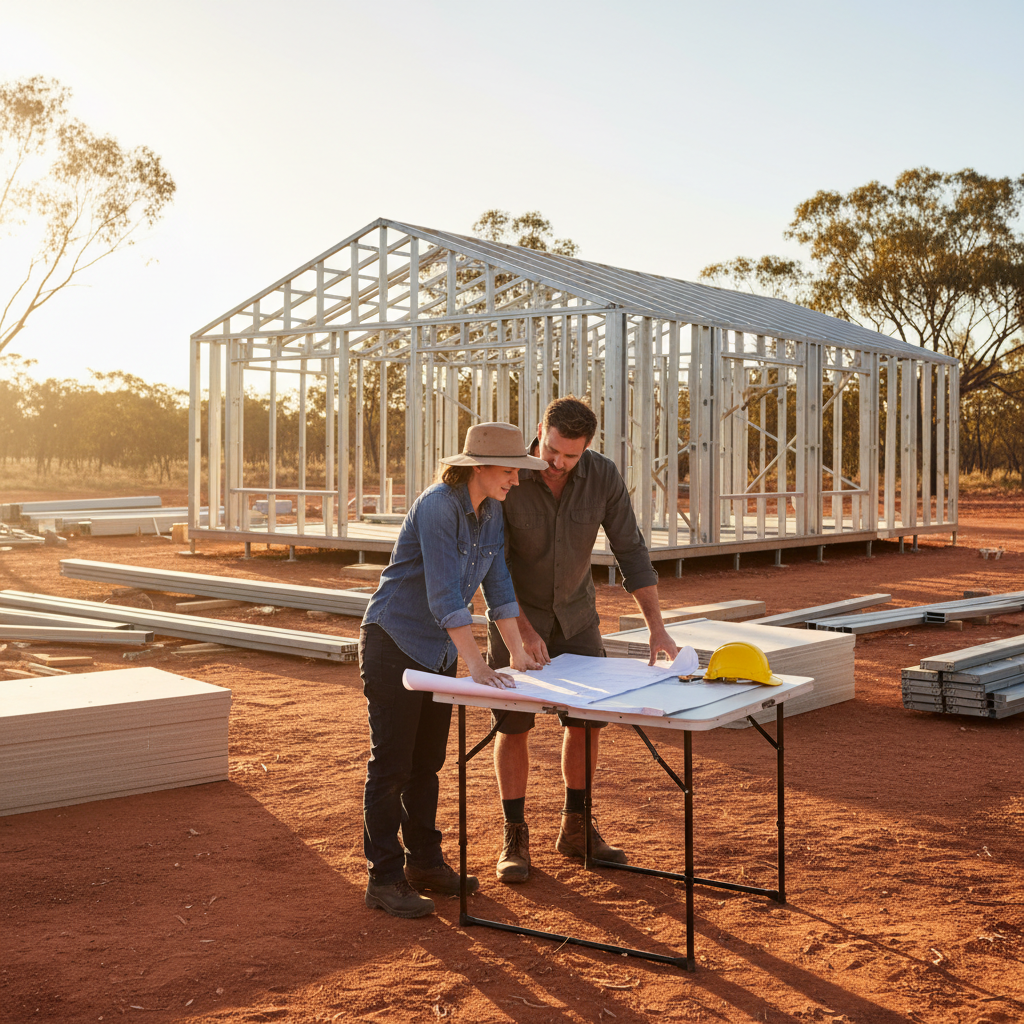
When you buy a kit home, you're getting the 'bones' of the house. The frames, the trusses, the cladding, and the insulation. But you're the one playing Tetris with the delivery. You need to have a clear spot on site that isn't in the way of the concrete truck. If your steel frames arrive and you've blocked the only access to the septic tank area, you're paying a machine operator to sit around and wait while you move stuff by hand. It's soul-destroying work. Plan your site layout on paper before the first semi-trailer rolls up the driveway.
And check your deliveries. Don't just sign the docket and let the driver leave. If you're short three lengths of flashing or a box of Tek screws, you'll be the one driving to Bunnings at 4pm on a Friday while your roofers are charging you by the hour to sit in their utes. Open the boxes. Count the spans. It feels pedantic but it's the difference between a smooth week and a total write-off.
The 'No Dramas' Approach to Conflict
Things will go wrong. A supplier will send the wrong color gutters. A chippy will cut a hole in the wrong spot. How you handle this determines if that person ever comes back to your site. Getting angry usually achieves nothing but a deserted worksite. Stay calm. Ask how they reckon it should be fixed. Usually, they've seen the same mess ten times before and know a workaround that works better than the original plan. But always check the fix doesn't compromise your structural integrity or your bushfire rating if you're in a BAL-40 or Flame Zone. Compromise is fine. Dodgy work isn't.
Managing the Hand-Offs
The trickiest part for any owner-builder is where one trade finishes and another starts. This is the 'grey zone.' For example, who's responsible for the flashing around the windows? Is it the guy installing the windows or the guy doing the cladding? If you don't specify this in your scope, they'll both point at each other while water leaks into your nice new insulation. You're the boss. You're the coordinator. You need to bridge those gaps. Ask each trade, 'What do you need the site to look like before you get here?' If the plumber says he needs the trenches clear of rocks and you haven't done it, that's on you.
Wait Times and Reality Checks
Don't book your trades back-to-back with no breathing room. It's tempting to try and smash it out in three months, but life doesn't work like that. It rains. People get sick. Trucks break down on the New England Highway. Always leave a three-day 'buffer' between major stages. If the slab goes down on Monday, don't have the frame crew booked for Tuesday. Give it time to go off. Give it time for the inspector to sign it off. Nothing is worse than having four blokes standing around doing nothing because the previous stage isn't ready. You'll still be paying them for their time.
Wrapping It Up
Being an owner-builder is a massive undertaking but it's not impossible if you treat it like a business. You're a project manager first and a builder second. Keep your paperwork in a folder on site. Have a kettle and some decent biscuits for the boys. Most importantly, be clear, be direct, and don't change your mind every five minutes. If you can do that, you'll actually enjoy the process of seeing those steel frames turn into a home. It's a hell of a feeling when you finally move in and realize you managed the whole show yourself. Just don't expect it to happen without a bit of sweat and a lot of phone calls.