I was standing on a site out near Mudgee a few years back, middle of a stinging cold winter morning. The owner-builder had gone with a traditional timber setup for his extension, not one of our kits, and the poor bloke was nearly in tears. Every single stud he'd delivered two weeks prior had bowed like a banana because they'd been sitting in the rain and then copped the frost. He was literally trying to plane down 90mm studs just to get his blueboard to sit flat. What a mess. That's the day I realized most people don't actually understand the term dimensional stability until it's too late.
The Myth of the Straight Stud
Timber is an organic material. It breathes. It drinks. It's basically still a tree, even when it's been ripped into 90x45 stick. If you've ever walked through a house and seen those tiny little cracks in the plasterboard cornices or noticed a door that suddenly sticks every time it rains, you're looking at movement. Timber shrinks across the grain as it loses moisture. Because it isn't uniform, it shrinks unevenly. That leads to twisting. When you're building a kit home yourself, the last thing you want is to be fighting your materials. You want to bolt it together and know for a fact that the wall is plumb, dead straight, and staying that way until the sun burns out.
Steel frames made from TRUECORE steel don't do that. They can't. Steel is an engineered product. It doesn't have a moisture content to lose. If a steel stud is 2400mm long today, it's 2400mm long in ten years. This isn't just about being picky. It's about your finishes. If the frame stays perfectly still, your plaster stays perfectly still. No popped nails. No wavy hallway walls when the afternoon sun hits them at an angle. Just a clean, professional finish that makes you look like a master tradesman even if it's your first time picking up an impact driver.
Managing the Build as an Owner-Builder
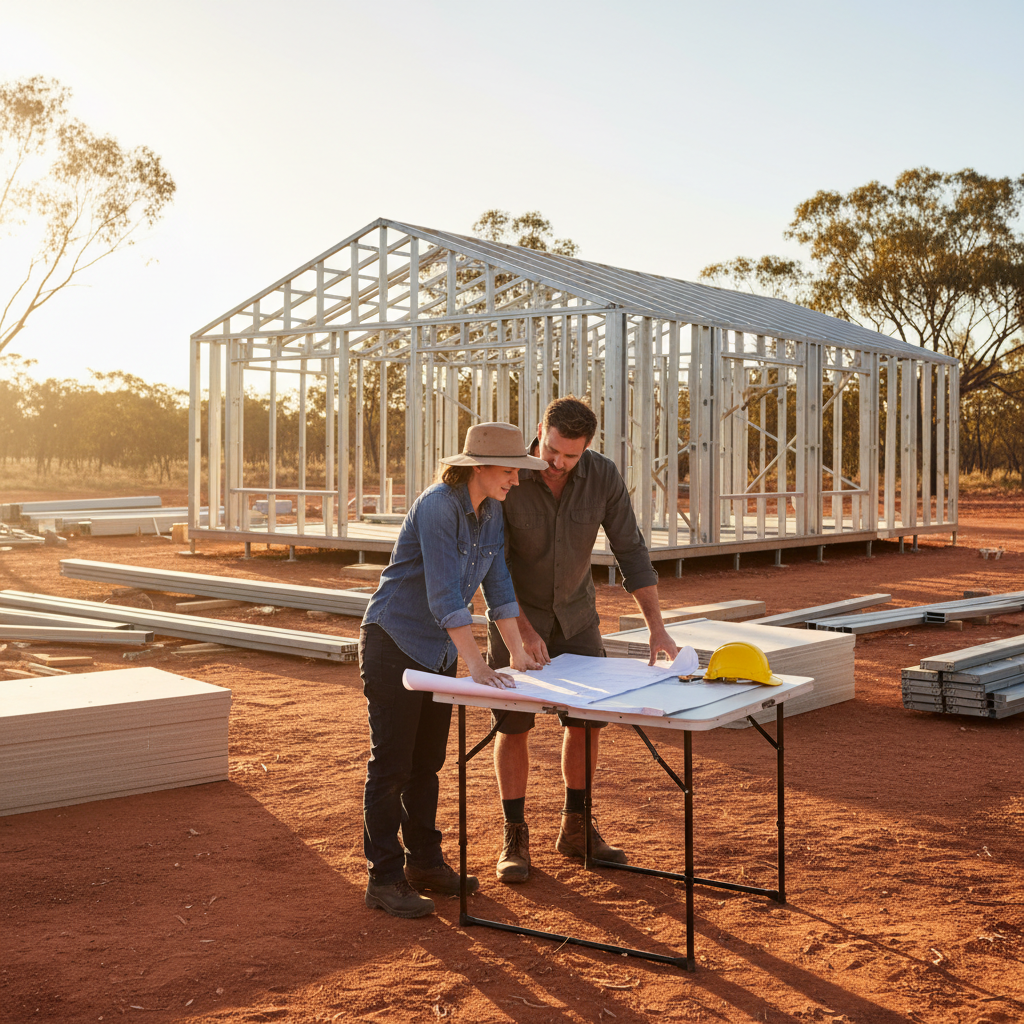
Most of the people we talk to at Imagine Kit Homes are doing the hard yards themselves. You're the one coordinating the slab, the plumber, and the sparky. Now, imagine your windows arrive. You've got $15,000 worth of double-glazed aluminium sitting on a pallet. If your wall openings have twisted or sagged because the frame moved during a wet week, those windows aren't going in without a fight. My tip? Stick with steel. It's lightweight enough that two of you can hand-ball the wall frames into place on the slab without needing a Franna crane. Plus, the holes for your electrical and plumbing are already punched out. No standing there with a spade bit for four hours getting sawdust in your eyes.
The Precision Factor
We use CAD software to design these frames down to the millimetre. Everything is pre-punched. Everything is notched. When you're out on site, maybe somewhere like the Sunshine Coast where the humidity is enough to make a fish sweat, that precision is your best friend. Wood swells in that gear. Steel stays put. Because the frames are straight, the cladding goes on faster. Your windows fit first time. Your doors don't need a plane taken to the top of them six months after move-in day. It saves you heaps of time in the long run.
And let's talk about termites. If you're building in Queensland or the top end of NSW, termites aren't just a possibility. They're an inevitability. They'll eat the frame out from under you if you give them half a chance. Steel is 100% termite proof. You don't need those nasty chemical barriers that smell like a refinery every few years. It's peace of mind. You can sleep in your new place without hearing the imaginary sound of little jaws munching on your rafters.
Technical Realities of Steel Frame Construction
It isn't all sunshine and rainbows. You've got to know how to work with it. For starters, you'll need a decent tin snip and a good quality impact driver. Forget your old wood saws. You're using tek screws now, not nails. AS 4100 is the standard for steel structures in Australia, and while our kits are engineered to meet all the requirements for residential builds (NCC Volume 2), you still need to respect the material. Steel conducts heat. That's why we include a thermal break. It's a simple bit of kit that stops the heat from the outside cladding jumping straight through the steel stud into your plasterboard. Don't skip it. It's what keeps your house cool in a 40-degree January buster.
If you're planning on hanging a massive 75-inch TV or some heavy-duty kitchen overheads, tell us early or chuck in some extra noggins. You can't just screw a heavy cabinet into the thin flange of a steel stud and expect it to hold a full set of ceramic plates. You need to plan your fixing points. It's a different way of thinking, but once it clicks, it's actually much more logical than traditional stick-building.
What Happens When the Weather Turns?
I've seen sites get rained out for three weeks straight. If you've got a timber frame standing there with no roof on, it's absorbing water like a sponge. It starts to grey off. It starts to cup. You have to wait for it to dry out before you can even think about putting insulation or plaster in, otherwise you're just trapping mould. Steel? It doesn't care. The BlueScope TRUECORE we use is galvanized. Rain on it all you want. When the clouds clear, you wipe the floor off and keep going. No waiting. No worrying about structural integrity. No drama.
Actually, there's a specific feeling when you're standing inside a steel-framed house during a massive storm. It feels solid. It doesn't creak or groan under wind load. Our kits are engineered for specific wind regions, including cyclonic areas. Because the connections are screwed and bolted, not just nailed, the whole structure acts as one rigid unit. It's a different level of security for your family.
A Note for the DIY Crowd
If you're doing this as an owner-builder, you're already taking on a lot. You're the project manager. You're the site foreman. You're the clean-up crew. Do yourself a massive favour and choose the material that makes your life easier. Steel frames are lighter than timber. A 3-metre wall section can be lifted by two people easily. You won't blow your back out before you've even got the roof on. Plus, there's no waste. We don't send you random lengths of wood that you have to cut down, leaving a pile of offcuts for the skip bin. Every piece has a home. It's like a giant Meccano set for adults.
I reckon the best park of a steel kit home is the longevity. You aren't building a house for five years. You're building it for fifty. You want the lines of the roof to stay straight. You want the corners of the rooms to stay square. In Australia, our climate is brutal. We have massive temperature swings, bone-dry droughts, and humid summers. Steel doesn't care about any of that. It just sits there, doing exactly what it was designed to do. No warping. No shrinking. Just a straight house that stays straight.
Don't let some old-school chippy tell you that 'wood is good' just because that's what he's been doing since 1985. Times change. Materials get better. If you want a house that's easy to build, impossible for termites to eat, and stays dead straight for life, steel is the only way to go. Get your floor plans sussed out, talk to your local council about the DA, and get ready to see how fast a steel kit goes together when every piece is exactly where it's supposed to be.