Building for the Australian Elements: A Guide to Wind Ratings
When you sit down to plan your dream kit home, you likely spend hours scrolling through floor plans, choosing cladding colours, and imagining the view from your new deck. However, before the first steel frame is bolted into place, there is a technical hurdle every Australian owner builder must clear: understanding wind ratings. In Australia, our climate is as diverse as it is beautiful, and the way we build must reflect that.
Whether you are building a quiet retreat in a leafy suburb or a coastal escape in the tropical north, your home must be engineered to withstand the specific wind pressures of its location. This is not just about safety, it is a legal requirement under the Building Code of Australia. In this guide, we will break down the technical world of N-ratings and C-ratings, explaining what they mean for your kit home project and how they influence the construction techniques used on site.
What Exactly is a Wind Rating?
At its simplest, a wind rating (or wind classification) is a measurement of the maximum wind speed a building is expected to face. This classification determines the engineering requirements for the entire structure. For a kit house, this dictates everything from the thickness of the steel frames to the type of roof screws and the spacing of the wall studs.
The Australian Standard AS 4055 (Wind Loads for Housing) is the rulebook we follow. It categorizes sites based on geographic region, terrain category, topographic effects, and shielding. While this sounds complex, it essentially boils down to how hard the wind is going to hit your house on the worst day of the year.
The Multi-Step Assessment Process
Before you order your kit, a site classification is usually performed by a structural engineer or a qualified surveyor. They look at four main factors:
- Wind Region: Australia is divided into four regions (A, B, C, and D). Region A is most of the country (non-cyclonic), while Region D covers the most severe cyclonic areas like the WA coast.
- Terrain Category: Is your land in a built-up suburb with lots of trees (high shielding) or is it on an open, flat plain?
- Topography: Are you on the crest of a hill where wind speeds accelerate, or in a protected gully?
- Shielding: How much protection do neighbouring buildings or permanent structures provide?
Understanding Non-Cyclonic Regions (N1 to N6)
Most Australian homes fall into the "N" or non-cyclonic categories. These ratings apply to the southern and inland parts of the country where the primary concern is strong gusts and thunderstorms rather than sustained tropical cyclones.
N1 and N2: Low to Medium
These are common in sheltered suburban areas. If you are building in a flat, developed area, you are likely looking at an N2 rating. The engineering for these homes focuses on standard tie-down methods. Steel frames are particularly effective here because they provide a high strength-to-weight ratio without needing overly complex connectors.
N3 and N4: High
As we move into N3 and N4, we are usually looking at exposed coastal sites or properties on hills. At this level, the building techniques change. You will see more robust bracing and specialized "triple grips" or cyclones ties used to secure the roof trusses to the wall frames. The windows and doors must also be rated to handle higher pressures to prevent them from blowing in or out during a storm.
N5 and N6: Very High
These are rare but occur in extremely exposed, high-altitude or coastal locations. In these instances, the kit home engineering becomes significantly more heavy-duty, often requiring thicker gauged steel and additional structural members.
Understanding Cyclonic Regions (C1 to C4)
If you are building in Northern Australia (roughly above the 25th parallel), you will be dealing with "C" ratings. These are designed to withstand the devastating forces of tropical cyclones, which include circular wind patterns and immense pressure changes.
C1 and C2: Cyclonic
A C1 rating is roughly equivalent to an N3/N4 in terms of wind speed but requires different construction techniques. In cyclonic areas, the focus is on "the chain of connection." Every component, from the roof sheet to the footing, must be linked. For kit homes, this means using specialized washers on roof screws and high-tensile steel straps that wrap around the frame and anchor into the slab.
C3 and C4: Severe Cyclonic
C4 is the highest rating in Australia, reserved for the most extreme conditions. Buildings in these zones are engineered as fortresses. The cladding, roofing, and windows must undergo debris impact testing, which involves firing timber planks and steel balls at the materials to ensure they won't breach during a storm. If the "envelope" of the house is breached, the internal pressure can literally lift the roof off from the inside.
Building Techniques: How Ratings Change Your Kit
When you choose a steel-framed kit home, the wind rating is integrated into the design from day one. You won't necessarily see the difference from the outside, but the internal skeletal structure tells the story.
1. Tie-Down Systems: In lower wind zones, screws and standard brackets are sufficient. In higher N or C zones, we use rods and heavy-duty straps. A common technique for steel frames is the use of long bolts that go from the top plate all the way through to the concrete slab, ensuring the house is literally bolted to the earth.
2. Batten and Purlin Spacing: To prevent the roof from peeling back like a sardine can, the spacing between the roof battens is reduced in high wind areas. This provides more fixing points for the Colorbond steel roofing.
3. Glass and Openings: Wind doesn't just push; it pulls (suction). In high wind zones, the glass must be thicker and the frames of the windows and doors must be reinforced so they don't pop out under pressure.
The Role of the Owner Builder
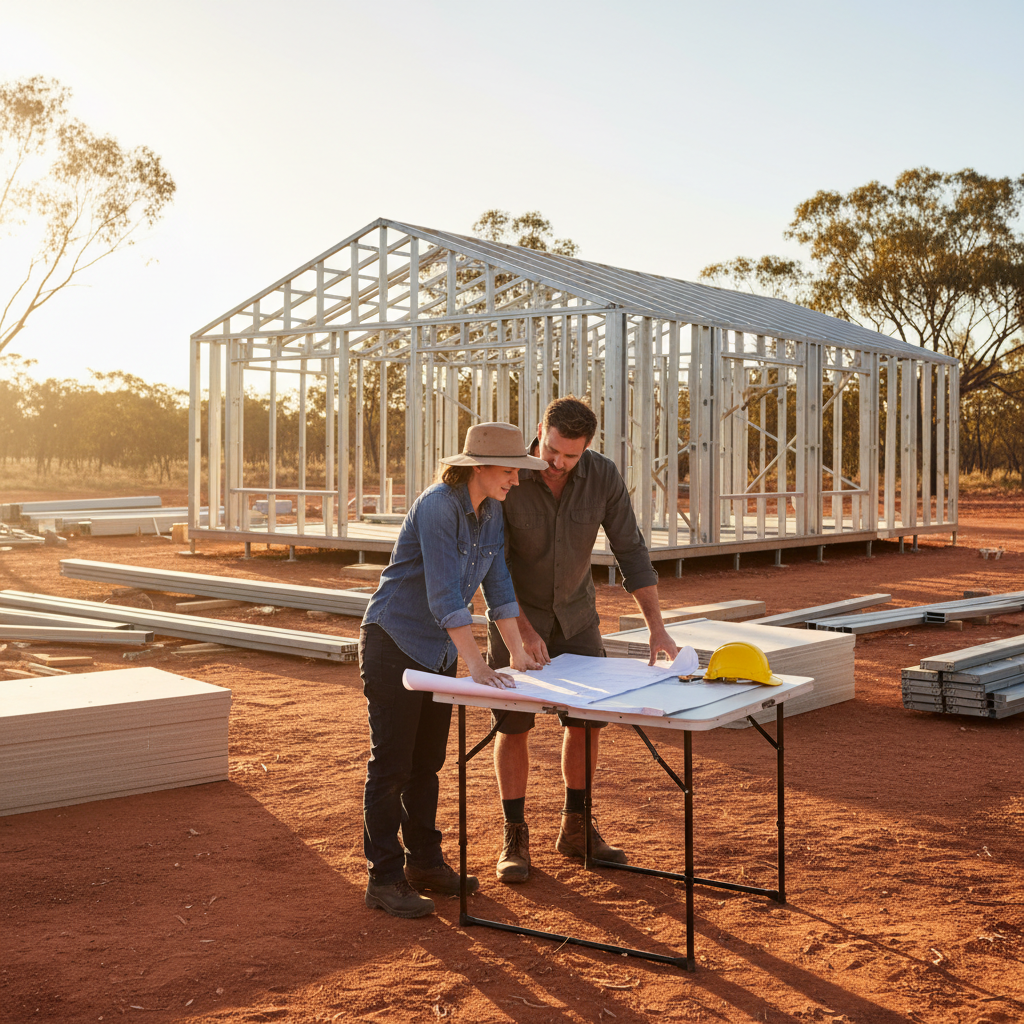
As an owner builder, you are the project manager. While your kit provider will supply frames and components engineered to your specific wind rating, it is your responsibility to ensure the installation matches the engineering plans. Here are some tips for DIY builders:
- Read the Tie-Down Schedule: Your kit will come with a detailed plan showing exactly where every strap, bolt, and screw goes. Never substitute a standard screw for a high-wind rated one.
- Focus on the Slab: The connection between your steel frames and the slab is the most critical point. Ensure your anchor bolts are placed exactly where the engineering specifies.
- Check Window Ratings: When your windows arrive, check the stickers to ensure they match the wind rating on your building permit. Installing N2 windows in an N4 zone will result in a failed inspection and a significant safety risk.
Why Steel Frames Excel in High Wind Zones
There is a reason why steel is a preferred material in cyclone-prone areas. Steel has a much higher strength-to-weight ratio than traditional timber. Because steel is manufactured to precise tolerances, every piece of your frame is uniform. In high-stress situations, steel does not split or warp around the fasteners. When using high-quality Australian steel, like TRUECORE, you are getting a product designed specifically for our harsh conditions, offering peace of mind that the structure will remain rigid and secure when the weather turns sour.
A Note on Different Housing Types
It is important for owner builders to distinguish between different construction methods. While you may hear about "transportable" or "relocatable" homes, a steel kit home is a permanent structure built on-site. Unlike some light-duty temporary structures, kit homes are engineered to the same (and often higher) standards as traditional brick-and-mortar houses. This building technique allows for greater flexibility in achieving high wind ratings because the structure is tied directly into a permanent concrete slab or high-strength pier system.
Conclusion
Understanding wind ratings might feel like a dive into technical jargon, but it is the foundation of a safe, long-lasting home. By knowing whether you need an N2 or a C1 rating, you ensure that your kit home is perfectly suited for its environment. It protects your investment, your family, and the longevity of your build.
When planning your project, always start with a professional site assessment. Let the data guide your design, and trust the engineering that goes into your steel frames. Australia is a land of extremes, but with the right building techniques and a thorough understanding of wind classifications, your new kit home will be ready for whatever the sky throws at it.