I spent twenty years on tools before I started writing about this stuff, and if there is one thing that gets my back up, it's the way people talk about 'green' building. Most of it is fluff. You see people talking about sustainable timber while ignoring the fact that half of it gets treated with enough chemicals to kill a small horse just so the termites don't eat the living room by Christmas. If you actually give a toss about the Australian environment, you need to look at what happens to your house in a hundred years, not just how it looks when the truck drops it off in your driveway.
The Infinite Lifecycle of BlueScope Steel
Steel is one of the few things on this planet that is 100 percent recyclable. Forever. You can melt down a car bumper and turn it into a floor joist, then eighty years later, melt that joist down to make a bridge. It doesn't lose its integrity. When we send out a kit home using TRUECORE steel, we're providing a frame that won't end up as toxic landfill. Timber? Once it's rot-affected or treated with copper chrome arsenic (CCA), it's basically waste. You can't even burn most of it without putting nasty stuff into the air.
Because steel is magnetic, it's easy to pull out of a demolition site. It doesn't get lost in the dirt. This matters for the future of Aussie suburbs. We've got enough junk in the ground. Using a material that can be reclaimed and reused without losing its 'strength'—that's the real definition of sustainability. Plus, the precision of a steel frame means we aren't sending three skips worth of offcuts to the tip during the build. Everything is cut to the millimetre in the factory. You get exactly what you need. No more, no less.
Termites, Toxins, and Your Lungs
In places like Darwin or even down on the NSW South Coast, termites are a nightmare. Most people stop them by drenching the ground in poison or using heavily treated frames. Here is the thing: steel is 100 percent termite-proof. It just is. They can't eat it. This means you aren't spraying chemicals around your slab every few years just to keep the house standing. If you're an owner-builder with kids or pets running around, that's a massive win for the immediate environment around your home. No chemicals in the soil means a healthier garden and a healthier family. Simple as that.
Precision Engineering Means Less Waste
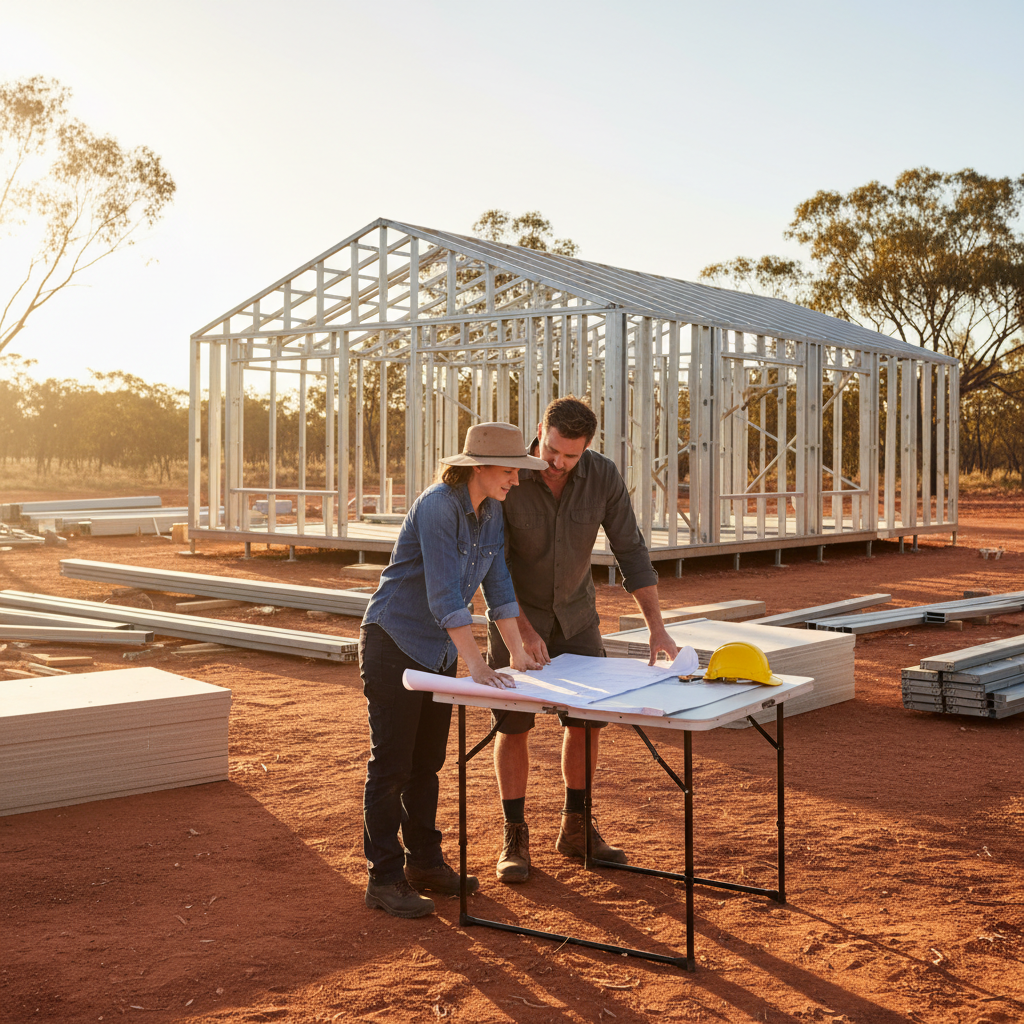
When you're building a kit home yourself, you'll notice pretty quickly how clean a steel site is. If you were framing with stick-built timber, the amount of sawdust and treated offcuts would be everywhere. With our kits, the frames arrive pre-punched and ready to bolt together. There's no sawing. No mess. It's a dry construction method. Because steel has a much higher strength-to-weight ratio than wood, we can achieve longer spans with less material. That's a lighter footprint on the earth because you're literally using fewer kilograms of raw material to hold up your roof.
Managing the Thermal Bridge
Now, I'll be the first to tell you that steel isn't magic. It conducts heat. If you just slap some cladding on a steel frame and call it a day, your house will be an oven in the summer and a fridge in the winter. This is where the 'it depends' stuff comes in. To make a steel frame kit truly environmentally friendly, you've got to use a thermal break. This is required under the National Construction Code (NCC) Volume 2, and it's there for a reason.
We include high-quality insulation and vapor barriers in our kits because the thermal performance of your home over thirty years is what really drives its carbon footprint. A well-sealed steel home with a proper thermal break and the right orientation—say, north-facing living areas—will outperform a drafty timber shack any day of the week. Don't be the guy who skimps on the wrap. You want that envelope tight so your aircon isn't working double time during those 40-degree mid-Feb arvos.
Built to Last the Aussie Climate
The most sustainable house is the one you don't have to rebuild. Australia is tough. We have crazy humidity, salt air if you're near the coast, and bushfires that don't mess around. Steel won't rot. It won't warp when the humidity hits 90 percent in January. It stays straight and true. When a timber frame warps, your windows start to stick, your plaster cracks, and your energy efficiency goes out the window.
And let's talk about fires. If you're building in a high BAL (Bushfire Attack Level) zone, steel is your best mate. It's non-combustible. While it won't make a house fireproof on its own—nothing will if the fire is hot enough—it doesn't add fuel to the flames. It stays standing. Recovering from a disaster is a massive environmental burden. Keeping a structure viable through its lifespan is the goal.
The Reality for the Owner-Builder
If you're tackling this as an owner-builder, you're going to appreciate the weight. Or lack of it. You can move these wall frames around with a mate without needing a massive crane for every little lift. This saves on fuel and heavy machinery hire, which is another small win for the planet. Plus, every piece of TRUECORE steel is branded, so you know exactly where it came from. Australian steel, made for Australian conditions.
Some blokes reckon steel is harder to work with because you can't just 'whack a nail in it'. To those blokes, I say get a decent impact driver. Once you get used to self-tapping screws, you won't want to go back to hammering till your elbow gives out. It's cleaner. It's more precise. And when you're done, you aren't left with a mountain of scrap. The tiny bit of steel waste you might have? Chuck it in the recycling bin. Bunnings or your local scrap yard will take it. Try doing that with a pile of wet, treated pine.
Why We Stick with BlueScope
There are cheaper imports out there. Don't touch them. We use BlueScope because it's manufactured to AS 1397 and AS/NZS 2728. The environmental standards in Australian blast furnaces are significantly higher than the stuff coming out of some unregulated overseas mills. If you care about the planet, you care about the supply chain. Buying local means less shipping, less diesel burnt on the ocean, and supporting an industry that's actually trying to move toward lower-emission production. Plus, it won't arrive on-site covered in rust after sitting in a shipping container for three months.
At the end of the day, building a kit home is a big job. It's a lot of sweat and a lot of Saturdays wasted. But if you're going to put in that effort, build something that stays straight for your grandkids. Build something that doesn't need a chemical barrier in the dirt. Build with steel because it's the only material that can be born again as something else when its time as a house is finally up. That's not marketing talk. That's just how the physics of the material works. Keep your site clean, get your thermal breaks sorted, and you'll have a home that's as green as it looks on the brochure.